Sunday, February 18, 2007

Robot Redux

I just bought a book entitled Robots of Westinghouse, 1924-Today by Scott Schaut, the curator of the Mansfield Memorial Museum. It started me thinking again about good old Elektro. I submitted the piece below to a few magazines. The editor of a small publication in Ohio called Bend of the River showed interest, but wanted revision, so I reworked the whole thing with more facts and less personal observation, and he accepted that. Since it doesn't look like anyone is going to accept the original article, I'm posting it here.


My wife and I are not in church on Palm Sunday, a day of paradox, when the Son of God, born of a virgin, rode into Jerusalem on a donkey, where he was greeted by cheering crowds, where he would be betrayed by a friend, where he would be scourged and crucified. Palm Sunday is tainted by the tragedy of tornadoes that tore through northern Indiana in 1965, not far from my boyhood home, cutting a swath of death and destruction, but on Palm Sunday, 2006, the world is full of the promise of spring. The skies are clear, trees are in bud, and daffodils are blooming. We are driving through Ohio Amish country, on our way to see not God incarnate, but a robot resurrected, or at least reassembled.

Paul Simon wrote of his pilgrimage to Memphis, “for reasons I cannot explain, some part of me wants to see Graceland.” For equally obscure reasons, we are rolling through the heartland to see Elektro, the Moto Man. Maybe it’s due in part to robots I knew as a child—a little windup toy, Robbie the Robot on TV, and Gort, from the movie “The Day the Earth Stood Still.” My need to see Elektro has something to do with the 1939 New York World’s Fair, where Elektro was a star attraction at the Westinghouse Pavilion. He was joined by the robot dog Sparko for the second season in 1940, when a girl of eighteen and a boy of twenty-one, who would later become my parents, drove from Indiana to New York to see the fair on their honeymoon. I don’t know if they visited the Westinghouse Pavilion, but I’d like to think they did. They’re dead now, and the fair is just one of many things I never asked them about when I had a chance. We can’t see my parents on this Palm Sunday, but we will see Elektro.

As we drive through the countryside on our way to Mansfield, Ohio, where Elektro was built at the Westinghouse factory, we pass an Amish farm, where Sunday service has just ended and families are walking or riding in buggies to their own farms. The Amish farms, with their neat white houses and barns, stand in stark contrast to the unkempt homesteads of some the English, as the Amish call their non-Amish neighbors. We pass houses with porches littered with plastic toys, old appliances, and other detritus of the modern America from which the Amish have set themselves apart. We pass junk cars and boats under blue plastic tarps. We see a four-wheel all-terrain vehicle parked in a neglected barn that is slowly collapsing and offers no overhead protection.

As we enter Mansfield, signs of rust belt decay alternate with signs of hope. A huge factory which looks abandoned sits on the far side of the railroad tracks which once brought raw materials in and finished products out of Mansfield. Murals are painted on some of the old brick buildings downtown. One, labeled “Johnny Appleseed Country,” depicts John Chapman, who lived here and grew apples between 1810 and 1830. Well known for planting apple trees on the frontier, Chapman is also honored by a plaque in downtown Mansfield for running the twenty-six miles from Mansfield to Mt. Vernon for help when the local settlers feared an Indian attack during the War of 1812. Unlike Pheidippides, who dropped dead after running from Marathon to Athens to announce the victory of the Athenians over the Persians in 490 B.C., Chapman survived.

A mural on another building shows a locomotive built by Westinghouse. The power of the image is diminished by a “Building For Sale” sign pasted over a corner of the mural. Down the street a carousel sits in a well-maintained building with glass doors closed on Palm Sunday morning. In what looks like a successful attempt to save downtown after Westinghouse pulled out in 1990, the City Council of Mansfield not only had an old-fashioned carousel built, but convinced the company that built the ride to move from Connecticut to Mansfield, Ohio. Subsequently, the city convinced another carousel company to relocate from Idaho. Now Mansfield has the distinction of being home to the only two companies carving and restoring wooden carousel horses in America.

We turn the corner onto Park Avenue West, formerly known as the Miracle Mile of retail in Mansfield, and park in front of a tattoo parlor, once a manifestation of urban decline, but in an era when body modification is more socially acceptable, perhaps now a symbol of urban renaissance. Mary and I walk down the street and climb the substantial stone steps of the Soldiers and Sailors Memorial Building and swing open one of the old oak and glass front doors. Stepping into the foyer, we wonder if we’ve come to the wrong place, despite the fact that the sandwich board on the sidewalk out front advertises the Westinghouse robot exhibit. People, including two young men in uniform, are standing in the foyer or sitting at a sturdy oak table in the next room, which once served as the reading room for Mansfield’s library. On a table in the foyer sits a partially eaten sheet cake with white frosting and an inscription in icing that we can’t read from where we stand. Taking the path of least resistance, I suggest we go upstairs. We ascend the wide staircase illuminated by stained glass windows. On the second floor, we find display cases filled with mammals and fish of all kinds, stuffed and put on display over a century ago. Among the obligatory exhibits of weapons of war, I pause before the case of rifles made at the Harper’s Ferry armory. My ancestor, George Zollinger, had been a gunsmith there during the war of 1812, and I hope against astronomical odds that I might see his name on one of the guns hanging in the display case. There is no indication of the maker on any of the guns, and we move on.

As Mary correctly predicted, we found no robots on the second floor, so we descended the stairs back to the foyer. We proceed to two rooms that once served as Mansfield’s library. Here we find the robot exhibit. We are greeted by the museum director, who is wearing a sweatshirt imprinted with a picture of the object of our quest, Elektro the Moto Man. As the crowd begins to thin out, we ask if we are intruding on a private function, and he assures us that we are not. The local citizens have gathered to honor a Mansfield boy who died in Iraq. Military history continues to unfold. The building in which we stand was erected as a memorial to boys killed in the Civil War. Weapons and uniforms from other wars are displayed upstairs, and future generations will create similar displays to commemorate boys and girls who went to war and never came back, or came back disabled. The Disabled American Veterans have an office in the basement of the museum where we stand. I wonder if they still sell poppies made of red crepe paper as they did every Memorial Day of my childhood.

The displays in the first room recount the origins of the Westinghouse robots, beginning in 1921, when Czech writer Karel Capek introduced the word robot in his play “RUR (Rossum’s Universal Robots).” In 1927, a Westinghouse employee attached a two-dimensional human cutout, like a larger-than life paper doll, to the front of a piece of equipment called the Televox, manufactured by Westinghouse. Named Herbert Televox, the robot could pick up a telephone, and then turn appliances on and off via tones transmitted via the phone. The story of robot genesis continues, without knowing and begetting in the biblical sense, through Katrina Televox, Rastus Televox (an African American robot with a body of Goodyear rubber that didn’t stand up well to the heat produced by his electric circuits), and Willie Vocalite.

But the real object of our pilgrimage stands, cordoned off by chains, in the next room. Elektro looks different than he did when he left the Westinghouse plant for New York in 1939. Then he was a seven and a half foot tall humanoid with an aluminum body painted gold, almond eyes, and a round hole in his chest where lights glowed when he received a command from his operator through a telephone handset. Now he is painted gray, his eyes are enlarged and have pupils, and the opening in his chest is square. These modifications were made before Elektro appeared in that classic of the silver screen, “Sex Kittens Go To College,” released in 1960 and featuring Elektro as Sam Thinko, the campus computer.

Elektro is inanimate now, but in 1939, he walked, he talked, and he smoked, thanks to an air compressor inside him. Two cords were attached to his foot, one for power, and one for carrying sound from a 78 RPM record player backstage. When his operator gave a command with the proper sequence of words and pauses, Elektro would walk, talk, smoke, or count on his fingers. Part of the exhibit includes information about the three Elektro operators still living. One is a 94-year-old woman. The museum director staged a reunion between the two at the museum, and he told us that the woman nearly fainted when her brain was flooded with memories on seeing Elektro again.

We see and hear Elektro’s history. After the fair, he went back to the Westinghouse plant in Mansfield. During World War II, when he was at risk for being scrapped, an employee who had worked on his creation took him home and stored him in his basement, where his son played with Elektro. After the war, Elektro traveled the country in a van, promoting Westinghouse products. During that period, a collision with another vehicle resulted in enough damage that his aluminum torso had to be replaced. His original gold color was covered with copper paint. In the 50’s, he went on display at Pacific Ocean Park in California and was painted silver. From there, he endured the ignominy of being in the cast of “Sex Kittens Go To College.” Surprisingly, a number of performers who appeared in that film, including Mamie Van Doren, Tuesday Weld, Louie Nye, Martin Milner, and Conway Twitty, went on to reasonably successful careers. After the movie, Elektro was disassembled, and his head was given to a retiring Westinghouse employee. I’ll bet he went to his decapitation willingly after appearing in the movie. Years later, the little boy who had played with Elektro in his father’s basement, now all grown up, reunited his head and body and loaned him to the Mansfield Memorial Museum for display.

And so now I stand with my long-suffering spouse, posing for pictures with a symbol of a time gone by—a time of innocence, when the world stood on the brink of war, when a mechanical man with forty-eight electrical relays for a brain promised a brighter future, and when two kids from Indiana with their lives before them came to the big city.

Friday, February 16, 2007

The Tragedy of Cora and Pardner


Pardner Cory

For several months, I have been contemplating, and even started writing, a fictionalization of the story of Pardner and Cora Cory. Pardner was a brother to my great grandfather, Harvey Vaneman Lincoln Cory. I took inspiration from an article in the November 13, 2006 edition of Time, which I happened to pick up from the waiting room to read while I waited for an MR scan to be completed on call one night. The article, by Pico Iyer, is entitled, "How to Write a Short Story," and talks about Alice Munro's book The View From Castle Rock, wherein she transforms her ancestors' lives into fiction.

So far I haven't succeeded in converting my own ancestors' lives into fiction, so I just present the facts.

Item: From the Indianan Republican (yes, it's spelled correctly--the result of a merger of the Daily Indianan with the Warsaw Weekly Republican newspapers), July 24, 1890.

SUICIDE: Cora, the wife of Partner (sic) F. Cory, of Syracuse, committed suicide at that place on Sunday by taking poison. She was only 17 years of age, and previous to her marriage she resided in New Paris and was the daughter of Elias Wright. Cory married her last spring and it is said that the marriage did not prove a happy one and while she was visiting her old home, her husband wrote that she need not return. She did return however, and later committed suicide.

Item: From a collection of Elkhart County, Indiana obituaries at Rootsweb, submitted by Terri Clemens. There is no further attribution. I assume "The News" refers to the Goshen (Indiana) News.

Our readers will remember the talk about a letter from Pardner Cory at the time of his death a couple of weeks ago. The News correspondent at New Paris sends us the letter which reads as follows:

At Home, Nov. 13th, 1890.
To the family, and Mr. and Mrs. Wright,
When I talk to one I mean all. This beautiful morning Nov. 13th gives warning to me to be ready to meet my God in peace. As you know I have been in bad shape ever since dear Cora went home and as I told her many times I could not stay in the world without her, and as it seems as God has a wonderful power and he seems to tell me it wont be long until I can again say good morning dear as I did every morning in this life. And to all who seem to think she and I did not love each other as dear as our own lives, it is a wonderful mistake, for the Sunday she took the arsenic we agreed to love and cherish each other as long as time should last, and O my God, my God, did we not?

I am so much pleased to go and be where man should be, with his companion of course. To those of Syracuse who said I was not half a husband God bless you and help you to be better to your own wife.

To Mrs. Wright, you ought to change your mind if you think I did the work with Cora, when you come home it may be we can talk over it together. But indeed I can not tell you how dear my daughter was to me, but O be a good woman and meet me in Heaven.

Good by Ma & Ma & Pa & all.

Pard.

(Blogger's note: Pard was saying goodbye to his mother and inlaws. His father, Robert V. [Lucky Bob] Cory had died in 1879 from an overdose of an arsenic-containing tonic called Fowler's solution.)

Referring to the above our correspondent says: "It may seem strange to some people that he wrote such a letter two days before his death. Mr. Kitson, his brother in law, explains that. He says Pardner had some 8 or 9 sick spells since the death of his wife and every time he thought he would die. About the time he wrote the letter he had a hard spell which he thought would kill him. He did not die with convulsions as was reported in the papers, heart failure was the trouble. Pardner went to his wife's grave quite often, sometimes he would write in the sand with his fingers "Remember Me" and a few days before his death he did some scribbling on a small flat stone lying on the grave. It was reported that Mrs. Elias Wright found a letter on the grave, but she says she knows nothing about it.

Tuesday, February 13, 2007

Random Thoughts During a Snow Storm

It's a slow day at work. It's 17 degrees and we may be getting up to a foot of snow before the storm that started last night ends, if it ends, tomorrow morning. This is what is called system snow, not caused by moist air blowing in off Lake Michigan. That will follow the current storm. At any rate, not many patients are venturing out for imaging studies this afternoon.

I got the latest edition of Poets and Writers magazine in the mail yesterday and it includes an article by Walter Mosley, who is coming out in April with a book on writing entitled This Year You Write Your Novel. He makes the point, which I already know but don't practice, that you must write every day, or a least sit down and do something with your writing every day. Maybe you reread or rewrite, but you do something. There are a lot of people who say they are writers who don't write. Seems simple enough, doesn't it?

I am reading the memoir of Ralph McInerny, philosopher and mystery writer (the Father Dowling mysteries, among others). He became a successful fiction writer in the golden age of the 50s, when magazines like Redbook and Saturday Evening Post actually bought and published fiction for popular consumption. A new word I learned from reading the book is velleity, which means a mere wish, or the lowest form of volition. My life is brimming with velleity. McInerny, who used to live at 2158 Portage Avenue just down the road from us a piece, started out standing up typing at a bench in his basement.

Our writing group meets March 1 and I have to take something. I have been working, intermittently (how else?) on a short story from the point of view of a mouse. Blame Kafka. I recently read some of his short stories, including the last he wrote before dying of TB, "Josephine the Singer, or the Mouse Folk." Well, don't blame Kafka. I accept all the blame, and I am blatantly stealing the character of Josephine. Not so much stealing as using. She vanishes in Kafka's story and reappears in another mouse village in mine. I just need a plot. A beginning, a middle (or muddle, as McInerny says, quoting another writer whose name escapes me at the moment), and an end. Desire. Conflict. The hero's best efforts have to make the situation worse before it gets better. Etc. Etc.

Somerset Maugham said that there are three rules for writing a novel, but no one knows what they are.

Sunday, January 07, 2007

Another Episode in the Strange Case of Arthur Griffith


I just received a parcel of old photographs my sister Diane had stored in the crawl space of her house. Alas, many of the old pictures, which include a number of tintypes, have no identification on them, and I have no idea who the subjects are. The most fascinating picture in the lot is the one shown above--a small picture pasted on cardboard which bears the holes of being tacked up somewhere at some time. The photo is undated, but on the back, in my grandfather Lee Cory's handwriting, is written, "Mrs. Harvey (Etta) Griffith." I know from my research of Arthur F. Griffith, the calculating prodigy discussed in earlier posts, that his parents were Harvey and Etta. Apparently, my grandfather knew the family well enough to have a picture of one of them in his possession. Oh, if only he would have written about them in his journals, instead of endless descriptions of cutting wood and how many times he chewed each mouthful of food (at least for a time he was a devotee of "Fletcherizing", a practice promoted by Horace Fletcher, who believed chewing each mouthful of food 45 times was the pathway to good health)! But he didn't, and so I can only regret that he is no longer around to ask.

I also find it a little spooky that this picture found its way to me, perhaps the one living human being with the greatest interest in and knowledge of Arthur Griffith.

This picture of Arthur appeared in the book by Lindley and Bryan. I assume it was a publicity still that was preautographed and handed out as he toured the country. Sort of reminds me of the often-reproduced photo of Blind Lemon Jefferson with the inscription "Cordially yours, Blind Lemon Jefferson" very neatly written across the bottom. If he was blind, how did Lemon Jefferson write so legibly?

Wednesday, November 29, 2006

Talk Smart and Influence People

Whenever I read John Updike or Joyce Carol Oates, I feel a gnawing sense of inadequacy when I come across words that A) I've never seen before, or 2) I've looked up at least once before and forgotten the definitions. Here are some examples from my recent reading:

exiguous: excessively scanty

exigency: that which is required in a particular situation or a state of affairs that makes urgent demands

desultory: marked by lack of a definite plan or not connected to the main subject or disappointing in progress, performance, or quality

cynosure: one who serves to direct or guide, or the center of attention

sinecure: an office or position that requires little or no work but that usually provides an income

Words like this are beautiful, but, at least among the people I interact with every day, aren't going to come up in conversation very often, even if I could remember them for more than 6 hours.

If you like this sort of thing, check out Wordsmith.org and their Word a Day section.

Saturday, November 18, 2006

Putting the X back in Christmas

A recent news item reinforced my feeling that Christmas in America has become a pagan holiday celebrating consumerism. I wrote a poem on that theme which was published approximately a hundred years ago in the newspaper, which I think was called Smoke Signals, at Wawasee High School. I don't recall the exact wording, but it went, as a lounge singer at the Holiday Inn might say, something like this:

A long time ago
wise men
followed a star
to a manger

Today
shoppers
follow a blue light
saying
"I got to find a pair of size 46 boxers for uncle Harry."

The blue light referred to the way K-Mart marked special sales within the store. I'm not sure blue light specials or K-Marts even exist anymore.

But I digress. The news item I saw was (those last two words are a palindrome [but I digress further {and become increasingly parenthetic}])that the Marines' Toys for Tots program had rejected a donation of 4000 talking Jesus dolls, on the basis that they don't know the religion of the tots getting the toys. They didn't want an unsuspecting Muslim or Jew pulling the cord and being offended by such dogma as "Love your neighbor as yourself." That's the spirit! Keep Jesus out of this holiday! Alas, my faith in American consumerism has been shaken, as the Marines have now reversed their decision and will find appropriate homes for the Jesus dolls. One can only hope that all this publicity results in more sales of religious action figures this season.

I think Kinky Friedman hit it spot-on in this lyric from his song, "They Ain't Makin' Jews Like Jesus Anymore:"

They oughta send you back to russia, boy, or New York City one
You just want to doodle a Christian girl and you killed God's only son.

I said, has it occurred to you, you nerd, that that's not very nice,
We Jews believe it was Santa Claus that killed Jesus Christ.


A column in the local paper the other day discussed "Christmas Creep." The display of Christmas merchandise and the appearance of Chrismas-themed commercials on TV occur earlier and earlier every year. Thanksgiving used to mark the beginning of the avaricious shopping season, but now it's closer to Halloweeen. I believe it was the first week in November when I heard the noxious "Little Drummer Boy" on the radio for the first time this year.

So perhaps there is hope that America will succeed in keeping the focus of Christmas where it belongs. BUY! BUY! BUY!

Thursday, October 26, 2006

Survival

This is our fifth day back in the rain, grey skies, and cold of Indiana in October after a trip to Maui, the island named for the demigod who pulled the Hawaiian islands up from the sea with his fish hook, lassoed the sun to make the days longer, and raised the vault of heaven so humans could walk upright. We are survivors of the earthquake of 2006, even though we didn't go to Crazy Shirts and buy T-shirts to prove it. On Sunday, October 15, at 7:07 AM Hawaiian time (now that Indiana is finally on daylight savings time, Hawaii and Arizona are the only states that never change their clocks), the earth, and our vacation rental house shook. A quake registering 6.7 on the Richter scale occurred off the coast of the Big Island. It felt like a 300 pound offensive tackle was running up the stairs at first, but the rumble and shaking intensified, and it didn't take long till we knew it was an earthquake. I am reminded of Kurt Vonnegut's description of the bombing of Dresden as he described it in Slaughterhouse Five: The giants walked and walked. My faultering memory is probably incorrect, but that's how I recall him describing the sensation American prisoners of war felt as they waited out the Allied bombing in the basement of a slaughterhouse. It was like giants walking overhead. Look it up and let me know if that's what he really said. I'm too tired to do it right now. Fortunately, tsunamis don't occur unless the intensity of a quake is greater than 7. Other than losing power for a couple hours, we were unaffected by the quake. Why? Dumb luck. Aloha.

Monday, September 25, 2006

Publication

My poem, The Barns of Indiana, appears in the just released online journal Poetry Midwest.

Monday, September 11, 2006

Arthur Griffith Update

Having found myself guilty of promulgating misinformation, I have put an addendum on my post, "Pooze the Prodigy" of August 24. I have discovered two books, On the Psychology of Learning a Life Occupation, by Bryan, Lindley, and Harter, and The Great Mental Calculators: The Psychology, Methods, and Lives of Calculating Prodigies Past and Present, by Steven B. Smith. Both books have filled in some of the gaps in my knowledge of Arthur Griffith, and human calculators in general.

Sunday, September 03, 2006

Lolita and the Monkey Ship

Somehow I reached the age of 53 without reading the infamous novel Lolita by Vladimir Nabokov, which is pronounced "Nab o' kov" with a long "o" in the accented second syllable, unlike Sting's pronunciation in the song "Don't Stand So Close to Me." Regarding pronunciation, I read a statement by Nabokov that Lolita should be pronounced with a short "o" like in "doll," even though the nickname is derived from the unfortunate girl's given name of Delores, and in places through the book is shortened to "Lo." In any case, I am in the midst of reading an annotated version of Lolita. Nabokov's style is complex, heavy with allusions, and I thought I would need all the help I could get to wade through it.

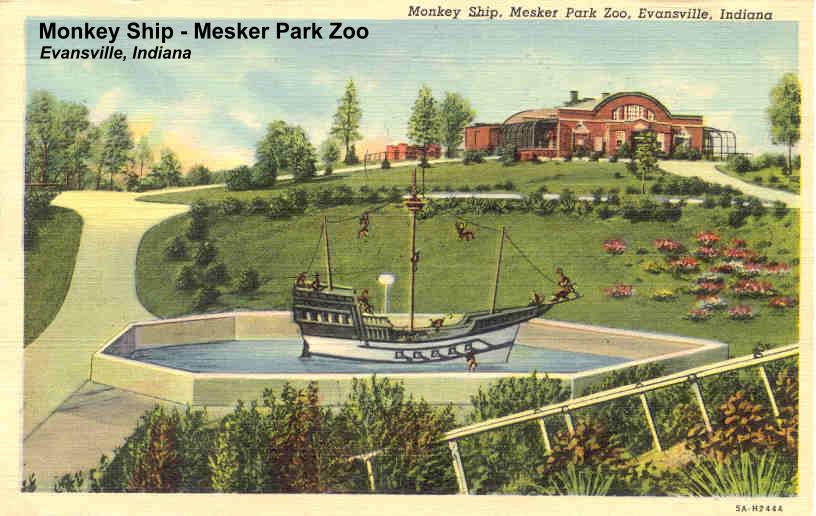
I was struck by one reference in Chapter Two of Part Two, where the main character, pedophile Humbert Humbert is describing sights he and Lolita had seen as they traveled across the country, including "(a) zoo in Indiana where a large troop of monkeys lived on concrete replica of Christopher Columbus' flagship." Sure enough, there is such a structure in the Mesker Park Zoo in Evansville, where Mary and I were married and lived for several years. It was a popular attraction beginning with its completion in the 1930's, but in more recent and enlightened times, it was determined that the 1/3 scale replica of the Santa Maria was unacceptable for simean habitation. The boat remains in the park sans monkeys to this day.