
Showing posts with label writers and writing. Show all posts
Showing posts with label writers and writing. Show all posts
Thursday, April 01, 2010
Hawaiian Hits
Judging from recent activity on this blog as documented in the Feedjit Live Traffic Feed, somebody in Honolulu must have given a homework assignment on Joseph Conrad and the phrase "lugubrious drollery." Eager students should check the sidebar on the right to see the phrase in context and to see definitions of the words.


Wednesday, February 24, 2010
Benchley on Jeopardy

On Monday, February 22, 2010, the $800 answer in Double Jeopardy was:
Medium of classic communications like Robert Benchley's from Venice: "Streets full of water. Please advise."The correct question was "What is a telegram?"
The internet's seas of misinformation are perhaps murkier than the canals of Venice, and finding the origin of this brilliant example of Benchley's wit is fraught with uncertainty. Well, maybe not fraught, but at least heavily tinged with uncertainty. OK, maybe not heavily tinged, but reaking slightly of uncertainty.
Well, I guess it's not all that uncertain. Two possible recipients of Benchley's telegram from Venice are cited in cyberspace: his editor at the New Yorker, Harold Ross, or tablemate at the Alonguin Round Table, Dorothy Parker. Either would have been equally amused by Benchley's telegraphic missive, I'm sure.
I found one version of the telegram which added the sentence "Beautiful city" before "Streets full of water. Please advise." I think that lowers the comic power of the telegram considerably, so I choose to ignore that version.
By the way, I discovered during my Googling of Benchley that The Benchley Roundup, a great collection of his essays, is now available online in Google Books. The online version is limited due to copyright restrictions, but a few essays can be read in their entirety. Also, the full text of the 1936 Benchley book, My Ten Years in a Quandary and How They Grew is avaiable at Project Gutenberg of Australia.
Friday, December 11, 2009
Nobel Peace Prize: A Study in Irony


And waving our red weapons o'er our heads,
Let's all cry, “Peace, freedom, and liberty!”
-William Shakespeare, Julius Caesar, Act III, Scene I
Friday, November 13, 2009
French for Americans

In a couple of previous posts ("Flushing Away Convention" and "The Avant-Garde Nature of Winky Dink"), I brought up the name of the French artist Marcel Duchamp. As I edited these posts, I found I tended to put an "s" (called le sigmoid in French) at the end of his name. I have a vague recollection from my single year of French study in high school (l'êcole elevée) that most self-respecting French words have approximately as many silent letters as letters which are pronounced, so it seemed only fitting and proper to tack on the "s" at the end of Marcel's surname. The extra letter adds heft and a certain je ne sais pas to the word without affecting its pronunciation, which I believe is Du-sha, perhaps implying the "m" by pursing the lips diffidently at the end, or perhaps not.
Since my matriculation at Wawasee High School occurred shortly after the glaciers receded from northern Indiana, I thought it would be a good idea to brush up on my French. For this, I turned to one of the books I have managed to retain from my youth. Like my own epidermis, the cover of my copy of The Benchley Roundup (pictured above) has seen better days. The price of $0.75 further betrays the paperback's age. Fortunately, the inside of the book is intact. Turning to the essay, "French for Americans," we learn that that in French the vowels a, e, i, o, and u are all pronounced "ong." Robert Benchley goes on to explain that "the French language has three accents, the acute e, the grave e, and the circumflex e, all of which are omitted." He also supplies a number of "phrases most in demand by Americans," such as "What kind of dump is this, anyhow?" (Quelle espèce de dump is this, anyhow?) and "Two hundred francs? In your hat." (Deux cent francs? Dans votre chapeau.). Benchley provides other helpful travel tips, such as places to find other Americans in Paris, and where to find American food, and side trips that involve getting on a ship and returning to America to relieve the tedium of staying in Paris. He explains currency conversion, with the value of the franc fluctuating as follows:
Monday: 5 centsHe concludes with a list of "Other Words You Will Have Little Use For," including vernisser (to varnish), dromer (to make one's neck stiff working at a sewing machine), and pardon (I beg your pardon).
Tuesday: 5.1 cents
Wednesday: 4.9 cents
Thursday: 1 lb. chestnuts
Friday: 2 1/2 yds. linoleum
Saturday: What-have -you
If you're interested in reading the entire essay, a used copy of The Benchley Roundup may be purchased online for as little as $1.58, though I wouldn't part with my copy for less than a bushel of chestnuts.
Friday, October 16, 2009
Updike's Ashes

John Updike died of lung cancer at age 76 in January. I have yet to write a Rest in Peace post for him, as I have for Tim Russert, Buddy Holly, Les Paul, and Dick Kemp, truck collector extraordinaire.
It was hard for me to come up with anything to write about this literary giant at the time of his death. For one thing, detailed obituaries are available from many major news outlets, and I don't need to rehash the details of his life . For another, his writing has resonated with me since I first picked up a copy of The Centaur on a trip to a continuing medical education meeting in Philadelphia in the 1980s, and I am saddened that his voice has been silenced.
I see this post not as a formal eulogy, but as a collection of random thoughts about Updike. Well, let's face it--this blog is nothing but a collection of random thoughts. Why should this post be any different?
Somewhere around here, I have a photo taken of me with John Updike at a reception following a lecture and reading he gave at the Dogwood Festival in Dowagiac, Michigan. I could have sworn I stuck the picture in the copy of the novel Brazil he autographed for me that night, but it's not there now. Someday, I hope it will turn up, in which case, I'll scan it and post it. One of the poems he read that night had to do with a Memorial Day celebration in a small town, and I have attended many of those. I find it awkward to try to come up with something to say to an author at a book signing, so I seized on that poem as something I could talk to Updike about, which I did when my turn came. He was very gracious and told me how his father had dressed up as Uncle Sam for a Memorial Day parade.
I've been thinking about Updike a lot since I read that his alma mater Harvard University has acquired his papers recently. As usual, one online discovery led to another, and I found out that a volume of his poems was published after Updike's death, so I bought the audiobook Endpoint from iTunes. Since the audiobook is abridged, I thought I should buy a printed copy. Then, driving between hospitals the other day, I decided to stop by a branch library to take have a few minutes respite before going back to work. In the unlikely event any of my partners should read this post, please note that I carry my lunch, and virtually never take a break to go to the doctors' dining room, so I'm entitled to ten minutes at the library. Not really expecting to find Endpoint on the shelf, I searched for Updike materials, and there it was, so I checked it out, along with Beowulf on the Beach (recommended highly by my son), Hollywood Foto-Rhetoric: The Lost Manuscript with photos by Barry Feinstein and text by Bob Dylan, and a CD of Bruce Hornsby's appearance on Marian McPartland's PIano Jazz radio show (which by the way is a great CD).
In further online meanderings I found out that Updike had been cremated and part of his ashes were scattered near the graves of his parents at the Grace Evangelical Lutheran Church in Shillington, Pennsylvania, where he lived till age 13.
Now comes the weird part. Last night at choir practice at our church, I read the fine print above the title of one piece of sheet music we worked on, which said it was written for the 100th anniversary of the Grace Evangelical Lutheran Church in Shillington, Pennsylvania! It's a town of 5000 people. It's over 600 miles from where I live. Yet there I was, holding a piece of music written to commemorate the church where Updike's ashes were spread. Uncanny coincidence, or an example of Jungian synchronicity?
Tuesday, March 24, 2009
Happy Birthday, Lawrence Ferlinghetti

City Lights Bookstore
Photo by Jeremy Brooks
Photo by Jeremy Brooks
Today is the 90th birthday of poet Lawrence Ferlinghetti, founder of City Lights Books in San Francisco. City Lights became widely known when Ferlinghetti was accused of violating obscenity laws for publishing Allen Ginsberg's Howl in 1956. I've been to City Lights a couple times, but can't locate any pictures I took right now, so I'm borrowing one from Flickr under Creative Commons license. By the way, this is a great picture by Jeremy Brooks--better than anything I took when I was in San Francisco.
Link to Creative Commons License Agreement.

Link to Jeremy Brooks' Flickr photostream
Link to Garrison Keillor's The Writer's Almanac and more information about Lawrence Ferlinghetti
Thursday, February 12, 2009
Handsome Frank and Honest Abe
 Today is the 200th anniversary of Abraham Lincoln's birth. As the nation honors a President famous for his honesty and wisdom, let us reflect on the life of an earlier President renowned for having good hair.
From the web site, American President: An Online Reference Resource:
Pierce settled in New Hampshire after his presidency. When the Civil War erupted, Pierce voiced support for the northern cause, as did many doughfaces—that is, northern men with southern principles. A loyal Democrat, Pierce did not support the new president, Abraham Lincoln. In fact, Pierce publicly blamed Lincoln for the war. This outspoken criticism cost the former President a number of longtime friendships.At least the hapless Pierce was able to talk his way out of the tight spot he had gotten himself into.
By the end of the war, Franklin Pierce was all but forgotten, as reclusive as his wife had been in the White House. Always fond of liquor, he had returned to it. When Lincoln was assassinated in April 1865, an angry mob surrounded Pierce's home. Only a final display of the old lawyer's once-famed oratorical skills kept his house in one piece: he gave a speech urging the crowd to disperse peacefully, and they did. When Franklin Pierce died in the fall of 1869, little was written about him.
While I'm on the topic of people who didn't like Abraham Lincoln, here's a photo of me at the tombstone of Edgar Lee Masters in Petersburg, Illinois in 2005, and a closeup of the plaque on the tombstone.


The curmudgeonly Masters, author of Spoon River River Anthology, was a one-time friend and later a rival of Carl Sandburg, who had placed Lincoln on a pedestal in his biography, Abraham Lincoln: The Prairie Years. Masters tried his best to knock Abe off that pedestal in his own 1931 Lincoln biography, Lincoln The Man. I have a copy of the book but I haven't read it yet.

According to John Aloysius Farrell, writing in his U.S. News and World Report blog, Masters depicted Abe Lincoln as "... cold, and cunning, and devious, and a sexual misfit, and a blundering politician who helped bring on the Civil War, trampled on civil liberties, and was ever-beholden to Eastern financial and manufacturing interests."
Link to American Presidents: An Online Reference Resource
Link to Farrell's article, "Abraham Lincoln Myth Had Its Doubters, Like Edgar Lee Masters"
Link to more information about Franklin Pierce's hair
Wednesday, January 07, 2009
Mystery

Einstein and Tagore, 1930
Photo by Martin Vos
Photo by Martin Vos
The picture was taken at a meeting between Nobel laureate in physics Albert Einstein and Bengali Nobel laureate in literature Rabindranath Tagore on July 14, 1930.
Yesterday, I read this quote from Einstein in Nature Photographer, a magazine I highly recommend, even if you don't own a camera. The pictures are spectacular and the writing is first-class.
The most beautiful experience we can have is the mysterious--the fundamental emotion which stands at the cradle of true art and true science.
Thursday, January 01, 2009
Updated Profile
In the spirit of new beginnings for the new year, I have updated my user profile, so that readers may better get inside my head, take a look around, and run away screaming as though they had just stepped in a pile of steaming dragon dung (simile paraphrased from Richard Brautigan).
The Droll Roll
As a new year dawns, Lugubrious Drollery is adding a new feature--the Droll Roll. This widget can be found at the top of the sidebar to the right. It is a place where people who find their lives aren't embarassing enough already have an opportunity to further humiliate themselves by acknowledging publicly that they read this blog. According to the description of the feature supplied by Blogger,
So step right up, ladies and gentlemen and children of all ages. Click on "Follow With Google Friend Connect." No, no--not here. Up there. To the right. Under the heading "Droll Roll: Irregular Readers." We few, we happy few readers of Lugubrious Drollery welcome you with open arms. Please plant yourself in the Droll Roll, so that I may grow you. There is abundant fertilizer here (see LD's previous post Franklin Pierce and the Golden Age of Guano).
Many readers ignore sidebar items so by writing a post about your followers widget and moving the widget to the top of your sidebar, you will inevitably grow your audience.Ah yes, that is my goal--to grow my audience, much as Sarah Palin progresses her great state of Alaska (see LD's previous post Sarah Palin Progresses Her Political Ambition at the Expense of the English Language).
So step right up, ladies and gentlemen and children of all ages. Click on "Follow With Google Friend Connect." No, no--not here. Up there. To the right. Under the heading "Droll Roll: Irregular Readers." We few, we happy few readers of Lugubrious Drollery welcome you with open arms. Please plant yourself in the Droll Roll, so that I may grow you. There is abundant fertilizer here (see LD's previous post Franklin Pierce and the Golden Age of Guano).
Thursday, December 18, 2008
The Most Boring Book Ever Written

William James Sidis (1898-1944) was an enigmatic character and a child prodigy. He spoke his first word ("door") at six months and was reading the New York Times at 18 months. He mastered numerous languages and even created his own language, called Vendergood. At age 9, he lectured the Harvard math club about the fourth dimension and entered Harvard as a student at age 11. Although his IQ was never formally tested, it has been estimated it was in the range of 250-300. His father Boris, a psychologist, and his mother Sarah, who graduated from medical school but never practiced, claimed their child-rearing methods were responsible for their son's genius. Despite his early promise, after an abortive attempt at teaching math at Rice in Houston, William James Sidis avoided academia as an adult. His preferred job was operating a comptometer, a calculating machine at which he was quite adept, but which did not require significant mental exertion on his part. He refused to take a job with any potential for promotion, and lived alone in a modest furnished apartment in Boston. His story is fascinating, and I would refer the interested reader to the biography, The Prodigy, by Amy Wallace.
Sidis received a lot of negative press for his eccentricity and perceived lack of success in life. He did, however, write extensively, usually under pseudonyms, on a variety of topics, including cosmology, history, and language. Only two of his book-length manuscripts were published. The first, The Animate and the Inanimate, which was published with the author's real name, predicted the presence of black holes. The second book, Notes on the Collection of Transfers, is a 300-page tome about peridromophilia, Sidis' peculiar hobby of collecting street car transfers. Sidis used the nom de plume Frank Falupa when he wrote the book. In The Prodigy, Amy Wallace states, "This book is arguably the most boring book ever written." In it, Sidis describes in excructiating detail the principles behind transfers, their physical appearance, and even how to collect discarded transfers off the street. For instance, if the paper transfer is frozen in ice, it is better to chip out the ticket and surrounding ice and take it home to thaw out, rather than to risk damage by trying to peel the paper off the ice on site.
And so forth.
Wallace mentions a few other contenders for the honor of most boring book. Nothing, by Methela, consisted of 200 blank pages. The Feminin Monarchi, written by Charles Butler in 1634, was a history of bees in phonetic spelling.
And so forth.
Now, there is a book--a book that has already been hailed as having the the oddest title of the last thirty years--with soporific potential which may approach that of Notes on the Collection of Transfers. As The Guardian reported on September 5, 2008:
The people have spoken and the oddest book title of the past 30 years has been selected: Greek Rural Postmen and their Cancellation Numbers. The impenetrable-sounding book, a comprehensive record of Greece's postal routes, is published by the Greek Hellenic Philatelic Society of Great Britain, which "exists to encourage the collection of Greek stamps and to promote their study".

In previous posts, I have mentioned the Diagram Prize, awarded annually by Bookseller magazine for the oddest book title of the year. This year, Bookseller awarded the Diagram of Diagrams to the book with the oddest title of the last 30 years. While the cover of Greek Rural Postmen and their Cancellation Numbers looks equally as boring as the cover of Notes on the Collection of Transfers, I'm not sure the scant 72 pages of text of the newer book can seriously challenge the 300 pages of Sidis' work. If any readers of this blog have access to these books and the stamina to slog through both, please report back.
Click on this link to see a gallery of some of the past annual Diagram winners which were considered for the Diagram of Diagrams Prize.
Wednesday, December 10, 2008
Happy Birthday, Mr. Conrad
While catching up on some podcasts of The Writer's Almanac on the way to the dentist for a root canal today, I learned that December 3 is the birthday of Joseph Conrad, who coined the phrase "lugubrious drollery." Happy belated birthday, Joe, dead though you have been since 1924.

Joseph Conrad said, "My task which I am trying to achieve is, by the power of the written word to make you hear, to make you feel — it is, before all, to make you see. That — and no more, and it is everything."

Joseph Conrad said, "My task which I am trying to achieve is, by the power of the written word to make you hear, to make you feel — it is, before all, to make you see. That — and no more, and it is everything."
Thursday, October 16, 2008
Shakespeare and Me
Here is the latest installment of my sporadic series of visits to sites associated with dead authors. Past visits have included the home and grave of Edgar Lee Masters in Petersburg, Illinois, places where Allen Ginsberg lived in Greenwich Village and in San Francisco, Jack London's estate (now a state park) in California, Washington Square Park in San Francisco, where Jack Kerouac drank port, and where a probably equally inebriated Richard Brautigan posed with his wife for the cover of Trout Fishing in America.
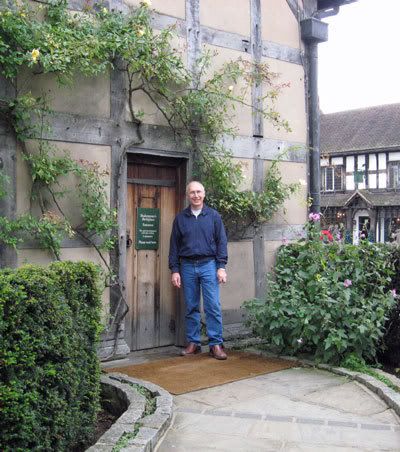
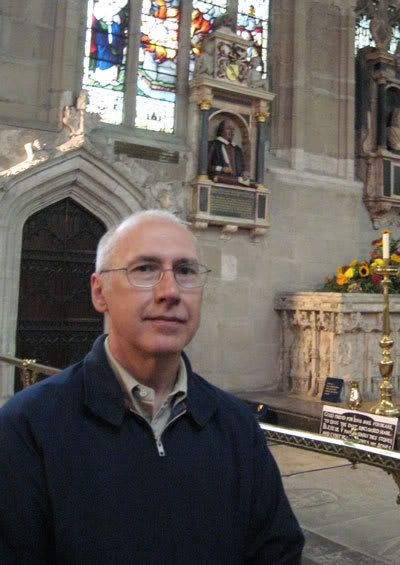
Old Will is planted under the floor in front of the candlestick to my left. The stone at the head of the grave reads:
GOOD FREND FOR IESUS SAKE FORBEARE,
TO DIGG THE DVST ENCLOASED HEARE.
BLESTE BE YE MAN YT SPARES THES STONES,
AND CVRST BE HE YT MOVES MY BONES.
Shakespeare's Birthplace, Stratford-on-Avon
Shakespeare's Burial Site, Trinity Church, Stratford-on-Avon
Old Will is planted under the floor in front of the candlestick to my left. The stone at the head of the grave reads:
GOOD FREND FOR IESUS SAKE FORBEARE,
TO DIGG THE DVST ENCLOASED HEARE.
BLESTE BE YE MAN YT SPARES THES STONES,
AND CVRST BE HE YT MOVES MY BONES.
Tuesday, May 23, 2006
First Entry
Well, here I am. This is my first attempt at this blogging thing. I am a board (bored) certified radiologist, seeking fulfillment and enlightenment by trying to do almost anything but what I am trained to do. I build guitars and ukuleles. I take guitar lessons and have performed a couple times. I write fiction and nonfiction, which so far has been rejected by several publications, although I have had a couple poems published in the online and print arts and literary journal, Children, Churches, and Daddies. I make no promise to write in this blog every day. The last time I resolved to write every day was in a noteboook I just dug out of a drawer--the entry was made in 1977 as I was getting ready to enter medical school. It didn't happen then and it's not going to happen now. I am in a writing group locally--four physicians. I read in the paper Monday that we are going to be featured tomorrow. I have no idea what's going to show up in the paper. Guess I'll find out in the morning.
Subscribe to:
Posts (Atom)