Showing posts with label writing. Show all posts

Wednesday, April 21, 2010

How to Avoid Writing, Ver. 2.0

Voltaire. Detail from an engraving by Baquoy (ca. 1795).

Back in 2007, I posted an essay titled "How to Avoid Writing." A couple weeks ago, I read in the local paper that the creative writing department of a local university was holding a contest. The winners would receive tickets to a reading by David Sedaris. I didn't know much about Sedaris, but I thought I'd take a crack at the contest, so, on the advice and with the editorial assistance of my son the former English major, I did some major revision of the 2007 essay. I won second place. Here is the revised version:

Those of us who are compelled by temperament, neurosis, or outright madness to put pen to paper or bang away at a keyboard often suffer from a stronger urge, which is the compulsion to avoid writing. Why should this be? If I don’t want to write, why don’t I just do something else with my time? I could polish my spoon collection, shampoo my pet wombat, or water my okra seedlings. But I feel I must write. As inadequate as I feel when writing, I may feel even worse if I don’t write. How can I call myself a writer if I am not writing? So, then why do I avoid it? Perfectionism is a factor. If I am not able to produce verbiage on a par with John Updike, with flawless use of simile, metaphor, gerunds, and undangling participles, why bother? The blank page reflects my anxiety, guilt and self-doubt. I am reminded of the brilliant humorist Robert Benchley, who one day rolled a fresh piece of paper into his typewriter and typed “The.” Different versions of the story have him staring at the paper for a prolonged period of time, then smoking his pipe, going for a walk, joining a poker game, meeting up with friends, drinking, or some combination of these activities. When he returned to the typewriter, he stared for a while at the solitary word “The,” finally added “hell with it,” and quit for the day.

Numerous impediments may get in the way of writing. You need to be prepared. If you chose to scribble your thoughts on paper, you need to remember where you left your favorite pen. If you use a computer, you need to know which of those little sliding things at the top of the computer screen produces a hanging indent. Indeed, you should know what a hanging indent is, and how it should be used. Research such as this takes time. Should I just launch into an essay or short story without knowing how to turn off that cartoon paper clip that thinks it knows what kind of document I am typing and cloyingly offers to help me write it? I think not, and wading through help menus takes time.

Beyond the pure mechanics of writing, it is necessary to have in mind something to write about, and to have in-depth knowledge of the subject. Aye, there’s the rub. Cable news pundits may pontificate on any topic at will without rigorous study of the issues, but as for me, knowledge is power. As Albert Einstein once said, “Chance favors the prepared mind. Don’t be caught with your intellectual knickers down!” Or was it his cousin Manny Einstein who said that? No matter. The point is, before fanning the fires of creativity, the writer must make sure his mental tinder box is full of wood shavings and gently-used toothpicks. The writer must be always prepared, ready at a moment's notice to produce a paragraph by rubbing two Boy Scouts together. He must be ready to spend as much time as necessary to hone his craft—not by writing, but by doing other things that seem dreadfully important at the time.

For instance, take the time I sat down to write about a letter that was handed down to me from my grandmother. Her brother had written to her while he was working away from home, early in the twentieth century. He mentioned in the letter that his scalp was itching because he had rabbits, and that my grandmother should be careful because there may be rabbits in the letter. Holding the envelope in my hand, I was fairly certain even a baby bunny couldn’t fit in there. I was absolutely sure that a fine upstanding young man like Great Uncle Charles would not have been in the grip of delirium tremens, longing for a drink of rotgut whiskey while imagining small furry mammals crawling over his head. My best guess was that “rabbit” was a slang term for head lice. Is this common knowledge? It wasn’t to me--what a wonderful opportunity to dive into research and avoid writing!

In days of yore, research involved going to the library to riffle through the card catalog and pore over The Reader’s Guide to Periodical Literature. Those quaint practices have been rendered obsolete by the internet. It is interesting that as I type this essay on a laptop computer wirelessly connected to the internet through my home network, squiggly red lines appear under the words internet, wirelessly, and even squiggly, indicating these words are unrecognized by the word-processing software. I can understand how squiggly may be suspect, as it is a lame word, but perhaps it is time for internet and wirelessly to become accepted parts of the lexicon. Or perhaps I just need to upgrade from Word 97.

But I digress. Being connected to the World Wide Web, I go to the modern equivalent of the card catalog and The Reader’s Guide—Google (another red squiggly line appears). I type in “rabbits” and “lice.” References to scientific experiments involving the two species appear, but not too far down the list is a link to an article by P.J. O’Rourke published in The Atlantic in 2003. The essay is an account of his daughter’s infestation by head lice and includes facts he had gathered by researching the topic in the New England Journal of Medicine and other sources. One of his sources was The American Thesaurus of Slang, published in the 1940s, which gave the following synonyms for lice: seam squirrels, shimmy lizards, and pants rabbits. I believe these sobriquets apply to pubic lice, more commonly known today by the trans-species appellation crabs.

Ah, now, armed with knowledge, I am ready to write. Or am I? Should I not go to the primary source myself? Of course. Perhaps The American Thesaurus of Slang is in the public domain and available online. I Google the title. Alas, no electronic version is available, but there appears a link to Worldcat.com, which tells me that a tangible copy sits on a shelf at the local campus of Indiana University, a tantalizing 13 miles away. Should I go? No, wait. In the endless list of links produced by Google is a review from a librarians’ journal. I must read it to know if it’s worth the effort to go on a quest for the book. The reviewer is gaga over the book. I must have it. Alas, I don’t have checkout privileges at the university. I go to the public library catalog online. The library doesn’t have The American Thesaurus of Slang, but does have a copy of the more recently published Thesaurus of American Slang. Maybe that’s close enough. Another blessed respite from writing calls to me. I could drive to the library, find the book, perhaps browse the CDs in the Sights and Sounds section, and maybe read a magazine. No, I tell myself sternly, I must write.

But first, I’ll see if a copy of the older book is for sale. After all, any writer worth his salt should have his own copy of this invaluable reference material. A search at Amazon.com reveals that the book is out of print, but a few used copies are available, ranging in price from less than eight dollars to more than a hundred, depending on condition. Thirty to fifty dollars would buy a copy in good condition. Hmmm…have to think about it.

And so, I push back from the keyboard with a sense of deep satisfaction. Mission accomplished! I have avoided writing—sort of.

Acknowledgment:

The author is grateful for the editorial assistance of Daniel P. Cory, J.D.

Tuesday, October 27, 2009

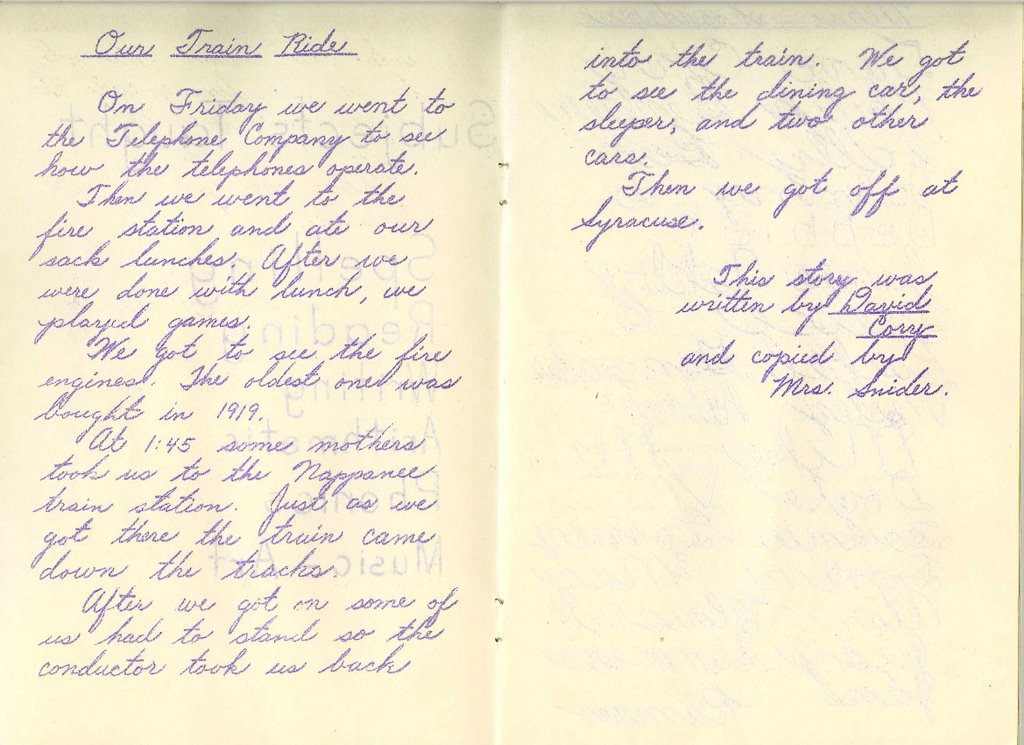
The Great Train Ride of 1961

As I explained back in 2006, in a post titled "Another San Francisco Dead Author," one of my earliest writing efforts still extant is the following account of a second-grade field trip. It could have occurred as early as the fall of 1960, but I think it more likely happened in the spring when teachers wanted to get out of the classroom at least as much as their young charges. If you want to know the tenuous connection between this trip and a dead author in San Francisco, you'll have to follow the link to the 2006 post. It's not worth repeating here.

Click to enlarge.

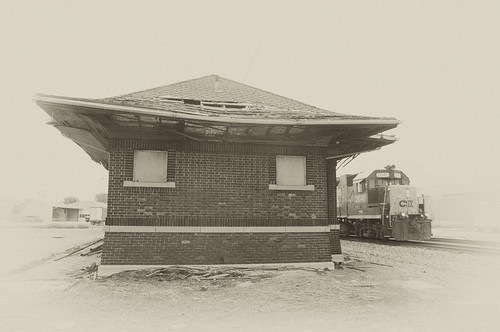
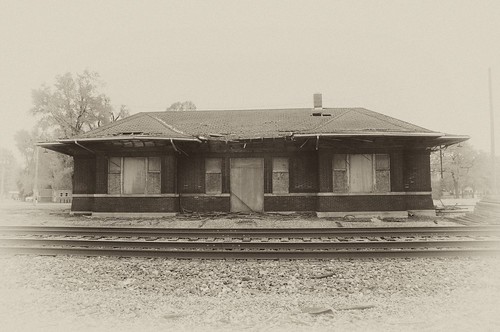
Today, I had a day off, and spent a few hours driving around the area looking for photo ops. I didn't really think about it till I was driving home, but I had taken pictures of the two train stations I visited almost a half century ago. The Nappanee station has been maintained over the years, but the Syracuse station, now owned by CSX, has fallen into disrepair. There is a movement afoot to save the station, move it, and renovate it. I hope it happens.

Nappanee Station
Nappanee Station, 2009

Syracuse Station
Syracuse Station and Passing CSX Freight Train, 2009

Syracuse Station
Syracuse Station, 2009

Tuesday, June 23, 2009

Ditzels, Schmutz, and Grumus: The Language of Radiology

_____________________________________________

Preface:

One of the things I find distasteful about writing for print media is the process of submitting my work. Once a piece is submitted, there are four possible outcomes. Frequently, an almost instanteous rejection occurs, raising doubt as to whether anyone actually read the piece. Second (rarely), the piece may be accepted after a reasonable period of evaluation. Third, the piece may be rejected after a reasonable period of evaluation. Finally, the piece may languish in limbo for a prolonged period of time without an editorial decision either way. The following falls into that category. I submitted it in March of 2008, over a year ago, to a periodical which states that a decision can be expected in four to six weeks! Despite additional queries to the editor, the article remains in queue, presumably unread. I present it here in the hopes that at least a couple of people may take the time to read it.

Gentle readers, this article contains 3 footnotes. It would please me greatly if you would click on the superscript numerals which link to the notes at the bottom of the article. At the end of each note is an upward-pointing arrow which will bring you back to the point in the article from whence you left. You can't imagine how long it took me to figure out how to do that in html code.


Wilhelm Conrad Roentgen with Radiograph of His Wife's Hand

In 1895, the German physicist Wilhelm Conrad Roentgen (or Röntgen, for you Teutonic purists1) discovered a type of radiation, which he called the X-ray, that could pass through solid objects. Shortly after his discovery, Roentgen used the mysterious ray to produce a picture (radiograph) of the bones of his wife's hand, which he could show around at scientific symposia, and possibly at cocktail parties. But might not someone outside Herr Professor Roentgen's circle of friends and acquaintances want to know what Frau Roentgen's phalanges looked like? Yes! And thus arose the need for someone who could look at the radiograph and dictate what we now know as a radiology report: “The bones are normal. There are no fractures. Mrs. Roentgen was unable to remove her ring due to consuming too much marzipan since her wedding.” And so forth. OK, it wasn't really as simple as all that, but eventually a group of physicians made it their business to produce and interpret radiographic images, or, as a patient once so delicately described it to me, to “look at people's guts all day.” In the early days, the specialty of diagnostic radiology depended solely on X-rays to produce medical images. Today, in addition to X-rays, images may be produced by sound waves (sonograms), radio waves in a strong magnetic field (magnetic resonance, or MR, scans), or minute amounts of radioactive material injected into the patient (nuclear medicine, known to some of its detractors by the anagrammic unclear medicine). In recent decades, medical imaging has been improved by rotating the X-ray tube around the patient, resulting in computerized axial tomography (CAT) scans. Even more recently, a new type of nuclear medicine scan, positron emission tomography, has become widely used, and nowadays is combined with the CAT scan to provide more precise diagnostic information. Thankfully, the more succinct “CT” replaces “CAT” in the name of the hybrid scan. Otherwise, we would be saddled with the PET/CAT scan instead of the PET/CT, and would have to suffer endless jokes about giving the family feline the once-over.

We enjoy the advantages of these new technologies today, but the early history of radiology was all about the X-ray, also called the Roentgen ray, in honor of the discoverer. To this day, one of the major professional associations for diagnostic radiology is The American Roentgen Ray Society, and their publication is The American Journal of Roentgenology, more commonly known as the AJR, or the Yellow Journal, not because of scandal-mongering editorial policies, but because of the color of the cover.

Like some early photographs, radiographs in the early twentieth century were recorded on glass plates coated with an emulsion. During World War I, if a medical officer wanted to locate a bullet in a doughboy's belly, he might have ordered a radiograph of the abdomen. The patient lay down under the X-ray tube with the emulsion-coated glass plate behind him. Today, even though radiographs are likely to be stored on a hard drive in digital format, the phrase "flat plate of the abdomen" refuses to die, and occasionally shows up in physicians' orders. Radiographs did not evolve directly from glass plates to digital images. A long intermediate step occurred when radiographs were produced on flexible films, like the ones seen hanging upside down in today's televised medical dramas. Before automated processors were invented, these films were dipped by hand into the developing solution and had to be hung up to dry. If the physician requesting the X-ray wanted to know the results immediately, the radiologist was asked to do a "wet read", or interpret the film before it had hung on the line long enough to dry. Even though it's been decades since films were hand processed, requests for wet reads still occur. More common terms today are STAT read or phone report.

Although not found in Dorland's Medical Dictionary, the term ditzel is universally recognized among radiologists as a very small nodule found in the lung. Such nodules are usually benign and related to a previous infection, but occasionally, a lung cancer can appear as a very small nodule if found early enough, presenting us with the daily dilemma of how to deal with these tiny lesions. The origins of this word are obscure. The only similar word I could find, ditz, emerged in the 1970s to describe a silly or inane person, and it seems unlikely that ditz morphed into ditzel. Even though ditzel does not appear in any dictionary, the word has been used in at least one article in the medical literature, specifically in the Yellow Journal.2

The suffix -oma (tumor, from the Greek -oma 'mass') is found frequently in medical parlance (lymphoma, sarcoma, hematoma, etc.). In radiology slang, the suffix is more loosely used to connote an abnormality. For instance, a lesion found on an examination performed for an unrelated reason may be referred to as an incidentaloma. Thus, a ditzel seen in the lung on a CT of the chest performed for suspected clots in the blood vessels could be called an incidentaloma. A ditzel that is hard to see might be called a vagoma. If it is so vague that only one radiologist sees it, it could be called an imaginoma by his snickering colleagues. If Dr. Hackenbush develops a reputation for seeing lots of imaginomas, these questionable abnormalities may then be called Hackenbushomas—a dubious honor at best for the good doctor. Disclaimer: I use the name Hackenbush for illustrative purposes only. I know of no radiologist, living or dead, named Hackenbush, and if there is or has been such a person, I am sure he or she is or was a fine diagnostician.3

While ditzel seems unique to radiology, some other unusual words, which can be found in dictionaries, are used in radiology reading rooms, if not in the medical literature. One of these is schmutz, defined as "dirt, filth, or rubbish," taken directly from Yiddish. In radiology jargon, the word implies something that doesn't belong, and is, in a sense, dirtying up the picture, as in “There is some schmutz around the pancreas. It must be inflamed,” or “There is a little schmutz in the right lung. Maybe the patient has pneumonia.”

I once attended a lecture about the coronary arteries, and the speaker talked about the grumus he identified in a vessel. This is a word I have heard occasionally bandied about in the reading room, used more or less interchangeably with schmutz, and pronounced grŭmŭs. The speaker, who used the same pronunciation, stated that grumus means a gelatinous blood clot. Being the skeptic, I resolved to research the word when I returned home from the conference. I was mildly surprised to find that no such noun appears in current editions of The Oxford English Dictionary or Dorland's Illustrated Medical Dictionary, though grume, pronounced grūm, derived from the Latin grumus (little heap or hillock), is listed in the OED as "1. A lump, obs. 2. A clot of blood; blood in a clotted or viscous condition. Also, any viscous fluid or mass of fluid." My search for the elusive grumus took me to Lippincott's Medical Dictionary, published in 1906. There I found grumus, again pronounced with a long first u, nestled somewhere between Gruber's bougies (to paraphrase the definition, these were little medicated sticks of gelatin put in the ear canal) and guano (“. . .the excrement of sea-fowl . . . used with benefit, internally and externally, as a remedy in different forms of lepra.” Whoa!). Lippincott's defined grumus as "a clot of milk or blood; a curd; thick or viscid fluid, as pus."

Dessert, anyone?

Enough of etymology. I must return to the roentgenology department in search of the next fascinoma.

Footnotes
1. Note to Teutonic purists: It's much easier for me to type “oe” than to figure out how to repeatedly insert an “o” with an umlaut, so we'll stick with the English spelling of Roentgen

2. Mundsen RF, Hess KR. “Ditzels” on Chest CT: Survey of Members of the Society of Thoracic Radiology. AJR 2001; 176:1363-1369.

3. Hugo Z. Hackenbush was the character played by Groucho Marx in the movie “A Day at the Races.” By the way, the movie includes a hilarious scene with the Marx Brothers performing a medical examination on Margaret Dumont's character. When one of the other characters calls for an X-ray, Harpo responds by producing a stack of newpapers and silently (of course) hawking “Extras.”

Thursday, December 25, 2008

Christmas Present

Among the Christmas cards in yesterday's mail was an envelope containing a check for the princely sum of $137.50 from History Magazine. I had sent them an article on the history of leprosy back in March. They accepted it, but then I didn't hear from them again till the check arrived. Last time they published an article of mine, they sent me galley proofs and then a copy of the magazine. This time I'll have to buy a copy to see how it turned out.

From the History Magazine web site:


In Our January 2009 Issue ...

The Christmas Truce of 1914
Ron Hunka looks at a historic day of peace in a time of war

Darwin Aboard the HMS Beagle
Phill Jones follows the trail of Charles Darwin's ground-breaking expedition

The History and Mystery of Leprosy
David A Cory, M.D., looks at a disease that has been misunderstood for centuries


American Hostages in the Middle East
John R. Herman examines an 18-th century hostage taking that took years to resolve

Monday, September 08, 2008

Janet Malcolm on Burdock

In an earlier post, I referred to an article titled "Burdock" by Janet Malcolm, in which she discussed spending three summers photographing burdock leaves. I made the observation that "it's hard to imagine there's a huge market for pictures of burdock leaves." Well, darned if I haven't just shelled out 40 bucks for a book of pictures of Burdock leaves by Ms. Malcolm. I'm looking forward to its arrival from Amazon any day now.

Tuesday, August 12, 2008

Way This Side of Paradise

Finally in print. The title of the story (above) is not included in the article. Click to enlarge to a readable size.

Saturday, August 02, 2008

Burdock


Burdock, St. Joesph County, Indiana, August 2, 2008


Until recently, my only knowledge of burdock (Arctium lappa and other species) came from a box of burdock root teabags that has sat in our pantry for years. The blurb on the side of the box extols its health benefits without specifically saying what those benefits are. On a few occasions, during my doomed attempts to get off caffeine, I drank burdock root tea when there was no other herb tea in the house. People have to believe that burdock root tea is healthful, because I can't imagine they would drink it for the taste.

The box of what by now must be unbelievably stale burdock root tea informs me that the plant is native to Europe and Asia, and if allowed, will grow in almost any uncultivated space. In addition to its health benefits, whatever they may be, the stalks can be boiled like asparagus or eaten raw with vinegar. In Japan it is known at gobo and the root is used in everyday cooking.

According to Wayne Bethard's book, Lotions, Potions, and Deadly Elixirs: Frontier Medicine in America, "many folk remedies contained burdock and were said to 'purify the blood' and cure everything from head colds and acne, to cancer and a leaning chimney." He doesn't explain how burdock was supposed to cure a leaning chimney, but he states that burdock extracts contain arctiopiricin, which has antibacterial properties, and he says burdock extracts also have some antitumor and antimutagenic activity.

What got me thinking about burdock recently is an article by Janet Malcolm, entitled "Burdock," in the August 14, 2008 edition of the New York Review of Books. She writes of photographing burdock leaves in a house in the Berkshires for three successive summers. She doesn't specify if this is her occupation or avocation. I assume it is a hobby, as it's hard to imagine there's a huge market for pictures of burdock leaves. She goes on to write about how "photography is naively believed to reproduce visual actuality," and decontextualization, and other things that tend to make my eyes glaze over.

But the thing I found interesting was her observation that burdock is a "rank weed that grows along roadsides and in waste places and around derelict buildings," and "writers have used it to denote ruin and desolation." Specifically, she cites Hawthorne and Chekhov.

The Hawthorne passage to which Ms. Malcolm refers in her article comes from Chapter 1 of The House of the Seven Gables:

On either side extended a ruinous wooden fence of open lattice-work, through which could be seen a grassy yard, and, especially in the angles of the building, an enormous fertility of burdocks, with leaves, it is hardly an exaggeration to say, two or three feet long.
Hawthorne mentioned burdocks again in Chapter 19:

A person of imaginative temperament, while passing by the house, would turn, once and again, and peruse it well: its many peaks, consenting together in the clustered chimney; the deep projection over its basement-story; the arched window, imparting a look, if not of grandeur, yet of antique gentility, to the broken portal over which it opened; the luxuriance of gigantic burdocks, near the threshold; he would note all these characteristics, and be conscious of something deeper than he saw. He would conceive the mansion to have been the residence of the stubborn old Puritan, Integrity, who, dying in some forgotten generation, had left a blessing in all its rooms and chambers, the efficacy of which was to be seen in the religion, honesty, moderate competence, or upright poverty and solid happiness, of his descendants, to this day.

And still later in Chapter 19, in in a scene involving the young Italian organ grinder I have mentioned in previous posts:

He entered the neglected yard (now wilder than ever with its growth of hog-weed and burdock), stationed himself at the doorstep of the main entrance, and, opening his show-box, began to play.

No Text
He persisted in his melodious appeals

Illustration by Maude and Genevieve Cowles, from 1899 edition of The House of the Seven Gables

Chekhov wrote in his short story, "Ward 6":

In the hospital yard there stands a small lodge surrounded by a perfect forest of burdocks, nettles, and wild hemp. Its roof is rusty, the chimney is tumbling down, the steps at the front-door are rotting away and overgrown with grass, and there are only traces left of the stucco.
and

If one imagined some spirit flying by the earthly globe in space in a million years he would see nothing but clay and bare rocks. Everything -- culture and the moral law -- would pass away and not even a burdock would grow out of them.
If that ain't ruin and desolation,I don't know what is. But not all writers focused on the negative aspects of burdock.

In his journal entry for July 19, 1896, Tolstoy recorded seeing, in the middle of a plowed field, a clump of burdock with one living shoot "black from dust, but still alive and red in the centre....It makes me want to write. It asserts life to the end, and alone in the midst of the whole field, somehow or other has asserted it."

Long live the lowly burdock.

Wednesday, June 18, 2008

Lydia the Tattooed Lady Revealed

This post, along with many others about the Marx Brothers, also appears in its entirety at my other blog, The Marx Brothers.


Image courtesy of the Yip Harburg Foundation

A lot of landmark events occurred in 1939. The New York World's Fair opened. Hitler invaded Poland. The movie The Wizard of Oz premiered, and the Marx Brothers movie At the Circus was released. Harold Arlen and lyricist E.Y. "Yip" Harburg wrote songs for both the Wizard of Oz and At the Circus. Groucho's performance of "Lydia the Tattooed Lady" is a classic.


As I pointed out in an earlier post about the song Cuban Pete, the internet is littered with inaccuracies. The World Wide Web abounds in multiple copies of a mistaken transcription of Groucho's introduction to "Lydia." What shows up in this transcription is:

My life was wrapped around the circus.
Her name was Lydia.
I met her at the World's Fair in 1900,
marked down from 1940.
Ah, Lydia.
She was the most glorious creature under the sun.
Guiess. Dubarry. Garbo.
Rolled into one.

If you watch the above clip from the movie, you'll see that when Groucho lists the three beauties that were all rolled into Lydia, the first one sounds like it rhymes with "vice". According to Nick Markovich, administrator/archivist of the Yip Harburg foundation, this was Thaïs, an Athenian courtesan who allegedly convinced Alexander the Great to burn the palace of Persepolis. Jules Massanet wrote an opera called Thaïs. The Scottish soprano Mary Garden made her American premiere in the title role. The other two women were Madame du Barry, mistress of Louis XV, and famed actress Greta Garbo. Interestingly, Yip Harburg also wrote lyrics for a song ("Salome") which was sung by Virginia O'Brien in the 1943 movie Du Barry Was a Lady.

Mary Garden as Thaïs

Madame du Barry

Greta Garbo

The joke about the World's Fairs in Groucho's intro refers to the Expositon Universelle in Paris in 1900, and the New York World's Fair, 1939-1940.

Exposition Universelle, Paris 1900

New York World's Fair, 1939

There are many historical and topical references in the song itself:

Battle of Waterloo - Napolean's final defeat by the Duke of Wellington


Wreck of the Hesperus - a poem by Longfellow, based on events that occurred during a blizzard off the east coast of the United States in 1839. In the poem, a sea captain's daughter is tied to the mast of a ship to keep her from being washed overboard during a storm, but both she and her father die.

Henry Wadsworth Longfellow

Kankakee - a town in Illinois


Paree - the one in France. You've heard of it--it's been in all the papers

Lisa Fonssagrives on the Eiffel Tower, Paris 1939.
Photo by Erwin Blumenfeld

Washington Crossing the Delaware - the famous painting by Emanuel Leutze of the beginning of the surprise attack on the Hessians in Trenton, New Jersey, Decemeber 25, 1776


Andrew Jackson - colonel in the Tennessee militia in the War of 1812 and later President of the U.S.


mazurka - a Polish dance


Niagara - the Falls--you know, the big ones between New York and Canada


Alcatraz - the island in San Francisco Bay that used to be a prison


Buffalo Bill - William F. Cody, of Wild West Show fame


Just a little classic by Mendel Picasso - This is the most puzzling phrase in the song, and one for which I can't find an explanation. The abstract artist Picasso's given name was Pablo Diego José Francisco de Paula Juan Nepomuceno María de los Remedios Cipriano de la Santísima Trinidad Martyr Patricio Clito Ruiz y Picasso. That's quite a mouthful, but I don't find anything that looks like Mendel in there.

Captain Spaulding - Groucho's character in Animal Crackers


Godiva - the lady who, according to legend, argued with her husband, Lord Leofric, about the oppressive taxes he levied on the citizens of Coventry in the eleventh century. He challenged her to ride naked through town, and promised to lift the taxes if no one looked at her. She rode, no one looked, the peasants cheered, and the taxes were lifted, or so one version of the legend goes.

Lady Godiva by John Collier

Grover Whalen unveilin' the Trylon - a great turn of phrase. Whalen was President of the World's Fair Corporation, which planned and built the 1939 World's Fair on the site of what was up to that time an ash dump in Flushing Meadow. The symbols of the fair were the Trylon and Perisphere--a big pointy tower next to a big round building.


Treasure Island - another topical reference. Treasure Island is an artificial island in the San Francisco Bay. It is connected by a small isthmus to Yerba Buena Island. It was created out of fill dredged from the bay in 1936 and 1937 for the 1939-1940 Golden Gate International Exposition.


Nijinsky adoin' the rhumba - a Russian ballet dancer and choreographer doing "the dance of Latin romance" (see Cuban Pete).

Vaslav Nijinsky not doing the rhumba

In their book, Who Put the Rainbow in the Wizard of Oz: Yip Harburg, Lyricist, Harold Meyerson and Ernie Harburg point out a couple interesting facts about "Lydia." The song was censored and in order to get it into the movie, Yip Harburg had to add the last stanza:

Oh, Lydia, the champ of them all
She once swept an Admiral clear off his feet
The ships on her hips made his heart skip a beat
And now the old boy's in command of the fleet
For he went and married Lydia

I guess the censors could accept the rest of what they considered a risque song as long as Lydia became an "honest woman" and got married in the end.

Myerson and Harburg also point out that Yip tried his best to make "Lydia" sound like Gilbert and Sullivan, because Groucho was a big fan and would have parties at his house where he would play recordings of Gilbert and Sullivan operas and sing along with them.

As I close this post, I must note a spooky coincidence(?). The Muzak coming out of the speaker in the office at the MRI Center where I am finishing this up is "Somewhere Over the Rainbow" by Arlen and Harburg!

Monday, June 09, 2008

Hawthorne and Lugubrious Drollery

I've now finished reading The House of the Seven Gables. I don't intend to give a formal review, but I would just like to quote one passage, from Chapter 19, where Hawthorne is describing the scene when the Italian organ grinder and his monkey (mentioned in an earlier post here) are performing outside the old Pyncheon house:
Was ever before such a grinding out of jigs and waltzes, where nobody was in the cue to dance? Yes, very often. This contrast of intermingling of tragedy with mirth, happens daily, hourly, momently. The gloomy and desolate old house, deserted of life, and with awful Death sitting sternly in its solitude, was the emblem of many a human heart, which, nevertheless, is compelled to hear the thrill and echo of the world's gayety around it.

I was struck by the juxtaposition of the mournful and the amusing in this passage.

Saturday, June 07, 2008

Franklin Pierce the Obscure


It probably has something to do with the fact that I am in my fourteenth hour of reading X-rays, CTs and ultrasounds on call today. I don't know how else to explain this post. I would do almost anything, read almost anything, Google almost anything to get away from the images of the huddled masses in the ERs and ICUs, yearning to have their brain hemorrhages, belly abscesses, and clotted veins diagnosed by yours truly. Actually, the afflicted have no idea who I am, nor will they ever, until they see my name on their bill, for radiologists labor for the most part in obscurity in front of computer monitors. So, for respite between cases, I have been surfing the web for material on the Marx brothers. They are cited as an area of interest in my Blogger profile, but I have not written about them yet. My search took me to David Holzel's zine The Jewish Angle, where he talks about being inspired by Groucho, and his plaster statue of Groucho, like the one I have.
In fact, I have plaster statues of Harpo and Chico as well. Harpo was a wedding present almost thirty-five years ago, and the other brothers were added soon after. From Holzel's site, I linked to The Franklin Pierce Pages, authored by Holzel, Benjamin Bratman, and Todd Leopold. Here, an unusual convergence of items from my recent posts occurred in Bratman's article "Wrested From the Jaws of Triviality." To wit:
Pierce had the peculiar distinction of having as vice president the only nationally elected American official ever to be sworn in on foreign soil. Pierce also had the peculiar distinction of having as vice president a man who never worked one day in the job. William Rufus de Vane King was terminally ill with tuberculosis when he was nominated and subsequently elected as vice president. (This begs the question, why was he selected?). He was sworn in in Cuba where he was seeking medical treatment. Less than a month later, he died, never having assumed his duties.
Ah ha! An example of the modern usage of "begs the question," which I had condemned in recent posts.

Also from Bratman's article:
Pierce’s salad days were clearly in college at Bowdoin College in Maine. There, he was a classmate of Nathaniel Hawthorne, who later became a writer and author of The Scarlet Letter, as well as one of Pierce’s closest friends and advisors.
Wow! Another of my newfound obsessions--Nathaniel Hawthorne! Bratman doesn't mention that Hawthorne wrote a campaign biography of his friend Franklin Pierce, and was rewarded with the American consulship to Liverpool after Pierce was elected. Hawthorne stayed at the post from 1853-57. Also of note, Hawthorne died on a trip to the White Mountains with Pierce in 1864.


Who knows, I may now become obsessed with Franklin Pierce. After all, writing about an obscure president (James Buchanan) paid off for John Updike in his play Buchanan Dying and his novel Memories of the Ford Administration.

Friday, June 06, 2008

Petitio Principii

Comfortably lounging in my glass house, in my last post, I tossed a stone or two in the direction of those who use the phrase "begs the question" to mean "invites the obvious question." In my post (since edited), I presented what I believed was the correct usage--"avoids answering the question." While this is one usage of the phrase, according to alt-english-usage.org, the oldest usage is in logic, where begging the question implies a circular argument. Here are excerpts from the explanation by Mark Israel, at alt-english-usage.org:

Fowler defines "begging the question" as the "fallacy of founding a conclusion on a basis that as much needs to be proved as the conclusion itself."

and

Many people unaware of the technical meaning of "to beg the question" in logic use it in one of two looser senses. The first of these, "to evade the question, to duck the issue", is attested since 1860 (WDEU). The second, "to invite the obvious question, (with an inanimate subject) to raise the question", is now the most commonly heard use of the phrase, although we have found no mention of it prior to The Oxford Guide to English Usage, 1st edition (1983), and it is not yet in most dictionaries. The meaning of the adjective "question-begging" does not seem to have suffered a similar broadening.
I also learned that the Latin for this fallacy is petitio principii. Thank goodness I corrected myself before one of my dozens of potential readers caught my error.

Tuesday, June 03, 2008

The Secret Staircase


In keeping with this blog's fixation on useless information, I have spent a fair amount of time researching one architectural feature which Mary and I saw on our recent tour of The House of the Seven Gables in Salem, Massachusetts. Adjacent to the central fireplace is a door which opens on a "secret staircase." You can't take pictures in the house, so I have included a picture of an old postcard, with the addition of two arrows to show the entry to the narrow stairway. I was pretty sure the guide said the staircase was installed during the 1909 restoration of the house initiated by Caroline Emmerton. When I came home and started looking around that great cesspool of misinformation known as the World Wide Web, I found many purported facts about the staircase, such as:

- In the novel, it led from Clifford's room to the first floor.
- Hawthorne learned about the staircase from his cousin, Susannah Ingersoll, who lived there
- It was built in the nineteenth century.
- The door to the staircase was discovered in the 1880s.
- It was used to hide slaves as part of the Underground Railroad.

To all these assertions, I respond with a resounding, "Horse hockey!" I am reading the novel now, and there I can find no mention of a secret staircase, nor can I find one online in searchable versions of the book. There is a scene where Hepzibah is looking for Clifford in his room and where he mysteriously appears in the parlor, but there is no indication of how he got there.

Regarding when the staircase was built, I cite as an authority Alexandria Mason, who wrote in the Curator's Corner column of the Summer/Fall 2004 edition of The House of the Seven Gables newsletter:

Some may wonder why we have chosen to restore the chimneys to their 1909 appearance rather than to one based on the 17th century. The answer is that preservationists today base restorations on hard evidence and we do not have information regarding the appearance of the original chimneys built by the Turners.

This leads to an important question. How did Chandler know what they looked like? Pictures of the house as early as 1857, of which Chandler would have known, reveal that the medieval chimneys were long gone, having been replaced with narrow chimneys used for gas stove pipes. In fact, Chandler’s restoration was very much influenced by Hawthorne’s novel, The House of the Seven Gables, and by his memory of the medieval chimneys of Europe. With both as his inspiration, he rebuilt all three chimneys to appear as if they were ancient, creating an elaborately pilastered central chimney with a “secret” stair descending from “Clifford’s room” in the attic to the dining room. One can assume Caroline Emmerton instructed him to make the house as exciting for visitors as possible in order to ensure revenue for her Settlement House activities!


She is referring to Joseph Everett Chandler, who was hired by Caroline Emmerton to renovate the house. I like Ms.Mason's writing for a few reasons. First, she implies with quotation marks that the idea of anyplace in this house being "Clifford's Room" is quite a stretch, as there doesn't seem to be all that much evidence that Hawthorne based much but the title on the Turner-Ingersoll house. Second, she is honest enough to admit that Caroline Emmerton's goal was to generate revenue rather than seeking historical accuracy. Third, instead of following the annoying modern trend of misusing the phrase, "begs the question," she correctly writes, "leads to the question." In logic, begging the question is a fallacy in which the premises include the claim that the conclusion is true or (directly or indirectly) assume that the conclusion is true.

Kudos to Ms. Mason for her article, and to Caroline Emmerton for making life imitate art, more or less.

Sunday, June 01, 2008

Prolixity

In the previous post, I talked about our visit to Salem, Mass., and landmarks associated with Nathaniel Hawthorne. I am doing my best to read The House of the Seven Gables. In Chapter XI, "The Arched Window," Hawthorne goes into a prolonged description (all his descriptions seem prolonged) of an Italian organ grinder and his monkey who plied their trade on the streets of the New England town (based on Salem) where the novel is set. He writes, "The monkey, meanwhile, with a thick tail curling out into preposterous prolixity from beneath his tartans, took his station at the Italian's feet." In the Merriam-Webster online dictionary, I found the following:

Main Entry: pro·lix
Pronunciation: \prō-ˈliks, ˈprō-(ˌ)\
Function: adjective
Etymology: Middle English, from Anglo-French & Latin; Anglo-French prolix, from Latin prolixus extended, from pro- forward + liquēre to be fluid — more at liquid
Date: 15th century
1 : unduly prolonged or drawn out : too long
2 : marked by or using an excess of words
synonyms see wordy
— pro·lix·i·ty \prō-ˈlik-sə-tē\ noun
— pro·lix·ly adverb

So it seems Hawthorne, who was given to prolixity in the sense of using an excess of words, considered the monkey's tail to be not only too long, but preposterously too long. Who is he to judge? Aren't monkeys supposed to have long tails?

In any case, the word reminded me of Prolixin, a brand name for the anti-psychotic drug fluphenazine. Although I have no reason to prescribe anti-psychotic drugs in my line of work, I will never forget Prolixin because of an encounter I had with a patient during a night on call on a psych rotation as a medical student. I believe it was at the county hospital, or maybe it was at the VA, and I had to interview a schizophrenic patient. He said to me, "I used to be big until they turned me into a baby with Proplipsin." I don't recall specifically why he showed up in the emergency room that night, or any of the rest of the conversation, but that statement, for some strange reason, has stuck with me. Partly, I suppose, it was the interesting pronunciation of the drug's name, and partly perhaps because on the face of it, it sounds absurd, but you can sort of understand what he meant--that he felt somehow diminished by his treatment.

Thursday, May 29, 2008

Nathaniel Hawthorne

Here is the latest in my continuing series of dead author landmarks. During our recent visit to Salem, Massachusetts, Mary took this picture of me at the birthplace of Nathaniel Hawthorne, with whom I first became acquainted playing the card game "Authors" as a child. Other authors I recall from the game are Alfred Lord Tennyson, Charles Dickens, and Louisa May Alcott. I don't recall that playing the game inspired me to read any of their works. But I digress. In keeping with the spirit of promoting tourism, which seems to be the main concern in Salem, Hawthorne's birthplace has been moved from its original location, and now sits on the same property as the House of the Seven Gables. One ticket buys you admission to both.


The only Nawthorne novel I had read up till now was The Scarlet Letter, and that was approximately a hundred years ago, in high school. I did my part to boost the local economy, and bought a copy of The House of The Seven Gables in the The House of Seven The Gables Bookstore, before taking the official guided tour of The House of the Seven Gables. The tour started a few minutes before the scheduled time because the guide was quite concerned that our group get through the house before a busload of 60 clamoring adolescents on a school field trip.


Turns out it's debatable that this is the house upon which Hawthorne based his book, although he had a cousin who lived there, and was known to have visited her at the house. As I understand it, the house has had a variable number of gables over the years due to repeated remodeling, and at some point had seven gables, but was down to three in Hawthorne's time. It was purchased in the early twentieth century by a woman who believed in life imitating art, and she had the mansion restored, complete with seven gables (though some people argue there are really eight), and put a cent shop in one of the rooms, like in the novel, even though there had never been a shop in the house. Whatever.


This is another house which Hawthorne lived in with his family after his father died--the Manning house.

Wednesday, May 28, 2008

Happy Birthday, Dr. Percy

Today is the birthday of the psychiatrist-turned-novelist, Walker Percy (1916-1990), who said,

"[We] live in a deranged age, more deranged than usual, because in spite of great scientific and technological advances, man has not the faintest idea of who he is or what he is doing."

Thursday, May 15, 2008

The First Time Ever I Saw Your Fez

In my last post, I mentioned the fez which I received in the 1962 Shrine Circus Essay Contest. I did find it in a box in the basement, still stuffed with the pages from the Goshen News and covered in the plastic bag my mother used to preserve it. The fez has weathered the last 46 years very well--the face below it, not so much.

Wednesday, May 14, 2008

First, At Last

Forty-six years ago I placed second in an essay contest in Kosciusko County, Indiana:
Somewhere I have another newspaper clipping with a picture of me sporting an even toothier (impossible, you say?) smile than this, wearing the Shriner's fez I won, and receiving my cash award, the amount of which escapes me now. Squirreled away in another box is the fez itself. My mother never threw anything away. Eventually I'll find it, but for now, here's a picture of Mr. Magoo to remind you what a fez looks like.
Now, after a quest of almost five decades, I have achieved my goal of being A-number-one, top of the list, king of the hill--not in New York, New York, but in Kosciusko County, Indiana. Last month, the Kosciusko County Literacy Society sponsored The Big Read, a project where the entire county was encouraged to read F. Scott Fitzgerald's The Great Gatsby. Part of the project was a contest to write an essay using the descriptive style of Fitzgerald. I entered, and lo and behold, I have won with my entry entitled, "Way This Side of Paradise," which uses way too many adjectives and adverbs to describe the experience of raising ducks in Milford, Indiana. The prize package includes publication in the KLS Newsletter, and two $25 Visa gift cards, which, allowing for inflation, is probably pretty close to what the Shriners forked over in 1962. But as most writers know, it's not about the money, or the fezzes.

Monday, March 31, 2008

2007 Diagram Prize

The votes are in, and the winner of the Diagram Prize for the weirdest book tile of 2007 is If You Want Closure in Your Relationship, Start With Your Legs, by a man using the pseudonym of Big Boom, who calls his work “a self-help book, written by a man for the benefit of women.”

Monday, February 25, 2008

The Diagram Prize

The The New York Times on Feb. 25, 2008 published a brief article about the Diagram Prize, awarded annually by the British trade magazine, The Bookseller, for the oddest book title of the year. It is gratifying that I am carrying on the proud literary tradition of nude mice with my story, "Josephine." The winner of the first Diagram Prize in 1978 was “Proceedings of the Second International Workshop on Nude Mice.”

Pimping

Back in 2006, I submitted a piece entitled "Pimping" to Verbatim, The Language Quarterly. The article concerns medical education and the perversion of the Socratic method of teaching known to its victims as pimping, wherein the teacher asks the student a question not so much to increase the knowledge of the student as to put him in his place--to establish the pecking order. My article was accepted, but has been significantly delayed in publication. In fact, the just-released edition where "Pimping" appears is the Autumn 2006 issue of the quarterly. You see, even though the publication schedule is quite mired down, the editor, Erin McKean, maintains the chronologic dating of issues, regardless of when the journal actually goes to press. The Autumn and Winter 2006 issues have just been released. Erin states she is raising the subscription rates, so will she will be able to hire staff and accelerate the rate of publication. Check out the web site and consider subscribing to Verbatim!