Whenever I read John Updike or Joyce Carol Oates, I feel a gnawing sense of inadequacy when I come across words that A) I've never seen before, or 2) I've looked up at least once before and forgotten the definitions. Here are some examples from my recent reading:
exiguous: excessively scanty
exigency: that which is required in a particular situation or a state of affairs that makes urgent demands
desultory: marked by lack of a definite plan or not connected to the main subject or disappointing in progress, performance, or quality
cynosure: one who serves to direct or guide, or the center of attention
sinecure: an office or position that requires little or no work but that usually provides an income
Words like this are beautiful, but, at least among the people I interact with every day, aren't going to come up in conversation very often, even if I could remember them for more than 6 hours.
If you like this sort of thing, check out Wordsmith.org and their Word a Day section.

Wednesday, November 29, 2006


Saturday, November 18, 2006
Putting the X back in Christmas
A recent news item reinforced my feeling that Christmas in America has become a pagan holiday celebrating consumerism. I wrote a poem on that theme which was published approximately a hundred years ago in the newspaper, which I think was called Smoke Signals, at Wawasee High School. I don't recall the exact wording, but it went, as a lounge singer at the Holiday Inn might say, something like this:
A long time ago
wise men
followed a star
to a manger
Today
shoppers
follow a blue light
saying
"I got to find a pair of size 46 boxers for uncle Harry."
The blue light referred to the way K-Mart marked special sales within the store. I'm not sure blue light specials or K-Marts even exist anymore.
But I digress. The news item I saw was (those last two words are a palindrome [but I digress further {and become increasingly parenthetic}])that the Marines' Toys for Tots program had rejected a donation of 4000 talking Jesus dolls, on the basis that they don't know the religion of the tots getting the toys. They didn't want an unsuspecting Muslim or Jew pulling the cord and being offended by such dogma as "Love your neighbor as yourself." That's the spirit! Keep Jesus out of this holiday! Alas, my faith in American consumerism has been shaken, as the Marines have now reversed their decision and will find appropriate homes for the Jesus dolls. One can only hope that all this publicity results in more sales of religious action figures this season.
I think Kinky Friedman hit it spot-on in this lyric from his song, "They Ain't Makin' Jews Like Jesus Anymore:"
They oughta send you back to russia, boy, or New York City one
You just want to doodle a Christian girl and you killed God's only son.
I said, has it occurred to you, you nerd, that that's not very nice,
We Jews believe it was Santa Claus that killed Jesus Christ.
A column in the local paper the other day discussed "Christmas Creep." The display of Christmas merchandise and the appearance of Chrismas-themed commercials on TV occur earlier and earlier every year. Thanksgiving used to mark the beginning of the avaricious shopping season, but now it's closer to Halloweeen. I believe it was the first week in November when I heard the noxious "Little Drummer Boy" on the radio for the first time this year.
So perhaps there is hope that America will succeed in keeping the focus of Christmas where it belongs. BUY! BUY! BUY!
Thursday, October 26, 2006
Survival
This is our fifth day back in the rain, grey skies, and cold of Indiana in October after a trip to Maui, the island named for the demigod who pulled the Hawaiian islands up from the sea with his fish hook, lassoed the sun to make the days longer, and raised the vault of heaven so humans could walk upright. We are survivors of the earthquake of 2006, even though we didn't go to Crazy Shirts and buy T-shirts to prove it. On Sunday, October 15, at 7:07 AM Hawaiian time (now that Indiana is finally on daylight savings time, Hawaii and Arizona are the only states that never change their clocks), the earth, and our vacation rental house shook. A quake registering 6.7 on the Richter scale occurred off the coast of the Big Island. It felt like a 300 pound offensive tackle was running up the stairs at first, but the rumble and shaking intensified, and it didn't take long till we knew it was an earthquake. I am reminded of Kurt Vonnegut's description of the bombing of Dresden as he described it in Slaughterhouse Five: The giants walked and walked. My faultering memory is probably incorrect, but that's how I recall him describing the sensation American prisoners of war felt as they waited out the Allied bombing in the basement of a slaughterhouse. It was like giants walking overhead. Look it up and let me know if that's what he really said. I'm too tired to do it right now. Fortunately, tsunamis don't occur unless the intensity of a quake is greater than 7. Other than losing power for a couple hours, we were unaffected by the quake. Why? Dumb luck. Aloha.
Monday, September 25, 2006
Publication
My poem, The Barns of Indiana, appears in the just released online journal Poetry Midwest.
Monday, September 11, 2006
Arthur Griffith Update
Having found myself guilty of promulgating misinformation, I have put an addendum on my post, "Pooze the Prodigy" of August 24. I have discovered two books, On the Psychology of Learning a Life Occupation, by Bryan, Lindley, and Harter, and The Great Mental Calculators: The Psychology, Methods, and Lives of Calculating Prodigies Past and Present, by Steven B. Smith. Both books have filled in some of the gaps in my knowledge of Arthur Griffith, and human calculators in general.
Sunday, September 03, 2006
Lolita and the Monkey Ship
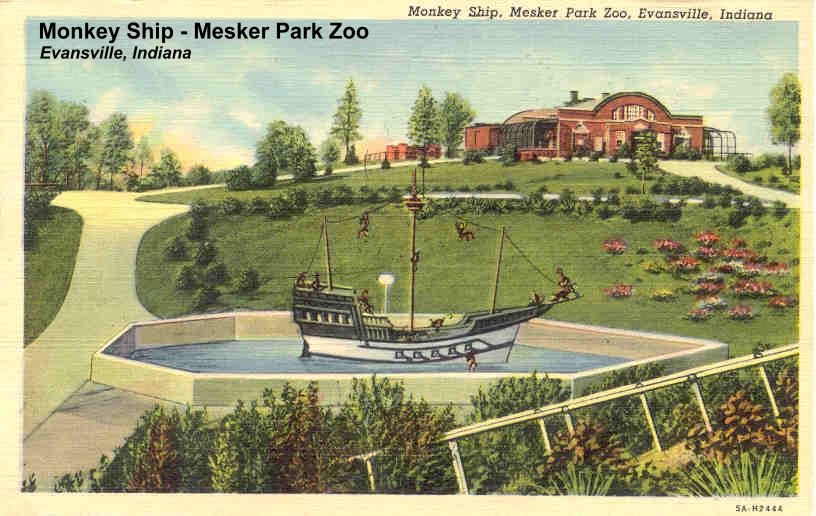 Somehow I reached the age of 53 without reading the infamous novel Lolita by Vladimir Nabokov, which is pronounced "Nab o' kov" with a long "o" in the accented second syllable, unlike Sting's pronunciation in the song "Don't Stand So Close to Me." Regarding pronunciation, I read a statement by Nabokov that Lolita should be pronounced with a short "o" like in "doll," even though the nickname is derived from the unfortunate girl's given name of Delores, and in places through the book is shortened to "Lo." In any case, I am in the midst of reading an annotated version of Lolita. Nabokov's style is complex, heavy with allusions, and I thought I would need all the help I could get to wade through it.
I was struck by one reference in Chapter Two of Part Two, where the main character, pedophile Humbert Humbert is describing sights he and Lolita had seen as they traveled across the country, including "(a) zoo in Indiana where a large troop of monkeys lived on concrete replica of Christopher Columbus' flagship." Sure enough, there is such a structure in the Mesker Park Zoo in Evansville, where Mary and I were married and lived for several years. It was a popular attraction beginning with its completion in the 1930's, but in more recent and enlightened times, it was determined that the 1/3 scale replica of the Santa Maria was unacceptable for simean habitation. The boat remains in the park sans monkeys to this day.
Thursday, August 24, 2006
Pooze the Prodigy
On a farm southwest of my hometown, Milford, Indiana, on July 30, 1880, Arthur F. Griffith was born. Somewhere along the line, for unknown reasons, he acquired the nickname of Pooze. I tried to find a definition of this word, and all I could find was in an online urban dictionary, which defined pooze as either the anus or the female genitalia. I doubt that those meanings applied in the late 19th century. Like most of us from Milford, Arthur might have lived in relative obscurity except for one inexplicable trait. He was a mathematical prodigy. He was able to count to 25,000 at age five, and memorized the multiplication tables through 130. He developed 47 methods of multiplication, 6 methods each for division and addition, and one for subtraction. He could tell you the date of Easter Sunday for any year in the 20th century. He was able to extract cube roots from numbers of 6 figures in seconds. He could watch a train of 100 cars go by on the Big Four tracks in Milford, and memorize the numbers painted on the sides. Arthur had no talent for nonmathematical subjects and didn't go to school beyond the eighth grade. So amazing were his abilities that he was studied by scientists at universities including Indiana University and Yale. His case was presented to the International Psychological Congress in Paris in 1900.
His head was so large, he had to have his hats custom made.
At one point, he said he would publish a book of this methods, but never did. He toured as a vaudeville act, and in 1902 was sentenced to 30 days in the Osceola County, Michigan jail, for failure to pay a boarding house bill. In 1907, he was working as a blacksmith's helper in St. Louis. He became so upset when he wasn't paid for the work he did, he was declared insane and put in the city hospital. He recovered, and was released after a period of observation. He never married, and when he wasn't touring or being studied at a university, he lived with his parents on the same farm where he was born.
Arthur had a history of epilepsy. Were some of his strange behaviors due to a brain lesion? For that matter, was there some structural "defect" of his brain that gave him his incredible mathematical abilities? We'll never know. He died in 1911, at age 31, in Springfield, Massachusetts, presumably on tour. The cause of death was apoplexy, which nowadays would be called a stroke. Perhaps he had a vascular malformation of the brain which ruptured. Again, I can only speculate. Thirty-one was pretty young to have a stroke, even in 1911.
One reason I'm posting this is that there is virtually nothing about dear old Pooze online, and I don't want to see such an amazing character forgotten. So now my vast audience knows his story.
ADDENDUM - 9/11/06:
I have found some more source material and need to correct a couple things in the original post: First, Arthur did publish a book of his methods, entitled The Easy and Speedy Reckoner in 1901. Copies still exist in the Library of Congress and in the Math Library at the University of Illinois. BTW, http://www.worldcat.orgis a great web site that tells you where books are located beginning with libraries closest to your zip code. Second, although Arthur had epilepsy, his seizures started after an unspecified illness at age 7, after he had started to display his calculating abilities, so the two weren't related. Third, he should be called a mental calculator rather than a math prodigy, as he didn't understand or have an interest in learning algebra. He was blessed with a fantastic memory and developed many calculating shortcuts.
Saturday, August 19, 2006
You'll Feel Better About Smoking . . .

While I'm on the subject of asbestos (see previous post "Asbestos, the Magic Mineral"), the makers of Kent cigarettes came up with an exceptionally bad idea in the 1950's. Filter cigarettes were becoming more popular as a means of assuaging smokers' health concerns. In 1957, Kent was recognized by Reader's Digest as having the lowest levels of tar and nicotine among filter cigarettes. Kent's advertising claimed their micronite filters were "developed by researchers in atomic energy plants." Unfortunately, these geniuses used crocidolite asbestos as a component of the filter. The combination of asbestos inhalation and smoking increases the risk of lung cancer about 100 times over the risk of smoking alone. On top of that, there was an epidemic of asbestos-related diseases among workers in the Kent factory.
Remember when tobacco companies advertised on TV? Winston even used the Flintstones in their commercials.
Finally, here's a transcript of a Kent TV commercial:
SCENE: MAN AND WOMAN RIDING BICYCLES. THEY STOP TO LIGHT UP KENT CIGARETTES.
ANNOUNCER (VOICE OVER):
It's a wonderful feeling to be alive and active – to enjoy a beautiful day with a congenial companion and feel that all your senses are alert – including your sense of taste. And with Kent, your taste buds become clear and alive.
. . .
CHORUS (SINGING): You'll feel better about smoking with the taste of Kent – Kent, with the micronite filter. Refines away harsh flavor, refines away hot taste. It makes the taste of a cigarette mild. It’s a wonderful feeling.
(Circa 1960)
Friday, August 18, 2006
Asbestos, the Magic Mineral
The title of this post comes from the sign on the Johns Manville Pavilion at the 1939 World's Fair. No kidding. Asbestos has gotten a bad rap in more recent years, to the point of being banned in most consumer products, but how bad is it? Well, it depends. Asbestos is a naturally occurring mineral, and comes in two forms: serpentine, of which the only subtype is chrysotile (white asbestos), and amphibole, of which there are several subtypes. The most common subtypes are amosite (from the acronym AMOSA--Asbestos Mines of South Africa), and crocidolite. Chrysotile fibers are curly, while amphibole fibers are straight. The amphiboles are the bad actors, more likely to cause asbestosis (scarring of the lungs), lung cancer, and malignant mesothelioma, a rare cancer of the lining of the chest or abdominal cavity, seen almost exclusively in patients with asbestos exposure. Asbestos alone doesn't increase risk of lung cancer much, but the combination of cigarette smoking and asbestos exposure increases the risk about a hundred fold. Fortunately, most of the asbestos in commercial use in years past--about 95%--was chrysotile, which is less likely to have adverse health effects. The EPA doesn't distinguish between the chrysotile and more dangerous types, nor is there any such distinction in asbestos litigation. I don't mean this as an apologia for the asbestos industry. There's no question many, many people who worked in mines, mills, and shipyards have had their lives cut short by asbestos-related disease. The reaction may be a bit overdone, though. Was it necessary to give up completely on a naturally fireproof, durable material (chrysotile) in favor of synthetic substitutes? I don't know.
Well, what I really wanted to talk about is misinformation. If you Google asbestos, you'll see a lot of web sites that refer to the Greek geographer Strabo and the Roman historian Pliny the Elder (and sometimes Pliny the Younger) as the first people to recognize the adverse health effects of asbestos in the first century A.D. They are variously credited with observing that slaves working in asbestos mines or who wove cloth out of asbestos didn't live long, or that they developed breathing problems. At none of these sites have I seen credible documentation backing up these assertions. I found one well-researched paper, "History of asbestos discovery and use and asbestos-related disease in context with the occurrence of asbestos within ophiolite complexes," by Malcolm Ross and Robert P. Nolan(www.rpnolan.com/html/HistoryAsb.pdf). This article contains about everything you'd want to know about asbestos, and more. The authors knock down the idea that ancient writers understood the health effects of asbestos, and they cite a letter to Lancet in 1990, which my friendly local medical librarian retrieved for me. The authors of that letter, entitled "Asbestos and the Romans," make a succinct and convincing argument that people who say the ancient Romans knew the health effects of asbestos are talking through their hats.
Veritas!
Thursday, August 10, 2006
I am not an English major
I once heard a piece of an interview on NPR (seems I hear lots of pieces of shows on NPR since I only listen to it in the truck) with Billy Collins, former U.S. Poet Laureate, and now Poet Laureate of New York. He said, "If you're majoring in English, you're majoring in death." Reading over the last few posts, I can see I'm going to have to lighten up or people are going to think I'm an English major.
Subscribe to:
Posts (Atom)