Showing posts sorted by relevance for query hair. Sort by date Show all posts

Tuesday, July 01, 2008

Hair Force One


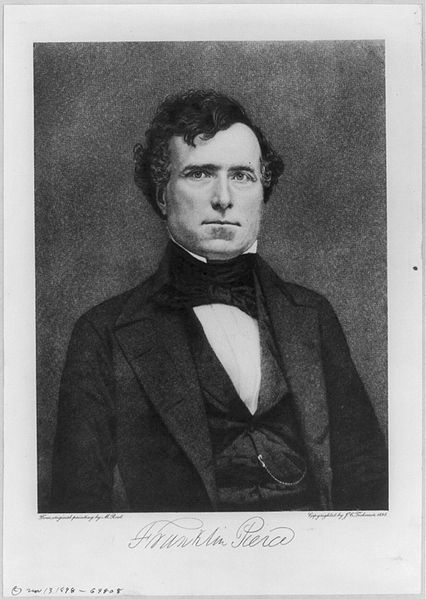
Currier Print of Franklin Pierce

The hair of Abraham Lincoln is so desirable to collectors that a 1/16-inch-long piece of a single hair, allegedly cut from the Great Emancipator's head on his deathbed, is listed on eBay at $1900. One-sixteenth of an inch!

Consider then, the value of this lock of Franklin Pierce's hair from the New Hampshire Historical Society collection.


To me, it looks like something a cat coughed up. That, plus Pierce's sullied reputation as an ineffective President, tells me that his tresses probably wouldn't fetch a high price in the booming deceased celebrity hair market. But I may be wrong. Maybe there are enough Pierce aficianados out there to bid up the price.

Apparently, Pierce's tonsorial splendor was one reason behind his nickname, Handsome Frank. Today, there is some question among Pierce commentators (don't look for them on CNN or MSNBC) about whether Franklin Pierce's hairdo was a result of careless indifference, or thoughtfully planned coiffure. The experts seem to come down on the side of thoughtful planning. Writing in the blog Mental Floss, David Holzel lists as number five of his "Five Amazing Facts About Franklin Pierce (In Honor of His 203rd Birthday)" the tantalizing possibility that Franklin Pierce perfected the combover. He cites as evidence a photo from 1862 which supposedly shows Pierce's hair on two levels--"above, the hair combed on a deep slant, and below, a small patch at the front and center of his wide forehead." Alas, the photo is not included in the article so that astute readers might judge for themselves. I haven't been able to locate the said photo, even in an extensive gallery of Pierce's hairstyles at the website of the New Hampshire Historical Society. The NHHS e-newsletter of February 15, 2008 focuses on a bit of evidence in the great hair, or should I say big hair, debate. The Society purchased a letter written by Franklin's wife, Jane, at auction. The letter, written to her sister in 1857, contains the passage, “Today, Mr. Pierce has met the citizens of Norfolk and after the fatigue is quietly lying on the sofa by a bright fire with Miriam brushing his hair soporifically.” Miriam was Mrs. Pierce's maid. I'm not sure if the phrase means that Mr. Pierce found the hair-brushing so relaxing he was falling asleep, or the maid found the task so boring that she was nodding off. In any case, one might conclude from this little vignette that Pierce was interested in the appearance of his hair. In the newsletter, Peter Wallner, director of the NHHS library and author of two volumes of Franklin Pierce biograpy, states, “While the evidence is not conclusive, the letter leads one to suspect that the vanity Pierce showed for his appearance extended to his hair as well.”

The other mention of President Pierce's hair I have found in my exhaustive research comes from the newspaper description of his lying in state at the New Hampshire State House in Concord, where mourners commented on “his mass of curly black hair, somewhat tinged by age, but which was still combed on a deep slant over his wide forehead.” [New Hampshire Daily Patriot, October 11, 1869]. Deep slant or combover? You be the judge. As David Holzel says at the conclusion of his Mental Floss article, "Pierce’s hair unquestionably is a subject for future historians to wrestle with." Let's just hope they don't have to wrestle with that hairball at the NHHS Museum.

Sunday, November 30, 2008

Hair Force One, Part 3 or Hair to the Chief

Statue of Franklin Pierce, prior to installation on the statehouse lawn at Concord, NH

In previous posts, I have discussed Franklin Pierce's hair, a topic which has fascinated historians and sparked spirited debate among cosmetologists for decades. I can't take full credit for the title of the current post. An occasional reader of this blog, Daniel P. Cory JD (an abbreviation which once may have stood for juvenile delinquent, but now indicates he is a full-fledged lawyer), suggested the title "Hair to the Chief" when commenting on one of the said previous posts. I was conflicted as to whether to use that as the title of the current missive, or to use "Hair Force One, Part 3," since two previous posts were "Hair Force One" and "Hair Force One, Part 2." I have gotten some hits to the blog via Google from people searching for Hair Force One. I assume most of them are looking for a heavy metal band by that name. Unfortunately, I just made a disturbing discovery by Googling "Hair Force One 3" myself. Topping the list of links is a site selling a series of adult movies entitled "Hair Force One." So maybe some of those people who land here via Google are looking for something other than loud music. Whatever. If it means more page views, I'll continue to use the phrase.

But, as usual, I digress.

I decided to follow the shining example of the writers of the 1960s cartoon, Rocky and Bullwinkle, and use both titles, as they frequently did. Examples include:

Axe Me Another or Heads You Lose!
Avalanche is Better Than None or Snows Your Old Man
The Deep Six or The Old Moose and the Sea

And on and on. Brilliant!

What was I talking about? Oh yeah, the hair of Franklin Pierce, 14th President of the USA. While researching another Pierce topic, soon to be revealed in a separate post, I found an article in the May 19, 1900 Fitchburg (Mass) Daily Sentinel in which F.C. Currier writes about meeting Franklin Pierce during the Presidential campaign of 1852. Currier described Pierce as follows:

He was tall and of slender build, with erect, military bearing, black hair, standing up somewhat in curls.
So there you have it. Another foray into the obscure. Hair today and gone tomorrow! Hey wait a minute! It's another title. . .

Sunday, July 06, 2008

Googling Hair Force One

I chose to use the term Hair Force One in two previous posts about President Franklin Pierce's hair. I chose this phrase because it is a word play on the name of the Presidential airplane. The only time I had heard it previously was on CNBC, in reference to commentator Joe Kernan on the show "Squawkbox." He is endowed with a full head of hair, and host Mark Haines sometimes refers to Kernan's desk as "Hair Force One." Anyway, monitoring hits on this blog via Feedjit, I noticed one reader arrived from a Google search "watch hair force one 3 online." Hmmm, I thought, I wonder what that's about. I ran a search for Hair Force One myself, and found out that there is a heavy metal/hair band by that name. Many of the search results had to do with a video of somebody named Edguy performing a cover of the band's romantic ballad "F***ing with Fire!" I also learned that Hair Force One is an online game at the National Pediculosis Association web site, where the player uses a Lice Meister comb to remove lice from a child's head (see also my previous post "How to Avoid Writing"). Finally, the search yielded a site with a rather disturbing video which "defends hairy women around the planet." A good portion of the video consists of a woman applying some sort of gel to the ample hair on her bare midrift. As if that weren't bad enough, a good portion of the rest focuses on unshaved female armpits. The moral of the story is that shaving of female body hair is the result of a greedy plot launched in 1915 by the Wilkinson Sword Razor Blade Co. and Harpers Bazaar Magazine. Wow! I won't supply a link to the video. If you're that interested, you can google it yourself.

I apologize to anyone who might have landed here looking for a heavy metal rock band, a louse-killing game, or hirsute females.

Thursday, July 03, 2008

Hair Force One, Part Two

It seems that Presidential hair was a hot topic around February 15, 2008. As I explained in an earlier post, that's when the New Hampshire Historical Society unveiled what they felt was the secret of Franklin Pierce's hair. That very Presidents Day weekend, the Academy of Natural Sciences in Philadelphia put on an exhibition of Presidential hair--really! The hair samples came from the Peter Browne Collection of Pile--again I say, really! Peter Browne (1762-1860) was a lawyer and amateur naturalist who was interested in sheep (in a nice way, I mean). He started out collecting wool, otherwise known as pile, and studied what types of wool would be suited to different uses. He then branched out into collecting samples of human hair, including the hair of famous people. Included in the collection are the locks of several Presidents, including none other than Franklin Pierce. Thus occurred another opportunity for the media to take potshots at the 14th President. Writing in the article "Presidential Hair on Display" at Philly.com, Philadelphia Inquirer reporter Alfred Lubrano pointed out that the hair samples do not include the follicles, and therefore would not be a source of DNA for "cloning the brilliant redhead Thomas Jefferson or, for sheer laughs, good ol' Franklin Pierce, the very distant relative of President Bush's mother, and a Confederacy-supporting alcoholic with a thick, brown mop."

Bashing of Handsome Frank aside, it's an interesting article with an accompanying video and a slideshow that includes a photo of the page from Browne's scrapbook with Pierce's hair sample. It's much more attractively displayed than the one at the New Hampshire Historical Society web site shown in my previous post, "Hair Force One."

Thursday, February 12, 2009

Handsome Frank and Honest Abe

Today is the 200th anniversary of Abraham Lincoln's birth. As the nation honors a President famous for his honesty and wisdom, let us reflect on the life of an earlier President renowned for having good hair.


From the web site, American President: An Online Reference Resource:
Pierce settled in New Hampshire after his presidency. When the Civil War erupted, Pierce voiced support for the northern cause, as did many doughfaces—that is, northern men with southern principles. A loyal Democrat, Pierce did not support the new president, Abraham Lincoln. In fact, Pierce publicly blamed Lincoln for the war. This outspoken criticism cost the former President a number of longtime friendships.

By the end of the war, Franklin Pierce was all but forgotten, as reclusive as his wife had been in the White House. Always fond of liquor, he had returned to it. When Lincoln was assassinated in April 1865, an angry mob surrounded Pierce's home. Only a final display of the old lawyer's once-famed oratorical skills kept his house in one piece: he gave a speech urging the crowd to disperse peacefully, and they did. When Franklin Pierce died in the fall of 1869, little was written about him.
At least the hapless Pierce was able to talk his way out of the tight spot he had gotten himself into.

While I'm on the topic of people who didn't like Abraham Lincoln, here's a photo of me at the tombstone of Edgar Lee Masters in Petersburg, Illinois in 2005, and a closeup of the plaque on the tombstone.


The curmudgeonly Masters, author of Spoon River River Anthology, was a one-time friend and later a rival of Carl Sandburg, who had placed Lincoln on a pedestal in his biography, Abraham Lincoln: The Prairie Years. Masters tried his best to knock Abe off that pedestal in his own 1931 Lincoln biography, Lincoln The Man. I have a copy of the book but I haven't read it yet.


According to John Aloysius Farrell, writing in his U.S. News and World Report blog, Masters depicted Abe Lincoln as "... cold, and cunning, and devious, and a sexual misfit, and a blundering politician who helped bring on the Civil War, trampled on civil liberties, and was ever-beholden to Eastern financial and manufacturing interests."

Link to American Presidents: An Online Reference Resource

Link to Farrell's article, "Abraham Lincoln Myth Had Its Doubters, Like Edgar Lee Masters"

Link to more information about Franklin Pierce's hair

Sunday, August 07, 2011

40 Year High School Reunion

The following is the essay I read at the reunion of the Wawasee High School Class of 1971 on August 6, 2011.

At graduation, some of us could have accurately said to each other, “See you in the next century.” Hard to believe, but here we are, 40 years later, dripping with nostalgia, and at our age, we’re lucky if that’s all that’s dripping. But here we are, still standing…or sitting down…or possibly lying down as the evening progresses.

We’ve seen a lot of changes in the world during our lifetimes. We came into a world shaped by a World War—the second and last World War, though there have been plenty of wars since then—Korea, the Cold War, Viet Nam, the War on Poverty, the War on Drugs, the First Gulf War, Iraq, Afghanistan, and so forth.

But WWII was the big one, and it changed our parents forever, though they might not have talked about it much. It gave them the satisfaction of fighting the good fight, of pulling together as a nation. Having lived through the worst of times, they saw the best of times ahead for them, and for us, their children. They liked Ike. They loved Lucy.

We were children of the 50s. You didn’t carry a phone with you then. You rented a phone—a single sturdy black phone—a phone with a dial—from Ma Bell, and it sat on its own piece of furniture in the living room. Even though dial phones have been extinct for decades, you still push the redial button to call someone back.

We grew up with television, with Miss Francis and Ding Dong School, with Captain Kangaroo, and Howdy Doody. With Disney in black and white and later the Wonderful World of Color, with Davy Crocket and coonskin caps, with Ed Sullivan and Elvis, but only from the waist up.

And we listened to the radio—AM stations, because that’s where the good music was. WOWO in Ft. Wayne, WLS and WCFL in Chicago. The only time we listened to FM was to hear Milo Clase broadcast the county basketball tourney on WRSW out of Warsaw.

We lived through the turbulent 60s, bombarded by ads for everything. Coke—the pause that refreshes, the real thing. I’d like to teach the world to sing. The Flintstones told us that Winston tastes good like a cigarette should. You don’t believe me? You can see the commercials with Fred and Barney puffing away on YouTube. By the way, it wasn’t until our graduation year of 1971 that cigarette ads were banned from TV.

And still we listened to music—on transistor radios, on 45s and LPs, and eventually on those awesome 8 track tapes, and the even more amazing cassettes.

24/7 news was unknown when we were kids. We got our TV news once a day from Walter Cronkite or Huntley and Brinkley. Local news came from real reporters like Harry Kevokian on channel 22, who was more concerned about current events than how his hair looked.

In our youth, computers filled rooms and cost millions of dollars. To have computers in your home, your car, or on your lap was unthinkable. We suffered through chemistry class with slide rules. Then in 1971 the microprocessor was invented and pocket calculators could be had for a few hundred dollars. There were no ebooks or iphones or email when we were in school. Only birds tweeted and Amazon was a river or a really big woman. Back then, text was a noun, something you produced with a typewriter, and the only thing you used your thumbs for was the space bar. You didn't delete your mistakes, you erased them, or covered them up with white fluid. Now text is also a verb, something we do with our thumbs, on devices that fit in our purses and pockets.

We remember where we were when JFK was shot, and how our little world seemed less secure after it happened. The summer of love came and went in 1967. We might have read about hippies in LIFE magazine and dreamed of wearing flowers in our hair, but we had to bale hay or work at other summer jobs. A guy needed money to buy V-neck sweaters he could tuck into his pants when fall came. Like many of our fashion statements, tucking one’s sweater into his pants seems laughable now. The girls, of course, could not wear pants to school. But we all have fond memories of mini skirts.

Change accelerated during our high school years. The assassinations continued in 1968 with Bobby Kennedy and Martin Luther King. In 1969, we watched men walk on the moon. In 1970, students died at Kent State. Protests and riots became commonplace. We felt the rumblings of change from afar on our farms, in our small towns, on our lake shores and creek banks, but there were crops to be harvested, football two-a-days to suffer through, and homecoming floats to be made, and life went on.

And here we are, four decades later—children of the fifties, geezers of the twenty-first century. It's been quite a ride. Thank you and enjoy the evening.

Monday, July 14, 2008

Marx and Pierce

Karl Marx (1818-1883) and Franklin Pierce (1804-1869) were contemporaries, but to my knowledge, they never met. The title of this post instead refers to Louis Marx, the toy magnate, whose company produced the semi-educational Presidents of the United States series of plastic figures beginning in the 1950's. Those interested can find more information at Disneykins.com. The series was produced in various sizes, some in white plastic that the owner could paint if so desired, and some pre-painted. I bought a painted version on eBay. It doesn't look all that much like Franklin Pierce, except for the wayward lock of hair on his forehead, and the Napoleanesque pose he affected in some of his portraits.

Tuesday, August 19, 2008

Franklin Pierce in Another Top Ten List!


Franklin Pierce is No. 5 in the Top Ten Heads of Presidential Hair at the blog Receiving Me?.

Thursday, July 31, 2008

Franklin Pierce Misses the Hit Parade Again


In a new book, The Leaders We Deserved (and a Few We Didn’t), Alvin S. Felzenberg enters the Presidential rating game. Not surprisingly, Franklin Pierce once again ranks among the worst Presidents. Felzenberg scored the Presidents on five qualities: character, vision, competence, economic policy, human rights, and foreign policy. Unfortunately, he didn't grade the Presidents' hair. Perhaps then Pierce would have fared better. Being the thorough and conscientious social critic that I am, I have no intention of actually reading the book, so I don't know exactly what Pierce's score is. However, when asked "Who didn't we deserve?" in an interview with the National Review Online, Felzenberg had this to say:

We could have done without Andrew Johnson, Pierce, Buchanan, Herbert Hoover, Jimmy Carter, and quite a few others.

When asked about his least favorite President, Felzenberg named James Buchanan, because the nation drifted further toward Civil War during his watch. So I guess Franklin Pierce wasn't at the absolute bottom of the list.

Wednesday, October 07, 2009

The Avant-Garde Nature of Winky Dink

Tonsure. Marcel Duchamp with haircut by George de Zayas, Paris, 1919. Photo by Man Ray.

In the book, Dada Culture: Critical Texts on the Avant-Garde, edited by Dafydd Jones, T.J. Demos writes:
In 1919 Duchamp had the shape of a star cut into the hair on the back of his head (Tonsure). Here, the articulations of his artistic practice...intersected with his bodily appearance, as language's flight crossed over Duchamp's own physical decontextualisation. Duchamp threw himself into the flux of expatriation, rewriting his own appearance, and giving life to his own inscriptions.
The author goes on, with terms like "ephemeral tattoo," "eventual erasure," "sublime state of pure becoming," and "perceptual counterpoint." You get the idea. I really can't bear to transcribe any more.

Winky Dink. Dell comic book, 1955.

No doubt, existential angst and surrealistic tendencies led my boyhood idol Winky Dink (see previous post "Winky Dink and Me") to adorn his cranium with a star. He was so out there, he went Duchamp one better by wearing a star for a collar.

Wednesday, January 06, 2010

Winky Dink and Homeland Security

Winky Dink. Dell comic book, 1955.


Happy young viewer bathed in radiation from the television as she draws with her magic crayons on her magic screen, 1953. Photo by Walter Sanders. From the Life Magazine archives.

The author has on numerous occasions expounded upon the significance of the cartoon character Winky Dink. Like the star inexplicably attached to his head, Winky Dink's influence shone brightly over the cultural landscape of 1950s America, sparking the creativity of hordes of rapt young viewers, while boosting the bottom line at CBS by selling millions of magic Winky Dink drawing kits at 50 cents a pop. The kits consisted of a box of crayons, a sheet of plastic, and a cloth. The cloth served two purposes. First, rubbing the sheet of plastic (AKA the magic screen) with the cloth generated a charge which would then cause the sheet to stick to the TV screen, similar to the way rubbing a balloon on your hair builds up static electricity that allows you to stick the balloon to the wall. Second, the cloth served as an eraser to clear the magic screen. To the chagrin of many parents, the cloth didn't erase crayon marks from the glass of the TV if Winky Dink's little fans forgot to attach the plastic sheet before drawing.

As the show unfolded, pictures would be displayed for Winky's viewers to complete. Missing elements included such items as Uncle Slim's bowtie, or a bridge or a ladder which would allow Winky to escape a bear attack or some other peril.

Sometimes, the missing piece of the picture was presented as a connect-the-dots puzzle.

Judging from the news coverage of the recent attempt to blow up an airliner with explosive underwear, what this country needs is someone who can connect the dots. The pundits and reporters on the cable news shows have seized upon the phrase "connect the dots" to explain what it is the intelligence agencies failed to do with the various pieces of evidence they had about the Nigerian terrorist who tried to blow up the plane. I believe I have heard the phrase "connect the dots" roughly 347 times over the past week. It may be used as frequently as twice in a single sentence. Usually, these sentences begin with the reporter lookly earnestly into the camera and saying "Look." Starting a sentence with the word "look" indicates the speaker without a doubt is speaking the truth, and you shouldn't even consider the possibility that he may be talking through his hat.

Even President Obama is getting in on the act. After meeting with his security team yesterday, he stated, "The bottom line is this, the U.S. government had sufficient information to have uncovered this plot and potentially disrupt the Christmas Day attack, but our intelligence community failed to connect those dots." The only way he could have made it better would have been to start out by saying, "Look, at the end of the day..."

Obviously, President Obama must be able to count on his trusted adviors to "connect the dots." We need change we can believe in! Heads must roll! High-ranking government officials must express a sudden desire to spend more time with their families and resign! I am hereby proposing that Janet Napolitano step down as Secretary of Homeland Security. As her replacement, my fellow Americans, I give you someone whose safety, whose security, whose very existence has depended on "connecting the dots" for over a half-century. I give you the one, the only--WINKY DINK! (Cue music: "Happy Days Are Here Again")