Wednesday, July 02, 2008

Franklin Pierce - Whipping Boy of Pundits and Naysayers


Once again, the name of Franklin Pierce comes up in the political blogosphere this election year. In her article, "Wes Clark and the Military Credential," in the TIME/CNN blog Swampland, Karen Tumulty discusses the men who had military experience as generals before being elected U.S. President. General Wes Clark recently said that John McCain's military service didn't necessarily mean he would be a good Commander-in-Chief, which set off a firestorm of chatter in the media. Ms. Tumulty, taking the same exhaustive, thorough approach to journalism that I do, used Google to find out how many U.S. Presidents had been generals, and how those Presidents ranked in a survey of historians, political scientists and legal scholars that the Wall Street Journal and the Federalist Society did in 2000. Please note that John McCain was not a general, the world changed quite a bit between the time of George Washington and Dwight D. Eisenhower, and I personally believe this whole discussion is irrelevant.

In any event, Ms. Tumulty notes that of the twelve former generals who became President, "...two were flat-out 'failures': Franklin Pierce (Mexican War) and Andrew Johnson (Civil War)." Poor Franklin Pierce--Rodney Dangerfield got more respect than this guy.

Franklin Pierce Bobblehead

I ordered mine yesterday from the New Hampshire Historical Society. Don't miss out! It's a limited edition!

Tuesday, July 01, 2008

Hair Force One


Currier Print of Franklin Pierce

The hair of Abraham Lincoln is so desirable to collectors that a 1/16-inch-long piece of a single hair, allegedly cut from the Great Emancipator's head on his deathbed, is listed on eBay at $1900. One-sixteenth of an inch!

Consider then, the value of this lock of Franklin Pierce's hair from the New Hampshire Historical Society collection.


To me, it looks like something a cat coughed up. That, plus Pierce's sullied reputation as an ineffective President, tells me that his tresses probably wouldn't fetch a high price in the booming deceased celebrity hair market. But I may be wrong. Maybe there are enough Pierce aficianados out there to bid up the price.

Apparently, Pierce's tonsorial splendor was one reason behind his nickname, Handsome Frank. Today, there is some question among Pierce commentators (don't look for them on CNN or MSNBC) about whether Franklin Pierce's hairdo was a result of careless indifference, or thoughtfully planned coiffure. The experts seem to come down on the side of thoughtful planning. Writing in the blog Mental Floss, David Holzel lists as number five of his "Five Amazing Facts About Franklin Pierce (In Honor of His 203rd Birthday)" the tantalizing possibility that Franklin Pierce perfected the combover. He cites as evidence a photo from 1862 which supposedly shows Pierce's hair on two levels--"above, the hair combed on a deep slant, and below, a small patch at the front and center of his wide forehead." Alas, the photo is not included in the article so that astute readers might judge for themselves. I haven't been able to locate the said photo, even in an extensive gallery of Pierce's hairstyles at the website of the New Hampshire Historical Society. The NHHS e-newsletter of February 15, 2008 focuses on a bit of evidence in the great hair, or should I say big hair, debate. The Society purchased a letter written by Franklin's wife, Jane, at auction. The letter, written to her sister in 1857, contains the passage, “Today, Mr. Pierce has met the citizens of Norfolk and after the fatigue is quietly lying on the sofa by a bright fire with Miriam brushing his hair soporifically.” Miriam was Mrs. Pierce's maid. I'm not sure if the phrase means that Mr. Pierce found the hair-brushing so relaxing he was falling asleep, or the maid found the task so boring that she was nodding off. In any case, one might conclude from this little vignette that Pierce was interested in the appearance of his hair. In the newsletter, Peter Wallner, director of the NHHS library and author of two volumes of Franklin Pierce biograpy, states, “While the evidence is not conclusive, the letter leads one to suspect that the vanity Pierce showed for his appearance extended to his hair as well.”

The other mention of President Pierce's hair I have found in my exhaustive research comes from the newspaper description of his lying in state at the New Hampshire State House in Concord, where mourners commented on “his mass of curly black hair, somewhat tinged by age, but which was still combed on a deep slant over his wide forehead.” [New Hampshire Daily Patriot, October 11, 1869]. Deep slant or combover? You be the judge. As David Holzel says at the conclusion of his Mental Floss article, "Pierce’s hair unquestionably is a subject for future historians to wrestle with." Let's just hope they don't have to wrestle with that hairball at the NHHS Museum.

Monday, June 30, 2008

Peculiar Pierce Memorabilia

Doing a search of blogs at Wordpress.com has turned up a few interesting Franklin Pierce related posts. First I learned that Amazon.com sells apparel such as T-shirts, bibs and onesies displaying the handsome visage of our 14th President. Next, I found a (mercifully) short-lived attempt at a Franklin Pierce comic strip. And finally, one blogger owns a piano from the Francestown (NH) Academy, where Franklin Pierce was a student. Whether he actually played the piano is unknown to me, but it makes for a nice Washington-slept-here type story.

Friday, June 27, 2008

Franklin Pierce Praised


New Hampshire man Elting E. Morison wrote a piece entitled "In Praise of Pierce" in the August/Sept. 1985 issue of American Heritage Magazine.

Franklin Pierce Dissed Again

On Feb. 6, 2007, US News and World Report posted an article on the ten worst Presidents in U.S. history. Franklin Pierce came in #4.

Saturday, June 21, 2008

The Big Peach


Fans of oversized food will want to travel down Highway 41 to the Bruceville, Indiana area to see the Big Peach. It stands outside a produce market, and bears an uncanny resemblance to the Trylon and Perisphere of the 1939 New York World's Fair. Well, OK, the tower is an obelisk and is only about 20 feet tall, while the Trylon was a three-sided spire about about 700 ft. tall. And, yes, the Trylon and Perisphere were the only structures on the World's Fair grounds painted pure white, while the obelisk and peach are shades of orange. But you have to admit that it's a weird example of serendipity that this picture I took of the peach a few years ago has a very similar perspective as the picture postcard of the Trylon and Perisphere I just found online.

Groucho Sings "Father's Day"

Thanks to a comment left by kt, here's a link to a studio version of Groucho singing "Father's Day." Till now, I had only heard the live version on the album An Evening With Groucho.

Wednesday, June 18, 2008

Lydia the Tattooed Lady Revealed

This post, along with many others about the Marx Brothers, also appears in its entirety at my other blog, The Marx Brothers.


Image courtesy of the Yip Harburg Foundation

A lot of landmark events occurred in 1939. The New York World's Fair opened. Hitler invaded Poland. The movie The Wizard of Oz premiered, and the Marx Brothers movie At the Circus was released. Harold Arlen and lyricist E.Y. "Yip" Harburg wrote songs for both the Wizard of Oz and At the Circus. Groucho's performance of "Lydia the Tattooed Lady" is a classic.


As I pointed out in an earlier post about the song Cuban Pete, the internet is littered with inaccuracies. The World Wide Web abounds in multiple copies of a mistaken transcription of Groucho's introduction to "Lydia." What shows up in this transcription is:

My life was wrapped around the circus.
Her name was Lydia.
I met her at the World's Fair in 1900,
marked down from 1940.
Ah, Lydia.
She was the most glorious creature under the sun.
Guiess. Dubarry. Garbo.
Rolled into one.

If you watch the above clip from the movie, you'll see that when Groucho lists the three beauties that were all rolled into Lydia, the first one sounds like it rhymes with "vice". According to Nick Markovich, administrator/archivist of the Yip Harburg foundation, this was Thaïs, an Athenian courtesan who allegedly convinced Alexander the Great to burn the palace of Persepolis. Jules Massanet wrote an opera called Thaïs. The Scottish soprano Mary Garden made her American premiere in the title role. The other two women were Madame du Barry, mistress of Louis XV, and famed actress Greta Garbo. Interestingly, Yip Harburg also wrote lyrics for a song ("Salome") which was sung by Virginia O'Brien in the 1943 movie Du Barry Was a Lady.

Mary Garden as Thaïs

Madame du Barry

Greta Garbo

The joke about the World's Fairs in Groucho's intro refers to the Expositon Universelle in Paris in 1900, and the New York World's Fair, 1939-1940.
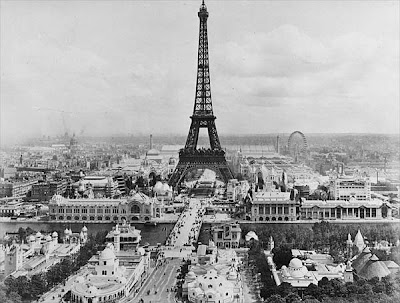
Exposition Universelle, Paris 1900

New York World's Fair, 1939

There are many historical and topical references in the song itself:

Battle of Waterloo - Napolean's final defeat by the Duke of Wellington


Wreck of the Hesperus - a poem by Longfellow, based on events that occurred during a blizzard off the east coast of the United States in 1839. In the poem, a sea captain's daughter is tied to the mast of a ship to keep her from being washed overboard during a storm, but both she and her father die.

Henry Wadsworth Longfellow

Kankakee - a town in Illinois


Paree - the one in France. You've heard of it--it's been in all the papers

Lisa Fonssagrives on the Eiffel Tower, Paris 1939.
Photo by Erwin Blumenfeld

Washington Crossing the Delaware - the famous painting by Emanuel Leutze of the beginning of the surprise attack on the Hessians in Trenton, New Jersey, Decemeber 25, 1776


Andrew Jackson - colonel in the Tennessee militia in the War of 1812 and later President of the U.S.


mazurka - a Polish dance


Niagara - the Falls--you know, the big ones between New York and Canada


Alcatraz - the island in San Francisco Bay that used to be a prison


Buffalo Bill - William F. Cody, of Wild West Show fame


Just a little classic by Mendel Picasso - This is the most puzzling phrase in the song, and one for which I can't find an explanation. The abstract artist Picasso's given name was Pablo Diego José Francisco de Paula Juan Nepomuceno María de los Remedios Cipriano de la Santísima Trinidad Martyr Patricio Clito Ruiz y Picasso. That's quite a mouthful, but I don't find anything that looks like Mendel in there.

Captain Spaulding - Groucho's character in Animal Crackers


Godiva - the lady who, according to legend, argued with her husband, Lord Leofric, about the oppressive taxes he levied on the citizens of Coventry in the eleventh century. He challenged her to ride naked through town, and promised to lift the taxes if no one looked at her. She rode, no one looked, the peasants cheered, and the taxes were lifted, or so one version of the legend goes.

Lady Godiva by John Collier

Grover Whalen unveilin' the Trylon - a great turn of phrase. Whalen was President of the World's Fair Corporation, which planned and built the 1939 World's Fair on the site of what was up to that time an ash dump in Flushing Meadow. The symbols of the fair were the Trylon and Perisphere--a big pointy tower next to a big round building.


Treasure Island - another topical reference. Treasure Island is an artificial island in the San Francisco Bay. It is connected by a small isthmus to Yerba Buena Island. It was created out of fill dredged from the bay in 1936 and 1937 for the 1939-1940 Golden Gate International Exposition.


Nijinsky adoin' the rhumba - a Russian ballet dancer and choreographer doing "the dance of Latin romance" (see Cuban Pete).

Vaslav Nijinsky not doing the rhumba

In their book, Who Put the Rainbow in the Wizard of Oz: Yip Harburg, Lyricist, Harold Meyerson and Ernie Harburg point out a couple interesting facts about "Lydia." The song was censored and in order to get it into the movie, Yip Harburg had to add the last stanza:

Oh, Lydia, the champ of them all
She once swept an Admiral clear off his feet
The ships on her hips made his heart skip a beat
And now the old boy's in command of the fleet
For he went and married Lydia

I guess the censors could accept the rest of what they considered a risque song as long as Lydia became an "honest woman" and got married in the end.

Myerson and Harburg also point out that Yip tried his best to make "Lydia" sound like Gilbert and Sullivan, because Groucho was a big fan and would have parties at his house where he would play recordings of Gilbert and Sullivan operas and sing along with them.

As I close this post, I must note a spooky coincidence(?). The Muzak coming out of the speaker in the office at the MRI Center where I am finishing this up is "Somewhere Over the Rainbow" by Arlen and Harburg!

Tuesday, June 17, 2008

Franklin Pierce Rising


Perhaps Franklin Pierce will rise from obscurity this election season. He is getting some publicity now. In the June 13, 2008 edition of the Christian Science Monitor, Ruth Walker writes in an article about the "historic" campaigns of Barack Obama and Hillary Clinton entitled "Not Quite the End of 'History',"
It is a moment to savor in the life of the nation. But is history the facts, the deeds themselves; or the telling of them? Of course they made history, one wants to say; the US presidency is always "historic." Consider Franklin Pierce, the obscure 14th president. Amazon lists a dozen biographies of him, including a new one due out in August, plus two compilations of his papers.
After checking on Amazon.com, it looks to me like the book being published in August is a recycling of a biography for children written by Steven Ferry in 2001, but at least the publisher is optimistic enough to think that children still read books and that they might be interested in history.

Blogger billysumday in his diary had me going for a minute with his parody of a recent John McCain remark. McCain responded to Barack Obama's comment that McCain was running for George W. Bush's third term by saying that Obama was running for Jimmy Carter's second term. Billysumday changed the response to make it Franklin Pierce's second term. The implication is that McCain is old and making outdated references. It may be the case that many young voters are equally unfamiliar with Carter and Pierce.

Finally, in an article about ex-Presidents, Jeremy Lott wrote of Bill Clinton in the blog Politico on May 20, 2008,
He may also be in the same strata as Franklin Pierce, who, though from New Hampshire, was a slavery enthusiast and denounced the Civil War effort to keep the nation united. Pierce died a reclusive alcoholic, a former president scorned even by local schoolchildren, who often threw pebbles at him on the rare occasions he ventured outside.
Little old lady English teacher note: If there are indeed different levels of bad ex-Presidents, then Clinton would be in the same stratum, not the same strata as Pierce, unless it is possible to be so bad as to occupy multiple levels in the hierarchy of former leaders of the free world.

For a nice concise video about Franklin Pierce, check out History.com.