Saturday, January 09, 2021

The Civil War Letters of Robert Z. Cory

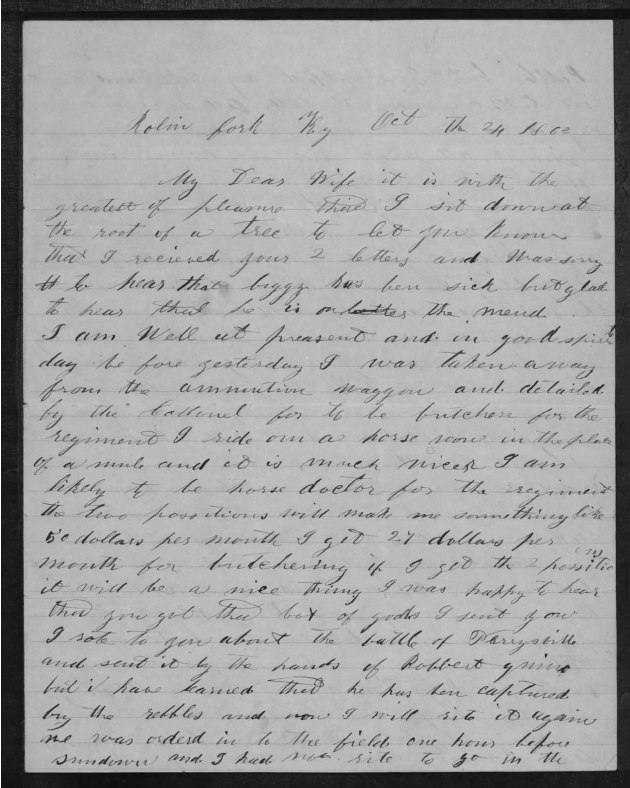
The Civil War Pension file for Robert Z. Cory contains two letters which he wrote home to his wife Matilda. They are reproduced below. Background on the family, his army service, and transcriptions of both letters can be found at The Civil War Letters of Robert Z. Cory.

Monday, January 04, 2021

Excerpts From the Greate Book With Printable Comments

The pdf file I previously published included comments which could only be viewed online. I've revised the file so that it can now be downloaded and printed with comments included: Excerpts From the Great Book Revised 2021

Saturday, January 02, 2021

The Strange Life and Death of Dr. John Calvin Cory

The life of John Calvin Cory was in some ways typical of the pioneer period of American history. He was part of a large family which migrated west from Ohio to Indiana to Iowa. However, there were some aspects of his life and death which were distinctly unusual.

John Calvin Cory was the oldest child of Jeremiah William Cory, Sr. and Dorothy “Dolly” Martin. He was born about 1815 in Pickaway County, Ohio. Nine siblings were to follow before Jeremiah and Dolly moved to northern Indiana in the 1830s. There the family acquired land and farmed. About 1835, John Calvin Cory married Martha Crosson, a daughter of Samuel Crosson, one of the founders of the town of Syracuse, Kosciusko County, Indiana. In 1836, Martha gave birth to John Walker Cory. She died the same year. Details are not available, but perhaps her death was a complication of childbirth. John Calvin Cory found his second bride in the person of Lavinia Stevens. They were married in 1839 in Lavinia's home county of Vermilion, Illinois. By the time of the 1840 census, the couple was living in Elkhart County, Indiana with young John Walker Cory. In the spring of 1846, John Calvin moved west to Iowa Territory. Whether he brought his wife and son with him is not documented. He was the first white settler in what would become Skunk Township of Polk County. In the fall of 1846, J.C.'s brother Isaac Walker and family migrated to Iowa, and in 1849, a wagon train comprising John Calvin's parents and several siblings with their families also made the trek to Iowa.

In 1848 the U.S. government began selling land to settlers in what had by then become the state of Iowa. There is no record that J.C. Cory bought any acreage, implying that he may have moved on. By the time of the 12 November 1850 federal census, John Calvin, Lavinia, and John Walker Cory were living in Pettis Township, Platte County, Missouri. Several members had been added to the household since the 1840 census. Three children had been born in Indiana: Christopher in about 1840, William Tigris, in about 1843, and James Euphrates, in about 1845. Daughter Cassa was born in Illinois about two months before the November 1850 census. Since Lavinia's pattern of childbearing was fairly typical of pioneer women—a birth every two to three years—while in Indiana, the gap of about five years between James and Cassa suggests Lavinia may not have accompanied John Calvin to Iowa in 1846, but rejoined him later. Lavinia's sister, Mary Ann Dunbar, 23, and her daughter, Columbia, age 3, were also living in the J.C. Cory household in 1850. Presumably, Mary Ann was widowed or divorced, but details of the father of Columbia are unknown.

In 1852 or 1853, the lives of the family took an unusual turn. According to findings of fact by a probate judge in the case of John C. Cory's estate, “...sometime after the marriage of John C. Cory and Lavinia Stevens, John C. Cory, about the year 1852 or 1853 abandoned the said Lavinia, his wife, and commenced living and cohabiting with Mary Ann Stevens, a sister of Lavinia and in 1856 John C. Cory removed from the State of Missouri to the State of California, taking Mary Jane (sic) Stevens with him where they continued to reside, and cohabit as man and wife, until the death of said Mary Ann Stevens, about the year 1865.” Mary Ann's daughter Columbia Dunbar also made the trip to California. Apparently, Mary Ann was pregnant when they left Missouri and migrated to California, as her first daughter by John Calvin Cory, named Nebraska, was born in Nebraska Territory in 1856. Their second daughter, Minerva Jane, was born in California about 1863.

While living in Butte County, California, John Calvin Cory was known as Dr. Cory. How or when he acquired this title is uncertain, but a history of Butte County by George C. Mansfield, published in 1918, described Dr. Cory as a “pioneer physician.” Licensing for physicians was lax at best on the frontier. It seems unlikely that he had any formal training. His brother back in Indiana, Robert V. Cory, advertised himself as a veterinary surgeon as well as an auctioneer, also without any evidence of a formal education.

After Mary Ann's death, Lavinia and John Calvin Cory reunited. Quoting again the findings of fact from John Calvin Cory's probate packet: “...upon the death of Mary Ann Stevens in 1865, Lavinia Cory, wife of said John C. Cory came to California in 1866 at the request of her husband, and from thenceforward, until the death of said John C. Cory in Butte Co Cal—lived with him as his wife.” Barring a personal visit, J.C. Cory must have sent a letter or telegram to Lavinia imploring her to take him back. What an interesting and persuasive document that must have been! The 1870 census indicates that Lavinia's brother Stephen C. Stevens, a schoolteacher, was living with J.C. and Lavinia in Plumas County, California. Interestingly, J.C., Lavinia, Nebraska, and Minerva Jane were counted a second time in the 1870 census—in Butte County. Presumably, J.C. Cory had property in both counties.

The death of John Calvin Cory was no less out of the ordinary than his life had been. On 12 February 1871, Dr. Cory was lying on the floor of his house, warming his feet at a fireplace with his head resting on a stool. A rifle held by his brother-in-law Stephen C. Stevens in an adjacent hallway discharged, and the bullet struck Cory in the top of the head, passed through his neck, and lodged in his left shoulder, killing him instantly. Stevens claimed he stumbled on his way to go outside to shoot ducks and that the gun discharged accidentally. Indicted for murder, he was found innocent at trial. After his acquittal, California newspapers had nothing positive to say about Stevens. The Chico Semi-Weekly Review of 6 December 1871 carried a short item which stated “S.C. Stevens, the fancy school teacher who sloshed around here last spring has turned up in San Jose, playing the confidence game. He has a niece along and represents her to be an heiress to considerable wealth, and himself to be possessed of means and property in Chico. He also represented himself as belonging to a benevolent institution, and on the strength of that succeeded in bilking some landlords. The San Jose Patriot gives about a half a column of his eccentricities.” An article with the headline “Turning Out Badly” in The Red Bluff Independent of 21 December 1871 reported that Stephen C. Stevens was “accompanied by his niece, whom, it is said, he represents as an heiress to great wealth. This disclosure is mortifying to those who believed in his innocence, and leaves him to go altogether to the dogs.” The niece in question was Nebraska, fifteen-year-old daughter of John Calvin Cory and Mary Ann Stevens Dunbar. Stephen C. Stevens and Nebraska were later married, on 26 July 1873. Unfortunately for the couple, in 1875 the probate court of Butte County, California denied Nebraska's claim to be an heir of the estate of her father, based on the fact that she and her sister Minerva Jane were illegitimate children of J.C. Cory and therefore ineligible to be his heirs.

California voter registrations of 1875 and 1880 listed S.C. Stevens’ occupation as lawyer, even though all previous documentation was that he was a schoolteacher. Whether he was actually qualified to be a lawyer or whether he merely posed as one is unknown, but he practiced in the Police Courts in Colusa and Tehama Counties. Stevens met a gruesome death on 27 August 1882. On that Sunday afternoon, he went to the home of Ashland Christian near Orland, Tehama County, California. Newspapers varied on the details of the dispute that ensued between the two men, but it centered on a piece of land. The Stockton Evening Mail of 29 August 1882 reported that Stevens was claiming “money as commission of a sale,” while the Chico Weekly Enterprise of 1 September 1882 reported the argument was over a piece of land that both Christian and Stevens laid claim to. In any event, Stevens pulled a knife and threatened the life of Christian, whereupon Christian knocked Stevens down and kicked him to death. The Evening Mail reported, “The deceased was much battered—had his skull fractured and two ribs broken. Christian, who is respectably connected, is under arrest.” The Enterprise described Stevens as “originally a school teacher, a particularly dressy young man” who “managed to worm himself into society,” and who, since being acquitted in his trial for the murder of Dr. Cory in 1871, had made a career as a swindler, confidence man, and claim jumper.

There was no mention of a widow in the news accounts of his murder, and what became of his wife (and niece) Nebraska is unknown. It does not appear that Ash Christian was convicted for the murder and no mention was made of the episode in his obituary when he died at age 69 in 1925. He was described as “one of the prominent men of Orland and was held in high esteem by all who knew him.”

Thursday, September 12, 2019

Excerpts from the Greate Book

Title page of the 1603 edition of Seven Treatises by Richard Rogers.
The book handed down from John Cory of Southold was titled Seven Treatises. When James Enos Cory examined and researched the book in the early twentieth century, the title page of the book, published in London in 1603, was missing (image above is from a copy of the book at Cambridge University). He paid a visit to the Librarian of Congress to find out the title. This and other fun facts (and some fallacies) can be read in a booklet titled Excerpts from the Greate Book compiled by Marge Chilson in 1991. I've scanned the booklet and included a brief introduction of my own in the pdf file at Google Docs. For a more in depth analysis, see The Great Book of John Cory

Sunday, September 08, 2019

The Great Book of John Cory


Yes, I am still alive. It's been a few years since I've posted here, but since I'm boycotting Facebook, Instagram, Twitter, etc., this is the one somewhat social medium open to me. I have just completed an ebooklet about the Great Book, a family heirloom handed down from the Puritan John Cory I of Southold, Long Island. It's publicly available, free of charge, on Google Drive. Enjoy.

Friday, February 27, 2015

Rev. Theodore Hesburgh


Rev. Theodore Hesburgh, past president of Notre Dame, died yesterday at the age of 97. I never had an opportunity to meet the great man, but I attended two events where he was also present. One was a a fundraiser for a South Bend nonprofit where Father Ted spoke. I don't recall the exact organization involved--possibly the Center for the Homeless. The thing I remember was Hesburgh quoting Matthew 25:40--"And the king will answer and say to them, verily I say to you, inasmuch as ye have done it to one of the least of these my brethren, ye have done it to me." 

Thanks to the internet, I am able to retrieve the details of the other event that Father Ted and I both attended. This was the 20th anniversary Red Smith Lecture in Journalism on Oct. 16, 2003 at the University of Notre Dame. The lecture was delivered by Frank McCourt,  author of the memoirs “Angela’s Ashes” and “’Tis.” One of the things McCourt talked about was how, as a child in Limerick, Ireland, he was enamored of the Fighting Irish football team of Notre Dame--until he encountered an American tourist who told him the Fighting Irish weren't really Irish, but just "a bunch of Goddamn Polacks." I was a little surprised that McCourt told the story in front of God and Father Ted and everybody, but it was pretty funny.

Sunday, November 09, 2014

New Blog

Since I'm concentrating on photography now, I have started a new blog, www.davidacoryphoto.blogspot.com. I will keep Lugubrious Drollery online and may occasionally post non-photography stuff here. Also, I have a website, davidacory.com with examples of my photography. My blog can also be viewed there.

Wednesday, February 05, 2014

Maholy-Nagy on Photography

László Maholy-Nagy 1895-1946

"The enemy of photography is the convention, the fixed rules of 'how to do.' The salvation of photography comes from experiment."

Sunday, November 03, 2013

Doesn't Anbody Review This Stuff Before Publishing?

I have two problems with an advertising section for Montefiore Medical Center in the New York Times Magazine for Sunday, November 3, 2013:

1. In not one, but two pictures, films of a brain MRI are upside down.
2. Nobody prints films of MRI scans anymore. The images are all on computer monitors.


Even if no actual physician was involved in the production of these photos, it's not hard for the people involved to see the text on the films is upside down.

Saturday, November 02, 2013

The Essence of Zen and the Art of Motorcycle Maintenance

Assembly of Japanese bicycle require great peace of mind.

Sunday, October 20, 2013

Sunday Morning

Running the juicer
this morning
a memory
bubbled up
from my subconscious:
my father
drinking grape juice
mixed with milk.

Saturday, August 31, 2013

Ralph Eugene Meatyard

I've sworn off Facebook, at least temporarily, which frees up some time for doing something constructive, like resurrecting my blogs. In connection with the publication of my photographic portfolio "Revolution," I've written an essay about the optician-photographer Ralph Eugene Meatyard for the blog of F-Stop Magazine.

Saturday, July 13, 2013

My Dad's Social Security Card

In my last post, I enumerated the contents of my father's wallet when he died in 1989. The Social Security card he was carrying at the time was printed in 1961 or later, so I inferred it was a replacement. Now I've located the original. It was in with a package labeled "My Senior Days" produced by the Camp Publishing Company of Ypsilanti, Michigan.


Inside the paper sleeve was a booklet that included a class picture of Milford's 1937 graduates...


and Dad's senior portrait.


There were some snapshots stuck in the booklet, including this one of Dad in cap and gown, posing by what we called the brick building, as it was the only brick structure on my grandparents' farm. I remember it as the place they kept their large deep freeze. I also recall an old radio that was stored in there which would no doubt be quite a collector's item if it still existed.


A program from the 1937 Milford High commencement was also stuck in there. The graduation occurred on April 30, quite early in the year by current standards.


Grandpa Cory gave the invocation.


Some of Dad's report cards were also stuck in the booklet. I won't scan those. Suffice it to say that he got a few A's in music and manual training (shop class). If you knew him, that shouldn't be surprising. I still have a bed he built in manual training class stored in the basement. He was a very smart guy, but I don't think he found school that interesting, and therefore didn't work very hard to get good grades.

But, as usual, I digress. Here is his original Social Security card.

Note: I have removed the image of the Social Security card. Someone stole the photo and information from an image of my dad's driver's license I had used in another post. They used them to set up a fake Facebook account. So, alas, I have removed that image as well as the Social Security  card image to prevent future mischief. -- DAC, November 30, 2015

It was never detached from the stub upon which is typed the name of his employer, Mogul Rubber Corporation in Goshen, Indiana, and his home address. Note the card was issued a week after his high school graduation. Nineteen thirty seven was the first year for Social Security.

So I guess he never bothered to carry his card with him. At some point in 1961 or later, he must have needed to have the card. By that time, I'm sure he forgot he had stuck it in with his graduation memorabilia and had to request a replacement.


Wednesday, August 01, 2012

Hiroshi Watanabe


"Pipe-cleaner Flower Arrangement in Gallon Jug, Tule Lake, California 1" by Hiroshi Watanabe

Gentle readers, after an absence of lo these many months, I feel it necessary to delve once again into the subject of fine art photography. As usual, I have no right to pontificate on this subject, save for the fact that I have spent some minutes Googling the California-based photographer Hiroshi Watanabe. Do not be deceived. The urge to inform you about this talented photographer does not derive solely from the fact that I know how to spell Hiroshi, a skill I acquired when I became fascinated by the work of another genius of the photographic medium, Hiroshi Sugimoto.

I believe I first heard about Mr. Watanabe from a podcast by Martin Bailey. After Mr. Watanabe's name rattled around the dank recesses of what remains of my mind for several months, the time for further research had arrived.

When the name of Hiroshi Watanabe bubbled up from my subconscious, I went to his very impressive web site. Among the many galleries of his brilliant work on display there, I was particularly taken with the portfolio titled "Artifacts - Things from Japanese Internment Camps." The photos are of items Mr. Watanabe found at the Japanese American Museum in San Jose, California, and at a dump site from a California internment camp where Japanese Americans were detained during WW II.

I believe the photo above, of a flower arrangement inside a gallon jug, made from pipe cleaners by a resident of the camp, and subsequently left in the dump when the detainees were released, is one of the most heartbreakingly beautiful images I have ever seen.

Monday, May 28, 2012

The Return of Elektro


A replica of the mighty Westinghouse robot, Elektro, is going on a national tour soon according to this NPR story about Elektro.

Sunday, May 27, 2012

Street Photography

A couple of years ago, I attended a photography workshop in Chicago. The instructor was really big on photographing strangers. He felt it was important for photographers, who tend to be introverts, to overcome their shyness and photograph strangers. Inspired, I set off for the local farmers' market the following weekend to photograph people. The first vendor I asked was very nice and cooperated willingly. The second one was a very interesting looking character who may have had a police record. In any case, he flatly refused to let me take his photo. This took considerable wind out of my sails, and I packed up my camera and went home.

As I look through my Flickr photostream of some 2600 pictures, I can find six photos where I had some level of consent from a stranger before clicking the shutter. It may have just been holding up the camera and getting a nod, or actually asking to take a picture. Two of these photos were of the same guy feeding pigeons in Daley Plaza in Chicago. I have taken a few other street photos without the subjects' knowledge. I hope in the future to include more people in my photography, as I think it adds an element of interest beyond that provided by inanimate objects or flora and fauna.

Revolution

Street Musician

Man and Pigeons 1

Man and Pigeons 2

Horse

Clown

Sunday, April 01, 2012

Bern Porter

Bern Porter, 1933, Brown University graduate student

As recently as a couple weeks ago, I had never heard of Bern Porter. Now, I find myself, as I often have in the past, pontificating upon a subject based upon scanty and hastily-acquired knowledge.

I have a weekend subscription to the New York Times. I do my best to read as much as I can on Sunday, but I save the book review section to read during the week. After accumulating a few weeks' worth, I was preparing to dispose of the pile, when a brief review from January 25, 2012 caught my eye:

FOUND POEMS
By Bern Porter. Nightboat Books. Paper, $24.95.
Inspired in part by Marcel Duchamp's ready-mades, Porter (1911-2004) created poetry from the mass-media images and "verbiage that one might call a kind of alternative literature - package labels, banal instructions, lists," David Byrne writes in his foreword. Above, "Glump."
If you are so lacking in self-respect that you have read this blog in the past, you may be aware of my interest in the art of Marcel Duchamp, including his famous urinal-as-art called "Fountain." Well, in my opinion, anyone influenced by Duchamp deserves further investigation.

As usual, I began, and pretty much ended, my research by typing "Bern Porter" into Google, which led me to bernporter.com. I would encourage the interested reader to peruse the wealth of information at that site, as I do not have the time or energy to plagiarize it here.

Just a few highlights I would like to include here:
Porter was a scientist who worked on the development of the cathode ray tube but never owned a television, or for that matter, a telephone.

He worked on the Saturn V rocket.

He worked on the Manhattan Project, but later renounced the atomic bomb.

His FBI files, which can be accessed via bernporter.com, reveal that he was considered a "screwball" by many people who knew him. If you doubt this characterization, I would encourage you to check out videos of his poetry readings on the web site. He really was weird. He also had a habit of abruptly walking away from conversations he found boring. Ah, wouldn't we all like to be able to do that?
One particularly interesting section of the Bern Porter web site includes pdf files of several of his books. One of these is called Aphasia (1961). Porter called it a "psycho-visual satire on printed communication." It consists of fragments cut from newspapers and magazines, reflecting the culture of the late fifties and early sixties. Most of the pages are ads, with some Sunday comics, stock tables, and other ephemera throw in. I must say, crazy as the concept is, I found it appealing. In the spirit of Porter, I've electronically cut some fragments from the book, which I present here. These things stirred memories of my own childhood.


Thursday, January 05, 2012

Trumbo on Jeopardy

Dalton and Cleo Trumbo at the House Un-American Activities Committee hearings in 1947

Last night, I had the satisfaction of coming up with the correct question in Final Jeopardy. Even better, all three contestants on the show were stumped.

The category was "1930s Novels."

The clue was:

AN AUDIO VERSION OF THIS ANTI-WAR NOVEL BY A ONCE BLACKLISTED AUTHOR HAS INTRODUCTIONS FROM CINDY SHEEHAN & RON KOVIC

The contestants all incorrectly guessed All Quiet on the Western Front. The correct response was "What is Johnny Got His Gun?"

I had read Johnny Got His Gun way back in 1971, when I was in college and should have been doing course work. During those tumultuous times, reading an antiwar novel seemed more important to me.

I didn't know much about the book's author, Dalton Trumbo, until 2008, when I heard a reading of his hilarious letter to the manager of the Franklin Hotel in Rochester, Minnesota. Subsequently, I did some reading about Trumbo and how he was affected by McCarthyism. I wrote about this in the previous post "Argus," which is a much better piece than the current entry. I highly recommend clicking on the link to read it.

Friday, December 30, 2011

Borderlands


Today I delivered twelve prints to Artpost Gallery in South Bend for my part of their January/February 2012 show. Many thanks to Kay and Jake for giving me this opportunity.

Friday, November 11, 2011

Duchamp's Fountain Appropriated

My favorite surrealist/dadaist nut-boy, Marcel Duchamp, deceased since 1968, once again resurfaces, this time in the New York Times.

In "Flattery (Sincere?) Lightly Dusted With Irony," Roberta Smith reviews an exhibit of Sherrie Levine's art at The Whitney Museum of American Art.

In keeping with the long-standing editorial policy of this blog, we borrow heavily from people who put forth the effort to come up with original thoughts, sparing us the effort. We also liberally refer to ourselves as the editorial we, even though only one person can be blamed for the content of this blog. Anyway, here is what Ms. Smith had to say:
For more than 30 years Ms. Levine has been slyly lifting images and forms from works by well-known Modernist artists and photographers, using them, her admirers maintain, in ways that undermine conventional notions of originality, artistic mastery and authorship. Her goal has apparently been to expose evils like the commodification or fetishization of the unique art object and to chip away at the myths of individual creativity that have historically served male artists and their markets.
I--er, I mean we--have learned from Ms. Smith that what Sherrie Levine produces is called appropriation art. The examples we found particularly interesting were (again we quote Ms. Smith) "two polished-bronze versions of Duchamp’s best-known readymade — the humble urinal that he placed on its back and renamed 'Fountain.'"

Duchamp's Fountain


One of Sherrie Levine's Versions

For more on Duchamp and his famous plumbing fixture, see earlier post, "Flushing Away Convention."