Showing posts with label Acme. Show all posts

Friday, March 11, 2011

Adventures With Acme, Part 5

In previous posts (see links below), I have chronicled the trials and tribulations of owning a vintage plastic camera. It's been over a year since my last post on this topic, so an update is long overdue.

In order to minimize light leaks, I have added some gaffer's tape to cover the red window on the back. This can be peeled back when winding the film. One lesson I learned is that the adhesive on the tape can pull the red window out of the camera, so I added a small piece of tape to the back of my makeshift cover. The two pieces of tape are placed with adhesive surfaces together, so the red window will no longer get pulled out.


Another problem I encountered was the locking lever on the bottom of the camera being inadvertently moved to the "Open" position, allowing the back of the camera to fall off. I solved this with another strip of gaffer's tape applied to the bottom of the camera. It can be peeled back for intentional opening of the camera.


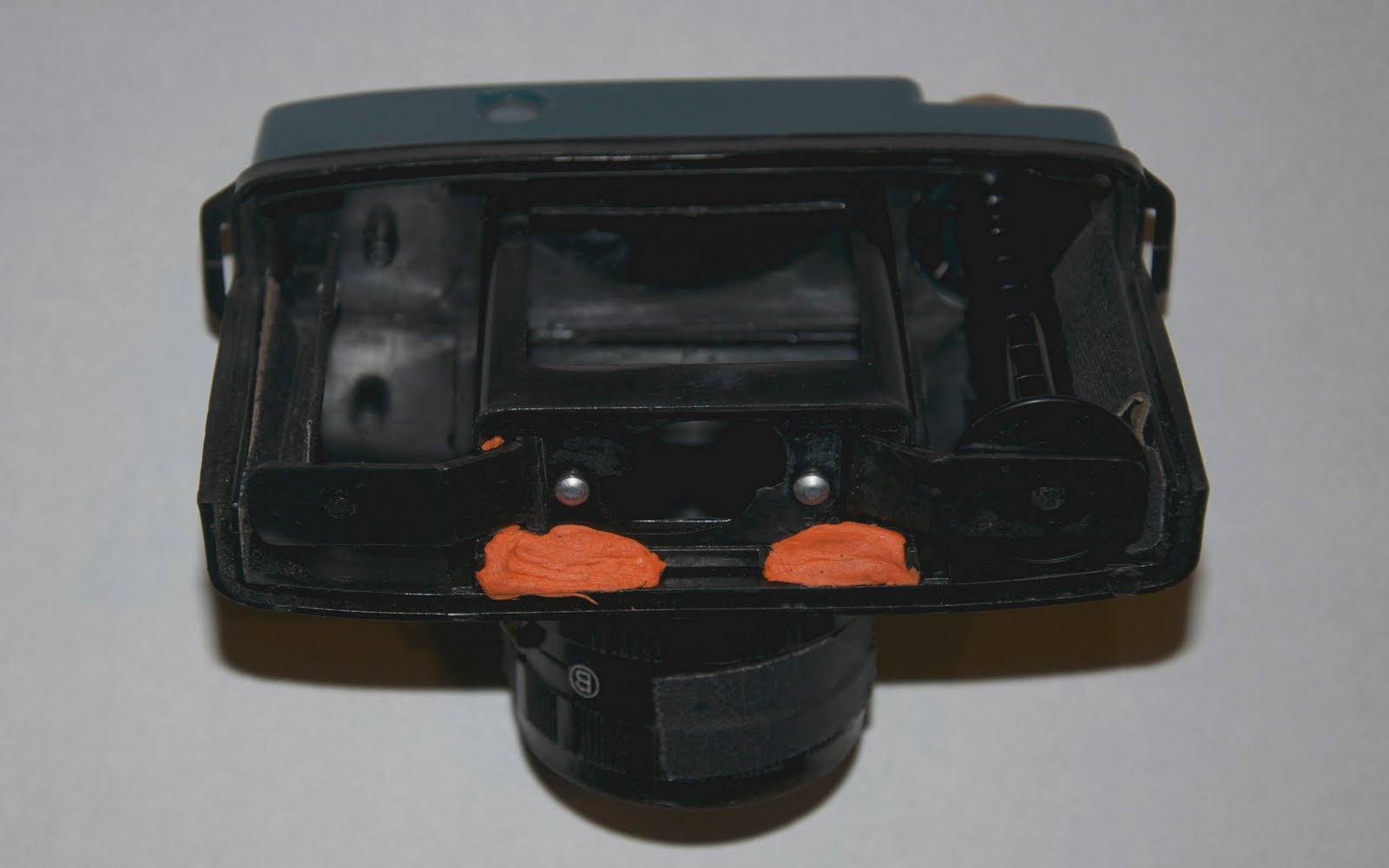
My most recent misadventure with the Acme involved faulty winding of the film. I could get the film to advance, but it didn't feel right. When I opened the camera, the film was wound loosely, and the piece that holds the take-up spool in place fell out. I had some stuff called Sugru in the shop. It's a putty-like substance that cures into a silicone material that is marketed for fixing things you might otherwise throw away. I used this to hold the broken piece in place and to reinforce the corresponding piece on the other side of the mechanism.


So now the Acme is ready to go again--till the next malfunction.

Links:

Adentures With Acme, Part 1

Adentures With Acme, Part 2

Adventures With Acme, Part 3

Adventures With Acme, Part 4

Thursday, October 01, 2009

Plastic Camera Skywatch

I've started developing B&W film at home. This image is from the first roll, exposed with my Acme W20 plastic camera, and developed with Diafine.

Wednesday, September 23, 2009

Adventures With Acme, Part 3

As threatened in previous posts "Adventures With Acme," Part 1 and Part 2, I am offering up some more of the pictures from the first roll of 120 film out of my Acme plastic camera.


Adventures with Acme, Part 2

Last week, I discussed my recent purchase of a cheesy toy camera on eBay.

Toy cameras have been popular with artists for several decades. The cheap plastic lenses, light leaks, and other imperfections of these cameras can result in interesting photographic effects, and the simple mechanics of the cameras prevent one from becoming caught up in technology. With a toy camera, you can concentrate on seeing your subject, and not endless fiddling with camera settings. One of the more popular brands has been the Holga, originally manufactured in Hong Kong beginning in 1982. They are now being manufactured in China and have been refined somewhat, but still have their quirks. Diana is another brand of toy camera that has been popular among artistic types. It was made in Hong Kong in the 1960s and 70s. The brand has been revived in the form of the the Diana F+, which is now being is being sold by a company called Lomography, which also markets Holga.

I noticed the Acme camera which I purchased on eBay for $14.66 bears a striking resemblance to the Diana, as you can see below.


At the wonderful web site Toycamera.com, I have learned that the Acme was made by the same Great Wall Plastic Company in Hong Kong where the original Dianas were produced. Great Wall turned out clones of the Diana under many brand names. For unknown reasons, several clones, including the Acme, had fake rangefinder light meters built into the camera bodies.

When the Acme arrived in its original cardboard box, a couple of problems became immediately apparent. The lens was just press fit onto the camera and could be easily pulled off. This was easy enough to fix with a little gaffer's tape. The shutter lever on the side of the lens barrel was intact, and the shutter worked. The switch on the other side of the lens for instant vs. button exposure also worked. Unfortunately, a third switch for selecting aperture was missing. The description on the box indicates "3 Apertures for Various Weather." Que sera sera--whatever the aperture will be will be.

More problematic was the fact that the knob to wind the film was cracked where it fit over its associated shaft. I made a couple attempts to fix it with super glue, which failed. I tried screwing the knob to the shaft, which resulted in the shaft cracking. The more I worked on it, the more the brittle plastic of the mechanism crumbled. Finally, I made a replacement shaft out of an oak dowel, with a little oak paddle on the end that would slip into the film spool. The oak paddle broke off after winding the film through a couple exposures, so the next repair used an ebony paddle on an oak shaft, which so far has worked.

I was careful to take the camera into a totally dark room to remove the film when I made these repairs, and store it in aluminum foil until I could put it back in the camera. Unfortunately, on one occasion, I neglected to move the locking lever on the back of the camera to the closed position after reinstalling the film, and the back of the camera fell off. I probably also suffered some light leaks when I removed the broken winding knob from its shaft with the film in the camera.

A few exposures survived all these events, and this is one of my favorites. It's a low spot in our neighborhood where mist was rising from the ground one morning. I can't explain the peculiar glow and all the other crazy artifacts on the image.

In postprocessing, I put a negative filter on the image, which I also like:

In future posts, I'll present some more conventional images, if you can apply that term to pictures taken with this type of camera.

Thursday, September 17, 2009

Adventures With Acme, Part 1

Readers with nothing better to do than to frequent this blog will be aware that recently I have eschewed digital photography in favor of film. Well, I really haven't given up on digital photography all together.I just wanted to use the word "eschewed." One thing is sure--I have become a regular customer at Gene's Camera Store, the only local place I know of that sells and processes 120 film.

My current arsenal of film cameras includes a Kodak Duaflex III twin lens reflex camera, and two toy cameras: a Holga 120CFN and an Acme W20. That's right--there really was a camera with the brand name Acme, made in Hong Kong. I picked it up on eBay. I read with amusement the description offered by the seller:
You are bidding on a Vintage Acme Camera with original box, model No. W20. Takes 16 color or black and white photos with Kodak 120 roll film. The camera looks like it's in great condition, never used, but I don't know if it works. The box is in good condition and shows some wear.
It was pretty obvious from the pictures accompanying the listing that the camera's condition was hardly "great...never used." Note, among other signs of wear and tear in the picture below, how the label around the lens is askew. There! I've done it! I used "eschew" and "askew" in the same post!


Despite the appearance of the camera, with an opening bid of $4.99, I couldn't resist. My winning bid, the solitary bid after some other adventuresome soul opened with the minimum $4.99, was $6.83, a dollar less than the shipping charges. So for a grand total of $14.66, I was the proud owner of a vintage plastic camera.

The brand name Acme conjures up images of Road Runner cartoons, and the outlandish devices that Wile E. Coyote ordered to capture the Road Runner.

The Acme Catalog by Charles Carney, published by Chronicle Books.

From the Wikipedia article, Wile E. Coyote and Road Runner, with italics added by me:
Wile E. Coyote often obtains complex and ludicrous devices from a mail-order company, the fictitious Acme Corporation, which he hopes will help him catch the Road Runner. The devices invariably fail in improbable and spectacular ways. Whether this is result of operator error or faulty merchandise is debatable. The coyote usually ends up burnt to a crisp, squashed flat, or at the bottom of a canyon (some shorts show him suffering a combination of these fates).
Thus, gentle readers, ends Part One of our cautionary tale. In Part Two, I will publish some photographs obtained before, during and after the Acme W20 failed in improbable and spectacular ways, along with descriptions of my improbable and far from spectacular repairs.