Showing posts with label History. Show all posts

Saturday, January 09, 2021

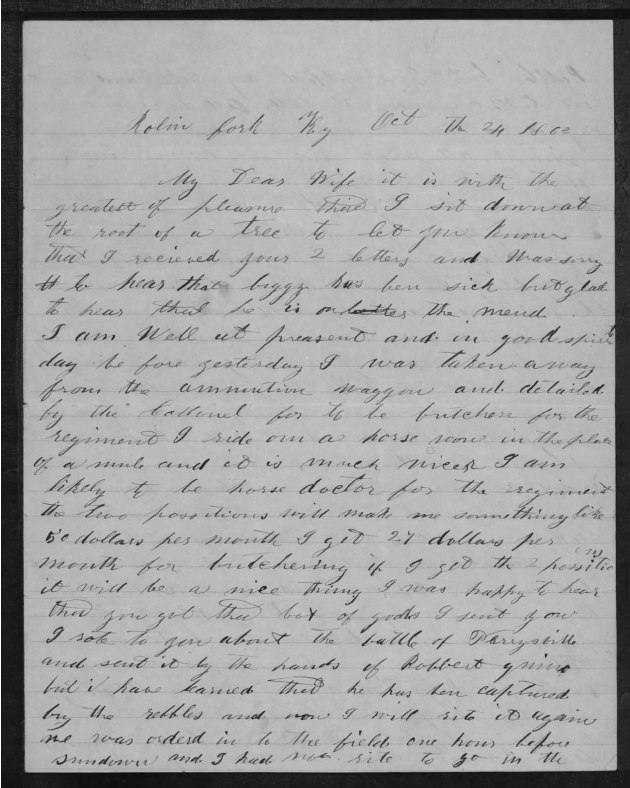
The Civil War Letters of Robert Z. Cory

The Civil War Pension file for Robert Z. Cory contains two letters which he wrote home to his wife Matilda. They are reproduced below. Background on the family, his army service, and transcriptions of both letters can be found at The Civil War Letters of Robert Z. Cory.

Sunday, September 08, 2019

The Great Book of John Cory


Yes, I am still alive. It's been a few years since I've posted here, but since I'm boycotting Facebook, Instagram, Twitter, etc., this is the one somewhat social medium open to me. I have just completed an ebooklet about the Great Book, a family heirloom handed down from the Puritan John Cory I of Southold, Long Island. It's publicly available, free of charge, on Google Drive. Enjoy.

Saturday, January 30, 2010

Monochrome Weekend: State Theater

State Theater
State Theater, South Bend, Indiana. Shot with a Holga 120N on bulb setting, secured to my pickup truck with a Gorillapod.

Built in 1921 as the Blackstone Theater, this classical revival theater has fallen on hard times. It stands on the same block in South Bend, Indiana where the Dillinger gang pulled their last bank robbery in 1934. Allegedly, the State Theater still bears the scars of bullets from the shootout between the bank robbers and the police. It was purchased in 2006 by a local Christian organization which intended to turn it into a cultural center. As of last summer, it was supposed to go on the auction block again, though I don't know what happened with that.

Wednesday, January 06, 2010

Winky Dink and Homeland Security

Winky Dink. Dell comic book, 1955.


Happy young viewer bathed in radiation from the television as she draws with her magic crayons on her magic screen, 1953. Photo by Walter Sanders. From the Life Magazine archives.

The author has on numerous occasions expounded upon the significance of the cartoon character Winky Dink. Like the star inexplicably attached to his head, Winky Dink's influence shone brightly over the cultural landscape of 1950s America, sparking the creativity of hordes of rapt young viewers, while boosting the bottom line at CBS by selling millions of magic Winky Dink drawing kits at 50 cents a pop. The kits consisted of a box of crayons, a sheet of plastic, and a cloth. The cloth served two purposes. First, rubbing the sheet of plastic (AKA the magic screen) with the cloth generated a charge which would then cause the sheet to stick to the TV screen, similar to the way rubbing a balloon on your hair builds up static electricity that allows you to stick the balloon to the wall. Second, the cloth served as an eraser to clear the magic screen. To the chagrin of many parents, the cloth didn't erase crayon marks from the glass of the TV if Winky Dink's little fans forgot to attach the plastic sheet before drawing.

As the show unfolded, pictures would be displayed for Winky's viewers to complete. Missing elements included such items as Uncle Slim's bowtie, or a bridge or a ladder which would allow Winky to escape a bear attack or some other peril.

Sometimes, the missing piece of the picture was presented as a connect-the-dots puzzle.

Judging from the news coverage of the recent attempt to blow up an airliner with explosive underwear, what this country needs is someone who can connect the dots. The pundits and reporters on the cable news shows have seized upon the phrase "connect the dots" to explain what it is the intelligence agencies failed to do with the various pieces of evidence they had about the Nigerian terrorist who tried to blow up the plane. I believe I have heard the phrase "connect the dots" roughly 347 times over the past week. It may be used as frequently as twice in a single sentence. Usually, these sentences begin with the reporter lookly earnestly into the camera and saying "Look." Starting a sentence with the word "look" indicates the speaker without a doubt is speaking the truth, and you shouldn't even consider the possibility that he may be talking through his hat.

Even President Obama is getting in on the act. After meeting with his security team yesterday, he stated, "The bottom line is this, the U.S. government had sufficient information to have uncovered this plot and potentially disrupt the Christmas Day attack, but our intelligence community failed to connect those dots." The only way he could have made it better would have been to start out by saying, "Look, at the end of the day..."

Obviously, President Obama must be able to count on his trusted adviors to "connect the dots." We need change we can believe in! Heads must roll! High-ranking government officials must express a sudden desire to spend more time with their families and resign! I am hereby proposing that Janet Napolitano step down as Secretary of Homeland Security. As her replacement, my fellow Americans, I give you someone whose safety, whose security, whose very existence has depended on "connecting the dots" for over a half-century. I give you the one, the only--WINKY DINK! (Cue music: "Happy Days Are Here Again")

Sunday, December 13, 2009

Stereopticon

I never had a Viewmaster as a child, but I spent many hours looking at 3D images through this stereopticon, which I believe belonged originally to my maternal grandparents.


I have many pictures to go with this device, and I've just started scanning them. Here's a sample:

Before Marriage

After Marriage

I've put a few more on Flickr, and hope to add more over time. From those pictures that are dated and from the topics of others, it appears they are “fin de siècle” (Fr. "end of the century" [see also the previous post "French for Americans"]), taken in the late 19th or early 20th century.

It would be cool if there were a way to see these in 3D on the computer screen.

Friday, November 06, 2009

Flushing Away Convention

"Fountain," readymade art by Marcel Duchamp, 1917. Photograph by Alfred Stieglitz.

I have developed a tendency to awaken early of late. When this happens, I may get up and read, or write, or watch the special features on a DVD. Sometime I'll have to tell you what happened to the Time Machine after the movie was completed in 1960. Other times I may just lie abed and ponder the Big Questions, such as why does the phrase, "early of late," used so cleverly in the opening sentence of this post, make sense, but the phrase "late of early" does not? Today, I awoke with visions of, not sugar plums, but a urinal dancing in my head. Yes, I have reached an age where the prostate gland looms ever larger on the horizon, much as Vladimir Putin "raises his head and comes into the air space of the United States of America," according to Sarah Palin (this memorable word salad occurs 59 seconds into the clip below of her interview with Katie Couric in 2008). But I was not thinking of a porcelain fixture because of a personal plumbing obstruction. I have not yet joined that jolly band of "guys" (as aging male baby booomers with problems below the belt are invariably called in TV commercials) who frequently must interrupt an ocean kayaking adventure with their buddies (other "guys") to look for a restroom onshore. It's interesting to me that the men in ads for prostate-shrinking drugs are a hale and hearty group, attending baseball games or bicycling across country, and not old coots in motorized chairs who have to take a break from the early bird special at Old Country Buffet to relieve themselves. No, they're all convivial, active "guys."


But enough of that. The reason I brought up the subject of urinals is I want to discuss the dada artist, Marcel Duchamp. As I have pointed out on numerous previous occasions, the blog Lugubrious Drollery is built on a rickety foundation of scant knowledge and an utter lack of expertise, particularly when it comes to the subject of art. This was perhaps best illustrated in the previous post, "The Avant-Garde Nature of Winky Dink," wherein I compared Monsieur Duchamp to a 1950s television cartoon character.

Tonsure. Marcel Duchamp with haircut by George de Zayas, Paris, 1919. Photo by Man Ray.

Winky Dink. Dell comic book, 1955.

My interest in Duchamp was reignited by a connection between one of his more notorious works and a piece of statuary on the courthouse square in Goshen, Indiana. Duchamp's piece is called simply "Fountain" and the Goshen piece is the "Neptune Fountain" or "Poseidon Fountain," and has been discussed here in two recent posts, "Monochrome Fountain," and "Neptune in the Heartland." One thing I found particularly fascinating is that both pieces came from the J.L. Mott Iron Works in New York City. This company produced statues as well as more utilitarian items like stoves, cast iron store fronts, and plumbing fixtures.

People with no more self-respect than to read this blog on a regular basis will appreciate that the author becomes easily fatigued when trying to compose fresh prose and frequently resorts to lifting text from other web sites. Let the current half-hearted effort be no exception! I quote from the article "Idol Thoughts," by Jerry Saltz, in the Feb. 21, 2006 Village Voice. I admire this article if for no other reason than the caption under a picture of Duchamp's urinal: Dada, where's the bathroom? Now there's a title worthy of a "Rocky and Bullwinkle" cartoon or an episode of "My Mother the Car."
In the winter of 1917, Duchamp—then 29, in America less than two years, teaching French, but still a sensation for the scandal his Nude Descending a Staircase, No. 2 caused at the Armory Show of 1913 (the year he created his first "readymade")—along with collector Walter Arensberg and artist Joseph Stella, bought a Bedfordshire model urinal from the J.L. Mott Iron Works at 118 Fifth Avenue. Duchamp took the fixture to his studio at 33 West 67th Street, laid it on its back, and signed it "R. Mutt 1917." The name is a play on its commercial origins and also on the famous comic strip of the time, Mutt and Jeff (making the urinal perhaps the first work of art based on a comic). In German, armut means poverty, although Duchamp said the R stood for Richard, French slang for "moneybags"...
Mr. Saltz goes on to explain how Duchamp submitted "Fountain" to an exhibit put on by the Society of Independent Artists. Everything submitted was supposed to be displayed, but the Independent Artists made an exception in Duchamp's case. Maybe he would have done better with the Society of Incontinent Artists. In any event, "Fountain" went missing after the exhibit. Duchamp eventually authorized eight replacements. Saltz reported in his article that on January 4, 2006, 77-year-old French performance artist Pierre Pinoncelli took a hammer to one of Duchamp's Fountains, valued at 3.4 million dollars, at a dada show at the Pompidous Center. This wasn't his first assault on Duchamp's work. In 1993, the iconoclastic Monsieur Pinoncelli urinated into "Fountain" and damaged it. Perhaps if he were on a drug to decrease the size of his prostate, he would be less irritable and instead of attacking pricy plumbing fixtures, could spend his time bicycling around the French countryside with other "guys," unimpeded by the need to stop at every pissoir along the way.

Duchamp set off a debate on the nature of art that continues to this day. Can found objects really be considered art? Is something art just because the artist says it is? Is Duchamp chortling up his sleeve in dada heaven to think that someone would consider paying 3.4 million dollars for something that he couldn't even get displayed at an art exhibit in 1917?

I'd like to stay and discuss this further, but I need to visit the restroom.

Wednesday, November 04, 2009

Neptune in the Heartland

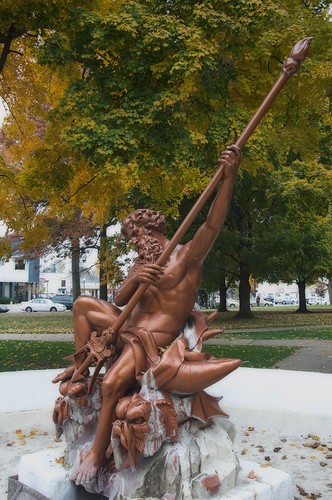
Earlier this week, I posted a monochrome photo of the Neptune Fountain on the courthouse square in Goshen, Indiana. Here is a color photo of the same fountain from a different angle.

Neptune Fountain, Goshen, Indiana

This landmark has been present for my entire life, though I believe the trident went missing or was broken for a while. I rode by this piece of art many times as a child, either on visits to relatives in Goshen, or on shopping trips, back in the days when department stores were located downtown. Later, as a teenager, I drove or rode past this fountain on innumerable nights, along with carloads of other hormonally oversaturated adolescents who were cruising the streets. This activity became so popular that eventually the town enacted an ordinance which specified the middle lanes of the major thoroughfares as emergency lanes at night, thus cutting down on the snarl of traffic and eventually eliminating the allure of cruising Goshen.

I had never thought about how such an impressive sculpture came to land in a small town in the Midwest until I dove into my usual intensive research (i.e., Googling) so I could include some information about the fountain with my first post. As luck would have it, a book was published earlier this year on the topic of zinc statuary, and in another stroke of luck, the book, sans pictures, is available online via Google books. I even went so far as to go to the Hesburgh Library at Notre Dame so I could actually pull the substantial 706 page book off the shelf and see the pictures. The book is Zinc Sculpture is America: 1850-1950, by Carol A. Grissom.

From the book, I learned that the Goshen Neptune Fountain is not unique. It is based on a work by French sculptor Gabriel Vital-Dubray (1813-1892). Many copies were produced and placed in public spaces in Europe, South America, and the U.S. In Germany, Kahle and Son cast the statue in zinc. One of these was erected at the city Neustadt an der Weinstrasse in 1882. In France, Neptune was cast in iron by the Val d'Osne company. On October 28, 2008, Christie's auction sold the cast iron example below for $110,500.

Neptune Statue, from a private collection. The edge of the conch-shell is signed and dated V. DUBRAY/1856, and the base is stamped VAL D'OSNE.

In America, two companies in New York City sold similar Neptune statues, cast in zinc. The Goshen Neptune was sold by the J.L. Mott Iron Works. It seems to be cast from the same model as the Val d'Osne statues. Four Neptunes from J.L. Mott were also installed as part of an elaborate fountain at Bedford and Division Avenues in Brooklyn. Unfortunately, that fountain was dismantled in 1950.

At least one other zinc Neptune survives in the U.S., sold by the J.W. Fiske company. Originally installed at the old sailors' home at Sailors' Snug Harbor, Staten Island, the statue deteriorated and was replaced with a cast iron replica. The original is now on display in the basement of the Visual Arts/Neuhouse Gallery on the grounds of what is now the Snug Harbor Cultural Center. The Fiske version differs from the Mott version in a few details, such as the appearance of the dolphins at the base, and must have come from a different model. Below are pictures of the origin Snug Harbor Neptune, and its replacement.

Original Neptune Fountain, Snug Harbor, Staten Island
Photo used under Creative Commons License. See original by wallyg at:
http://www.flickr.com/photos/wallyg/
For terms of CC License, click here: CC BY-NC-ND 2.0

Neptune Fountain Replica, Snug Harbor, Staten Island
Photo used under Creative Commons License. See original by apollonia666 at:
http://www.flickr.com/photos/apollonia666/.
For terms of CC License, click here: CC BY-NC-SA 2.0

Well, so how did old Neptune wind up in Goshen? In 1901, an enterprising individual named James Polezoes immigrated to the U.S. from Greece. He wound up in Goshen in 1910, where he opened a confectionery across the street from the county courthouse, selling candy and ice cream. He must have done quite well in that business, and in 1912, he purchased the Neptune Fountain as a gift to his adopted city for helping him achieve the American dream. Another Greek immigrant, Nicholas Paflas arrived in Goshen in 1912, and worked for Polezoes, making hand-dipped chocolates and running the soda fountain. In 1920, Paflas bought the confectionary and named it the Olympia Candy Kitchen. It's still in operation in the original location, run by Paflas family members, but that's another story.

Tuesday, October 27, 2009

The Great Train Ride of 1961

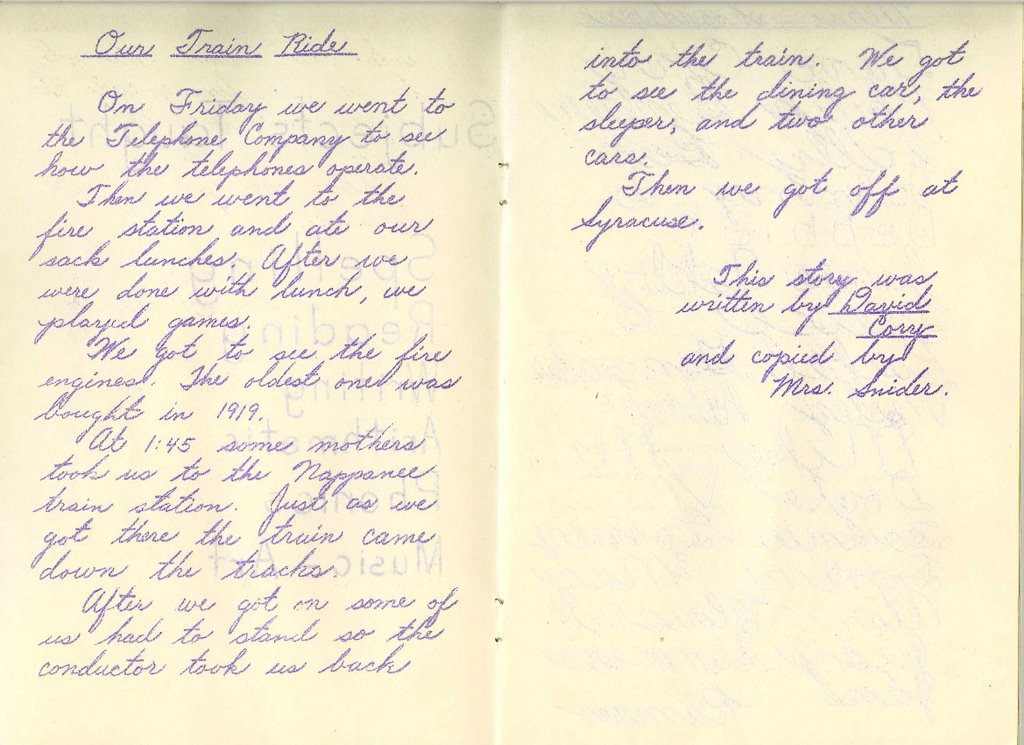
As I explained back in 2006, in a post titled "Another San Francisco Dead Author," one of my earliest writing efforts still extant is the following account of a second-grade field trip. It could have occurred as early as the fall of 1960, but I think it more likely happened in the spring when teachers wanted to get out of the classroom at least as much as their young charges. If you want to know the tenuous connection between this trip and a dead author in San Francisco, you'll have to follow the link to the 2006 post. It's not worth repeating here.

Click to enlarge.

Today, I had a day off, and spent a few hours driving around the area looking for photo ops. I didn't really think about it till I was driving home, but I had taken pictures of the two train stations I visited almost a half century ago. The Nappanee station has been maintained over the years, but the Syracuse station, now owned by CSX, has fallen into disrepair. There is a movement afoot to save the station, move it, and renovate it. I hope it happens.

Nappanee Station
Nappanee Station, 2009

Syracuse Station
Syracuse Station and Passing CSX Freight Train, 2009

Syracuse Station
Syracuse Station, 2009

Thursday, October 15, 2009

Skywatch Friday Season 4, Episode 14

Armco Ferro

This shot was taken at the Indiana Dunes National Lakeshore. The house in the foreground is the Armco Ferro House built for display at the 1933 Chicago World's Fair. It, along with four other houses built for the fair, was moved across Lake Michigan by barge in 1935. It is built of steel and is being renovated.

For more pictures of this and other Century of Progress Houses, click this link.

Wednesday, October 07, 2009

Photo Multigraphs

Charles Dana Lewis, Photo by Bostwick, NY. From the Images of the History of Medicine Collection, National Library of Medicine

In the late nineteenth century, a photographic technique emerged, enjoyed limited popularity, and then sank into obscurity. Via the internet, I have been able to learn about this technique, which I find fascinating. The photos are called fivefold portraits or photo multigraphs. Thanks to the web site Uneinsamkeite/Unsolitudes, authored by Herr Heinz-Werner Lawo, many of these mesmerizing photos are now online. The photos were typically made into postcards.

How was it done? With mirrors. The subject was seated in front of two mirrors which intersected at an angle of 65-75 degrees, which resulted in four refections of the subject. The photographer stood behind the subject to capture the image. Usually, the subject faced away from the photographer and toward the mirrors, although he may have been seated in profile or facing the camera. A popular motif was to have the subject seated at a table, appearing to play cards with four clones of himself.

I had to give this a try, so I went out a bought a couple mirrors and set them up to obtain this photo of The Intrepid Explorer, which you may recognize from an earlier post, "Shadow Shot Sunday, #71."

Intrepid Explorer, Photo Multigraph by David Cory, 2009

Rather than launch into a detailed description of the history and technique of photo multigraphs, I will refer the interested reader to an excellent article, "A Multigraph from Montreal," by Irwin Reichstein.

Monday, September 14, 2009

Monochrome Maniacs: Niles Daily Sun

Building formerly housing the Niles (Michigan) Daily Sun newspaper, published from 1890 till it merged with the Niles Daily Star in 1919.

This photo was obtained with a Holga 120CFN camera. The camera comes with a plastic mask which serves two purposes--producing a 6X6 cm image with (relatively) sharp borders, and holding the AA batteries for the flash in place. I was experimenting with leaving the mask out and taping the batteries in place. I learned a third function of the mask is protecting the film from reflections off the batteries and their metal contacts in the camera. Neglecting to cover the bright shiny battery contacts with tape resulted in the extreme exposures at the corners of the image. This seems appropriate for a picture of the Daily Sun.

Tuesday, August 25, 2009

Winky Dink Dragged Through the Mud!

The good name of one of my TV cartoon heroes of the 1950s is tarnished forever! The alleged mistress of convicted Ponzi schemer Bernie Madoff has written a book, hoping to recoup some of the dough which her boyfriend bilked her out of. The illustrious New York Daily News reports that Sheryl Weinstein said of Madoff,
He was a "good kisser,"...who gave her a "welcoming smile (she'd)never forget" the moment they met. She even came up with a code name for him - "Mr. Winky Dink" - based on his nervous blinking.
Oh, pity poor Winky Dink, who never wanted anything but for young children to absorb emissions from primitive cathode ray tubes as they sat frighteningly close to their televisions and drew on their magic screens with their magic crayons. We should draw him a magic grave so he can roll over in it as he receives this news.

Thursday, July 09, 2009

First Michael Jackson, and Now...

Still reeling from the shock of Michael Jackson's death, Lugubrious Drollery has just received the following sad news:
MADISON, Wis. (AP) -- Oscar G. Mayer, retired chairman of the Wisconsin-based meat processing company that bears his name, has died at the age of 95.

Mayer's wife, Geraldine, said he died of old age Monday age at Hospice Care in Fitchburg.

He was the third Oscar Mayer in the family that founded Oscar Mayer Foods, which was once the largest private employer in Madison. His grandfather, Oscar F. Mayer, died in 1955 and his father, Oscar G. Mayer Sr., died in 1965.

Mayer retired as chairman of the board in 1977 at age 62 soon after the company recorded its first $1 billion year. The company was later sold to General Foods and is now a business unit of Kraft.

Mayer's first wife, Rosalie, died in 1998. He married Geraldine Fitzpatrick in 1999.
Even more disturbing is the fact that one of the current fleet of Wienermobiles passed through my hometown recently and I missed it.

Mr. Mayer requested that there be no Wienermobile in his funeral procession. More's the pity.

Monday, June 29, 2009

Winky Dink and Me

My mother, God rest her soul, seldom threw away any of my stuff. As a consequence, I still have two of the three essential components of my Winky Dink kit--the magic window and the magic crayons--well, at least three of the four magic crayons. Somewhere along the line, the black one was lost. I've still got the yellow, green, and red ones in what's left of the original box.


The second component of kit, the magic window, was a sheet of thick green-tinted plastic attached to the television screen through the magic of static electricity, generated by rubbing the plastic sheet with the magic erasing cloth, which was the third essential element of the kit. My erasing cloth has been lost, and the magic window has acquired an oily film during its decades of storage. I'm not sure if this is due to toxic organic compounds leaching from the plastic or some primitive slime mold taking up residence on the screen. In any case, I don't think even vigorous rubbing with a magic erasing cloth--should one be located--could produce the requisite charge. For the carefully staged re-enactment below, I taped the magic screen to the bezel of my computer monitor.


Note that I am simulating drawing a red flower on the lapel of Winky Dink's Uncle Slim, whose image appears on the monitor. I would have drawn it for real, but then there's that issue of the missing erasing cloth. Plus, I don't think a modern LCD screen could withstand the same pressure which could be applied to the sturdy cathode ray tube of a vintage television.

For those who might not know, Winky Dink and You was a children's TV show that ran on CBS Saturday mornings in the mid-50s. The show was hosted by Jack Barry, who went on to a long career as a game-show host. Winky Dink was a little cartoon character with a star for a hat. The big attraction of the show was that pictures, such as Uncle Slim's picture above, would be left onscreen for a period of time so young Winky Dink fans could fill in details with their magic Winky Dink kits. This concept was brilliant on several levels. Since there wasn't a lot of action, production costs were low, and parents had to shell out the dough to buy little urchins like me a Winky Dink kit.

A full episode of the show is available at Archive.org. Here's a link to the video. Fair warning: It's about 28 minutes long. You only need to watch the first few minutes to get a feel for the show, including a live demonstation by an actual child applying the magic screen to a TV.

As I watched the show, I thought I recognized the voice of Winky Dink. Turns out it's the voice of Mae Questel, shown below in a picture from an earlier era.


In the 1930s, Mae was the voice of the cartoon vamp Betty Boop. Later she provided the voice for the cartoon characters Olive Oyl, Little Audrey, and Little Lulu. She appeared in commercials over the years, notably as Aunt Bluebell in Scott Towel ads. I think the main reason I recognized her voice was because I hear it every holiday season when I watch National Lampoon's Christmas Vacation, where Mae plays Aunt Bethany, who wrapped her cat up as a Christmas present and recites the Pledge of Allegiance when asked to say grace at the Christmas Eve Dinner.

Bill Gates allegedly called Winky Dink the first interactive television show. It doesn't seem that we've made a lot of progress in that department, based on what's available on TV today.

Wednesday, June 24, 2009

New Blog: Getting Pierced


It is time for a second spinoff from Lugubrious Drollery. In order to make the posts about Franklin Pierce which have appeared in this blog more accessible, I have moved them to a new blog, Getting Pierced. Stop by if you have a chance.

Tuesday, June 09, 2009

The Worst TV Show Ever?

Model car kit like the one assembled by the author, ca. 1966

Regular readers of Lugubrious Drollery, if such a class of human beings exists, will be aware that the author has what some might call a disturbing fascination with the contempible. Previous posts have investigated the most boring book of all time, the closely related topic of the weirdest book title, the most hideously decorated cakes, the worst vice-presidential candidate (Sarah Palin), the lowliest weed (burdock), the most maligned mineral (asbestos), and of course, the worst U.S. Presidents, especially that perpetual object of scorn and rebuke, Franklin Pierce.

Recent interactions with fellow bloggers have started me thinking about a television show that has been ranked by TV Guide as one of the worst TV shows ever produced, ranking just above The Jerry Springer Show, which was designated as the worst. Considering the vast collection of dreck broadcast over the airwaves over the last sixty years or so, that's quite a distinction. The show singled out for this dubious honor was My Mother the Car. Thirty episodes were aired in 1965 and 1966, and then it was all over. I don't believe the show was ever brought back in syndication, although a few episodes are now available for viewing on YouTube.

What initially reminded me of MMTC was a post about the fantasy TV shows of the 60s, including The Flying Nun, at the blog of W.Z. Snyder, #167 Dad. He mentioned the premise of MMTC--a guy's mother is reincarnated as a 1928 Porter automobile--which reminded me that one of the many model cars I assembled as a nerdy adolescent was My Mother the Car (shown above). After that, I couldn't get this fragment of the theme song from MMTC out of my head:
A 1928 Porter
That's my mother dear
She helps me through
Everything I do
And I'm so glad she's here
As if that weren't bad enough, Matthew Coniam, at his blog The Marx Brothers Council of Britain, stirred up more memories when his post about director Norman Z. McLeod included a poster for the movie Swing Shift Maisie (1943). The poster features the young and beautiful star Ann Sothern, who went on to have her own TV show, and still later was the voice of none other than My Mother the Car.

Now that MMTC has been forced back into my consciousness, I have done some research and found out the following about the show:
Jerry VanDyke, brother of Dick VanDyke, turned down the part of Gilligan in Gilligan's Island to play Dave Crabtree, the lead in MMTC.

Two cars were used to film the series. Neither was a real Porter. They were assembled from parts of other old cars plus some custom made parts by George Barris, who also created the Batmobile for the Batman TV series, the Munster Koach, and many other cars for TV and the movies. The power train consisted of a 283 cu. in. Chevy V8 and a Powerglide automatic transmission. One of the "Porters" was a stunt car with the floorboards removed and equipped with mirrors so the driver could be out of sight in scenes where Mother was supposed to be traveling around on her own.
Was MMTC really any worse than shows about a witch in the suburbs, a Martian masquerading as an earthling's uncle, hillbillies living in a mansion, etc., etc.? In my opinion, it's a close race.

One thing MMTC had going for it was the fact it was created by Allan Burns and Chris Hayward, who also created The Rocky and Bullwinkle Show, which usually had great titles for its episodes. Some of this same brilliance shines through in the titles of the MMTC episodes. The complete list follows:
"Come Honk Your Horn"
"The De-Fenders"
"What Makes Auntie Freeze"
"Lassie, I Mean Mother, Come Home"
"Burned at the Steak"
"I'm Through Being a Nice Guy"
"Lights, Camera, Mother"
"The Captain Manzini Grand Prix"
"TV or Not TV"
"My Son, the Ventriloquist"
"My Son, the Judge"
"And Leave the Drive-In to Us"
"For Whom the Horn Honks"
"Hey Lady, Your Slip Isn't Showing"
"Many Happy No-Returns"
"Shine On, Shine On, Honeymoon"
"I Remember Mama, Why Can't You Remember Me?"
"Goldporter"
"The Incredible Shrinking Car"
"I'd Rather Do it Myself, Mother"
"You Can't Get There From Here"
"A Riddler on the Roof"
"My Son, the Criminal"
"An Unreasonable Facsimile"
"Over the Hill to the Junkyard"
"It Might as Well Be Spring as Not"
"Absorba the Greek"
"The Blabbermouth"
"When You Wish Upon a Car"
"Desperate Minutes"
I've watched part of the first episode, "Come Honk Your Horn" (a takeoff on "Come Blow Your Horn," Neil Simon's first play, later a movie starring Frank Sinatra), on YouTube, and I'd have to say the title is the best part of the show.
Monday, June 01, 2009

Another Pierce Biographer

Brian Matthew Jordan

In response to my post of December 28, 2008, Who Is Shannon Berry and How Does She Know So Much About Franklin Pierce?, fellow Franklin Pierce enthusiast David Holzel made the observation, "Someday, everyone will have written a biography of Franklin Pierce." It seems we are one step closer to fulfilling David's chilling prophecy. Today, I discovered a Pierce biography hitherto unknown to me, and doubtless unknown to most of America. The author, Brian Matthew Jordan, wrote his book, Triumphant Mourner: The Tragic Dimension of Franklin Pierce while in high school. I have learned via the internet that he is in the class of '09 at Gettysburg College, majoring in Civil War era studies, and is now off to Yale for graduate work.

In the preface of his book, the precocious Mr. Jordan stated,
Ask Americans today the question "Who was Franklin Pierce?" and they are most likely to respond to your question with a puzzled expression or a shrug. If any president in our history, in particular, has suffered from oblivion in American memory, it is Franklin Pierce. . . Franklin Pierce was our most obscure president.
As Scrooge said in Dickens' A Christmas Carol, "An intelligent boy! A remarkable boy!"

Back to the Salt Mines

Salt Miners, Winsford, England

Quick! Without resorting to Google, can you name the capital of Missouri? Hint: it's not Missouriopolis. But, according to fellow blogger Elektra Tig, Missouriopolis was under consideration as the name of the capital of Missouri around 1821. My home state is unique in being the only state to incorporate its name into the name of its capital--Indianapolis, which lies at the center of the state. Residents of Iowa Center, a town laid out at the center of that state in 1855, had high hopes that their town would be the capital of Iowa. Unfortunately for them, Iowa Center lost out to another city (bonus question: what is the capital of Iowa?), so Indiana remains the only state having the distinction of a capital which both incorporates the name of the state and which lies at the center of the state.

And then there's a town built in the middle of Kansas. It includes only the first three letters of the state's name, but Kanopolis rolls off the tongue more easily than Kansasopolis. The town was built on the site of Fort Harker, an Army base important in the Indian Wars from 1867 till it was abandoned in 1872. After the fort was closed, the land and buildings were acquired by private individuals with the intent of building a city that would become the state capital. Kanopolis was established in 1887, and was laid out to accommodate up to 150,000 residents. The developers had visions of Kanopolis being not just the state capital. Since it also lies in the middle of the country, they thought it should be the capital of the U.S. as well. Alas, neither dream came to fruition. Kanopolis didn't even become the county seat. This honor fell to nearby Ellsworth, which would seem to have had an unfair edge in Ellsworth County.

Like many small towns, Kanopolis was once more prosperous than it is today. The U.S. Census of 2000 counted only 543 residents. Businesses which once thrived have left town, although one industry, salt mining, still has a presence in Kanopolis. The town has the good fortune to sit on a large vein of salt, which brings me (finally) to the topic of this post.

I seldom eat in the doctors' dining room when I work at the hospital these days. I prefer to carry my lunch and eat in the relative peace and quiet and absence of political rhetoric in the radiology department. When I did eat lunch upstairs, I often found myself leaving the room by saying it was time to get back to the salt mines. I never stopped to consider the origin of this phrase until I started researching the salt mining industry in connection with my new-found interest in Kanopolis. In A Dictionary of Catch Phrases from the Sixteenth Century to the Present Day, by Eric Partridge (edited by Paul Beale), the author states that the phrase comes "from the Western idea--not far from wrong at that!--that, in both imperial and in communist Russia, political prioners were sent to do hard labour in the salt mines of Siberia." He also writes, "Col. (Albert F.) Moe thinks back to the mines! is the earliest form and attributes it to a play of the 1890s, Siberia, with its dramatic poster of a party of Russians proceeding to Siberia 'under the lashes of the Cossacks.'"

So there you have it. I tried to find a picture of some hapless Kansans toiling in the salt mines, but the closest I could come was the photo of English salt miners at the beginning of this post. They don't look all that miserable, but then I suppose things were a lot worse in Siberia when the only tools available were picks and shovels. Let's face it--almost anything would be worse in Siberia, regardless of the tools available.

Link:
Kanopolis History by Jesse Manning

Tuesday, May 19, 2009

American Presidents Blog

I have just discovered another blog devoting significant space to none other than our 14th President, Franklin Pierce--the American Presidents Blog. The article about the false story of Pierce becoming a baker back in New Hampshire after his single term in the White House is especially interesting.

Thursday, April 23, 2009

RIP Dick Kemp

I'm a little late in eulogizing Dick Kemp, who died Sept. 7, 2007. I never met the man, and in fact had never heard of him until I started to research the history of a political rally for presidential candidate Franklin Pierce in 1852. I mean the rally was held in 1852, not that I started researching in 1852. Why, I wasn't even born until several years later.

Mr. Kemp began collecting trucks in the early 1950s. He bought a 1930 Mack Bulldog for $50. He continued for decades to buy old trucks, restore them to working order, and make them look presentable, without trying to hammer out all the dents. In the 1970s, he began to display them on his property in Hillsborough, New Hampshire, and thus was born Kemp's Truck Museum. When he died at age 76, his collection included over a hundred vehicles. He didn't charge admission, didn't attempt flawless museum-quality restorations, and encouraged visitors to touch and sit in his vehicles.

I learned of Kemp's Truck Museum because it is located on the Contoocook River next to the old stone oven built to cook an ox for the Great Pierce Barbecue of 1852. See link at the end of this post for further details of that event and my efforts to locate the oven with the help of Hillsboro resident, Steve Davidson.


Old Oven with Kemp Vehicles in the Background
Photo by Steve Davidson

Dick Kemp was interviewed for a special Thanksgiving edition of CNN Newsnight with Aaron Brown which aired November 25, 2004. He concluded the interview by saying,
But everybody asks me, you know, What's going to happen to this collection when you go? I don't know. That's somebody else's problem.
Now we know what will happen. Most of the collection will be auctioned off this year. Some of the proceeds will go toward the care and support of Kemp’s 101-year-old mother, but most will provide financial aid for students at nearby Hillsborough-Deering High School to attend vocational and trade schools on full scholarships.

As a further tribute, the City of Hillsborough will keep two trucks on the property, which will be called Kemp Park. A side benefit may be that the old Pierce stone oven may receive more attention than it has in recent years.

Links:

The Great Pierce Barbecue of 1852

"Tears for a bulldog: Kemp’s Truck Museum faces an uncertain future after the passing of its owner" by Chuck Miller