I just bought a book entitled Robots of Westinghouse, 1924-Today
by Scott Schaut, the curator of the Mansfield Memorial Museum. It started me thinking again about good old Elektro. I submitted the piece below to a few magazines. The editor of a small publication in Ohio called Bend of the River
showed interest, but wanted revision, so I reworked the whole thing with more facts and less personal observation, and he accepted that. Since it doesn't look like anyone is going to accept the original article, I'm posting it here.

My wife and I are not in church on Palm Sunday, a day of paradox, when the Son of God, born of a virgin, rode into Jerusalem on a donkey, where he was greeted by cheering crowds, where he would be betrayed by a friend, where he would be scourged and crucified. Palm Sunday is tainted by the tragedy of tornadoes that tore through northern Indiana in 1965, not far from my boyhood home, cutting a swath of death and destruction, but on Palm Sunday, 2006, the world is full of the promise of spring. The skies are clear, trees are in bud, and daffodils are blooming. We are driving through Ohio Amish country, on our way to see not God incarnate, but a robot resurrected, or at least reassembled.
Paul Simon wrote of his pilgrimage to Memphis, “for reasons I cannot explain, some part of me wants to see Graceland.” For equally obscure reasons, we are rolling through the heartland to see Elektro, the Moto Man. Maybe it’s due in part to robots I knew as a child—a little windup toy, Robbie the Robot on TV, and Gort, from the movie “The Day the Earth Stood Still.” My need to see Elektro has something to do with the 1939 New York World’s Fair, where Elektro was a star attraction at the Westinghouse Pavilion. He was joined by the robot dog Sparko for the second season in 1940, when a girl of eighteen and a boy of twenty-one, who would later become my parents, drove from Indiana to New York to see the fair on their honeymoon. I don’t know if they visited the Westinghouse Pavilion, but I’d like to think they did. They’re dead now, and the fair is just one of many things I never asked them about when I had a chance. We can’t see my parents on this Palm Sunday, but we will see Elektro.
As we drive through the countryside on our way to Mansfield, Ohio, where Elektro was built at the Westinghouse factory, we pass an Amish farm, where Sunday service has just ended and families are walking or riding in buggies to their own farms. The Amish farms, with their neat white houses and barns, stand in stark contrast to the unkempt homesteads of some the English, as the Amish call their non-Amish neighbors. We pass houses with porches littered with plastic toys, old appliances, and other detritus of the modern America from which the Amish have set themselves apart. We pass junk cars and boats under blue plastic tarps. We see a four-wheel all-terrain vehicle parked in a neglected barn that is slowly collapsing and offers no overhead protection.
As we enter Mansfield, signs of rust belt decay alternate with signs of hope. A huge factory which looks abandoned sits on the far side of the railroad tracks which once brought raw materials in and finished products out of Mansfield. Murals are painted on some of the old brick buildings downtown. One, labeled “Johnny Appleseed Country,” depicts John Chapman, who lived here and grew apples between 1810 and 1830. Well known for planting apple trees on the frontier, Chapman is also honored by a plaque in downtown Mansfield for running the twenty-six miles from Mansfield to Mt. Vernon for help when the local settlers feared an Indian attack during the War of 1812. Unlike Pheidippides, who dropped dead after running from Marathon to Athens to announce the victory of the Athenians over the Persians in 490 B.C., Chapman survived.
A mural on another building shows a locomotive built by Westinghouse. The power of the image is diminished by a “Building For Sale” sign pasted over a corner of the mural. Down the street a carousel sits in a well-maintained building with glass doors closed on Palm Sunday morning. In what looks like a successful attempt to save downtown after Westinghouse pulled out in 1990, the City Council of Mansfield not only had an old-fashioned carousel built, but convinced the company that built the ride to move from Connecticut to Mansfield, Ohio. Subsequently, the city convinced another carousel company to relocate from Idaho. Now Mansfield has the distinction of being home to the only two companies carving and restoring wooden carousel horses in America.
We turn the corner onto Park Avenue West, formerly known as the Miracle Mile of retail in Mansfield, and park in front of a tattoo parlor, once a manifestation of urban decline, but in an era when body modification is more socially acceptable, perhaps now a symbol of urban renaissance. Mary and I walk down the street and climb the substantial stone steps of the Soldiers and Sailors Memorial Building and swing open one of the old oak and glass front doors. Stepping into the foyer, we wonder if we’ve come to the wrong place, despite the fact that the sandwich board on the sidewalk out front advertises the Westinghouse robot exhibit. People, including two young men in uniform, are standing in the foyer or sitting at a sturdy oak table in the next room, which once served as the reading room for Mansfield’s library. On a table in the foyer sits a partially eaten sheet cake with white frosting and an inscription in icing that we can’t read from where we stand. Taking the path of least resistance, I suggest we go upstairs. We ascend the wide staircase illuminated by stained glass windows. On the second floor, we find display cases filled with mammals and fish of all kinds, stuffed and put on display over a century ago. Among the obligatory exhibits of weapons of war, I pause before the case of rifles made at the Harper’s Ferry armory. My ancestor, George Zollinger, had been a gunsmith there during the war of 1812, and I hope against astronomical odds that I might see his name on one of the guns hanging in the display case. There is no indication of the maker on any of the guns, and we move on.
As Mary correctly predicted, we found no robots on the second floor, so we descended the stairs back to the foyer. We proceed to two rooms that once served as Mansfield’s library. Here we find the robot exhibit. We are greeted by the museum director, who is wearing a sweatshirt imprinted with a picture of the object of our quest, Elektro the Moto Man. As the crowd begins to thin out, we ask if we are intruding on a private function, and he assures us that we are not. The local citizens have gathered to honor a Mansfield boy who died in Iraq. Military history continues to unfold. The building in which we stand was erected as a memorial to boys killed in the Civil War. Weapons and uniforms from other wars are displayed upstairs, and future generations will create similar displays to commemorate boys and girls who went to war and never came back, or came back disabled. The Disabled American Veterans have an office in the basement of the museum where we stand. I wonder if they still sell poppies made of red crepe paper as they did every Memorial Day of my childhood.
The displays in the first room recount the origins of the Westinghouse robots, beginning in 1921, when Czech writer Karel Capek introduced the word robot in his play “RUR (Rossum’s Universal Robots).” In 1927, a Westinghouse employee attached a two-dimensional human cutout, like a larger-than life paper doll, to the front of a piece of equipment called the Televox, manufactured by Westinghouse. Named Herbert Televox, the robot could pick up a telephone, and then turn appliances on and off via tones transmitted via the phone. The story of robot genesis continues, without knowing and begetting in the biblical sense, through Katrina Televox, Rastus Televox (an African American robot with a body of Goodyear rubber that didn’t stand up well to the heat produced by his electric circuits), and Willie Vocalite.
But the real object of our pilgrimage stands, cordoned off by chains, in the next room. Elektro looks different than he did when he left the Westinghouse plant for New York in 1939. Then he was a seven and a half foot tall humanoid with an aluminum body painted gold, almond eyes, and a round hole in his chest where lights glowed when he received a command from his operator through a telephone handset. Now he is painted gray, his eyes are enlarged and have pupils, and the opening in his chest is square. These modifications were made before Elektro appeared in that classic of the silver screen, “Sex Kittens Go To College,” released in 1960 and featuring Elektro as Sam Thinko, the campus computer.
Elektro is inanimate now, but in 1939, he walked, he talked, and he smoked, thanks to an air compressor inside him. Two cords were attached to his foot, one for power, and one for carrying sound from a 78 RPM record player backstage. When his operator gave a command with the proper sequence of words and pauses, Elektro would walk, talk, smoke, or count on his fingers. Part of the exhibit includes information about the three Elektro operators still living. One is a 94-year-old woman. The museum director staged a reunion between the two at the museum, and he told us that the woman nearly fainted when her brain was flooded with memories on seeing Elektro again.
We see and hear Elektro’s history. After the fair, he went back to the Westinghouse plant in Mansfield. During World War II, when he was at risk for being scrapped, an employee who had worked on his creation took him home and stored him in his basement, where his son played with Elektro. After the war, Elektro traveled the country in a van, promoting Westinghouse products. During that period, a collision with another vehicle resulted in enough damage that his aluminum torso had to be replaced. His original gold color was covered with copper paint. In the 50’s, he went on display at Pacific Ocean Park in California and was painted silver. From there, he endured the ignominy of being in the cast of “Sex Kittens Go To College.” Surprisingly, a number of performers who appeared in that film, including Mamie Van Doren, Tuesday Weld, Louie Nye, Martin Milner, and Conway Twitty, went on to reasonably successful careers. After the movie, Elektro was disassembled, and his head was given to a retiring Westinghouse employee. I’ll bet he went to his decapitation willingly after appearing in the movie. Years later, the little boy who had played with Elektro in his father’s basement, now all grown up, reunited his head and body and loaned him to the Mansfield Memorial Museum for display.
And so now I stand with my long-suffering spouse, posing for pictures with a symbol of a time gone by—a time of innocence, when the world stood on the brink of war, when a mechanical man with forty-eight electrical relays for a brain promised a brighter future, and when two kids from Indiana with their lives before them came to the big city.


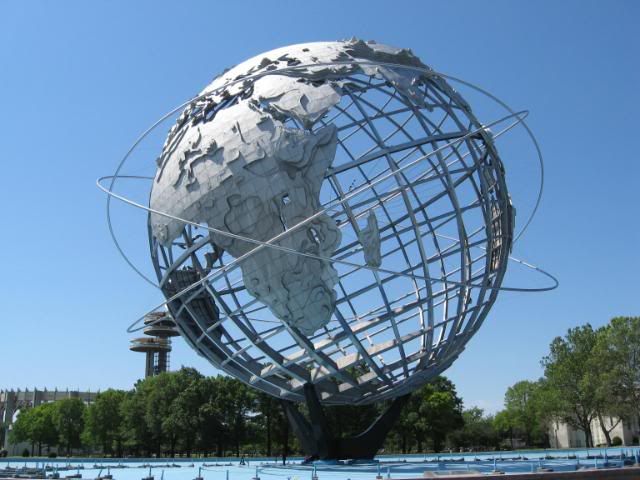
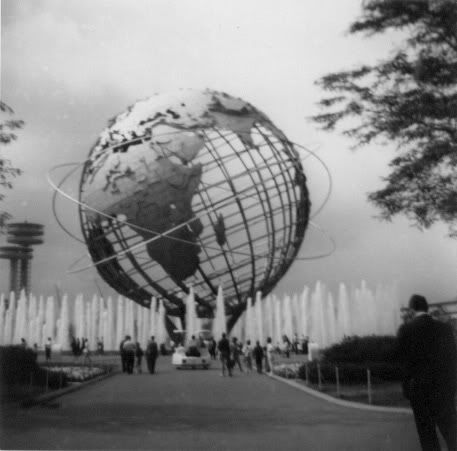 On our current vacation, Mary and I took the long ride on the 7 train from Manhattan to Flushing Meadows Corona Park. The former ash dump which was spruced up for the 1939 World's Fair and again for the 1964 World's Fair is a nice park today, and home to the U.S. Tennis Center. The Unisphere, erected for the '64 Fair, is still there, but the fountains are dry.
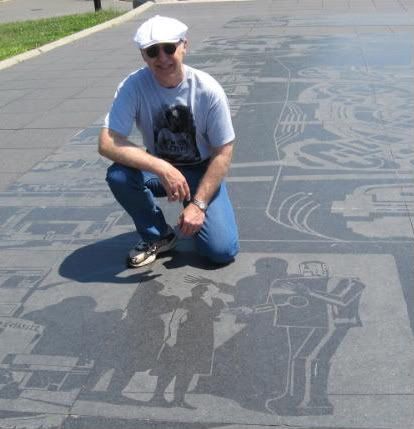
 The plaza next to the Unisphere is decorated with maps of the 1939 and 1964 fair grounds, and various icons of each fair. Here I am posing with an etching of Elektro and a female admirer, along with the original photograph.