Saturday, June 14, 2008

Tim Russert, RIP

Let me begin by saying I have no doubt that Tim Russert, host of NBC's Meet the Press, a well-known and widely-recognized talking head, was a wonderful man. Although he was surely a pundit, I hope that Hillary Clinton would not include him among the pundits and naysayers who accurately recognized she didn't have a snowball's chance of winning the Democratic (if you so choose, you may change the adjective to “Democrat,” as it seems these days it is unacceptable for members of the GOP to imply that Democrats are in any way democratic) nomination for the office of President long before she did. Naysayers—what a wonderful word for a politician to use. It's almost as good as George W. Bush's “evil-doers," and just think what a killer phrase Spiro T. Agnew would have had if his speech writer had thrown in one more word and coined the phrase “nattering naysaying nabobs of negativism.”

Without question, Tim Russert was a smart, courteous guy who loved his family and was widely respected. I am truly sorry he dropped dead of a heart attack yesterday at age 58, and I am sorry for his family's loss.

BUT. . . do we now have to suffer through a prolonged televised wallowing in grief a la the death of Princess Di? Lord love a duck! MSNBC has been going all day on this one topic! Yes, he was a great man! Yes, he was one of their own! A newsman, struck down in the prime of life! Yes! It's all true! But let's move on! As the funeral director says when showing you the most expensive casket, he would have wanted it that way! The last time I tuned into MSNBC, Mike Barnacle, Russert's fellow blue-collar-roots, sports-loving newsman was relating a story of Tim finding out about the fake ID his son had at college! Who cares?

But it will go on, and on, and on, for we live in the twenty-four-hour news cycle. The cable channels are in constant need of material. This is grist for the mill, especially since Barack Obama is currently not affiliated with any wacko preachers. What happened when Chet Huntley died? I think David Brinkley talked briefly about it on the nightly news show the two of them co-anchored for so many years, but there were other things going on in the world, and more importantly, there were only three networks in those days, and there was even such a thing as a sign-off late at night, meaning there were (gasp) no overnight broadcasts, and all you'd see till the next day's programming started was a test pattern.Alas, those days are gone. Let the wallowing continue!

Monday, June 09, 2008

Hawthorne and Lugubrious Drollery

I've now finished reading The House of the Seven Gables. I don't intend to give a formal review, but I would just like to quote one passage, from Chapter 19, where Hawthorne is describing the scene when the Italian organ grinder and his monkey (mentioned in an earlier post here) are performing outside the old Pyncheon house:
Was ever before such a grinding out of jigs and waltzes, where nobody was in the cue to dance? Yes, very often. This contrast of intermingling of tragedy with mirth, happens daily, hourly, momently. The gloomy and desolate old house, deserted of life, and with awful Death sitting sternly in its solitude, was the emblem of many a human heart, which, nevertheless, is compelled to hear the thrill and echo of the world's gayety around it.

I was struck by the juxtaposition of the mournful and the amusing in this passage.

Saturday, June 07, 2008

Franklin Pierce the Obscure


It probably has something to do with the fact that I am in my fourteenth hour of reading X-rays, CTs and ultrasounds on call today. I don't know how else to explain this post. I would do almost anything, read almost anything, Google almost anything to get away from the images of the huddled masses in the ERs and ICUs, yearning to have their brain hemorrhages, belly abscesses, and clotted veins diagnosed by yours truly. Actually, the afflicted have no idea who I am, nor will they ever, until they see my name on their bill, for radiologists labor for the most part in obscurity in front of computer monitors. So, for respite between cases, I have been surfing the web for material on the Marx brothers. They are cited as an area of interest in my Blogger profile, but I have not written about them yet. My search took me to David Holzel's zine The Jewish Angle, where he talks about being inspired by Groucho, and his plaster statue of Groucho, like the one I have.
In fact, I have plaster statues of Harpo and Chico as well. Harpo was a wedding present almost thirty-five years ago, and the other brothers were added soon after. From Holzel's site, I linked to The Franklin Pierce Pages, authored by Holzel, Benjamin Bratman, and Todd Leopold. Here, an unusual convergence of items from my recent posts occurred in Bratman's article "Wrested From the Jaws of Triviality." To wit:
Pierce had the peculiar distinction of having as vice president the only nationally elected American official ever to be sworn in on foreign soil. Pierce also had the peculiar distinction of having as vice president a man who never worked one day in the job. William Rufus de Vane King was terminally ill with tuberculosis when he was nominated and subsequently elected as vice president. (This begs the question, why was he selected?). He was sworn in in Cuba where he was seeking medical treatment. Less than a month later, he died, never having assumed his duties.
Ah ha! An example of the modern usage of "begs the question," which I had condemned in recent posts.

Also from Bratman's article:
Pierce’s salad days were clearly in college at Bowdoin College in Maine. There, he was a classmate of Nathaniel Hawthorne, who later became a writer and author of The Scarlet Letter, as well as one of Pierce’s closest friends and advisors.
Wow! Another of my newfound obsessions--Nathaniel Hawthorne! Bratman doesn't mention that Hawthorne wrote a campaign biography of his friend Franklin Pierce, and was rewarded with the American consulship to Liverpool after Pierce was elected. Hawthorne stayed at the post from 1853-57. Also of note, Hawthorne died on a trip to the White Mountains with Pierce in 1864.


Who knows, I may now become obsessed with Franklin Pierce. After all, writing about an obscure president (James Buchanan) paid off for John Updike in his play Buchanan Dying and his novel Memories of the Ford Administration.

Friday, June 06, 2008

Petitio Principii

Comfortably lounging in my glass house, in my last post, I tossed a stone or two in the direction of those who use the phrase "begs the question" to mean "invites the obvious question." In my post (since edited), I presented what I believed was the correct usage--"avoids answering the question." While this is one usage of the phrase, according to alt-english-usage.org, the oldest usage is in logic, where begging the question implies a circular argument. Here are excerpts from the explanation by Mark Israel, at alt-english-usage.org:

Fowler defines "begging the question" as the "fallacy of founding a conclusion on a basis that as much needs to be proved as the conclusion itself."

and

Many people unaware of the technical meaning of "to beg the question" in logic use it in one of two looser senses. The first of these, "to evade the question, to duck the issue", is attested since 1860 (WDEU). The second, "to invite the obvious question, (with an inanimate subject) to raise the question", is now the most commonly heard use of the phrase, although we have found no mention of it prior to The Oxford Guide to English Usage, 1st edition (1983), and it is not yet in most dictionaries. The meaning of the adjective "question-begging" does not seem to have suffered a similar broadening.
I also learned that the Latin for this fallacy is petitio principii. Thank goodness I corrected myself before one of my dozens of potential readers caught my error.

Tuesday, June 03, 2008

The Secret Staircase


In keeping with this blog's fixation on useless information, I have spent a fair amount of time researching one architectural feature which Mary and I saw on our recent tour of The House of the Seven Gables in Salem, Massachusetts. Adjacent to the central fireplace is a door which opens on a "secret staircase." You can't take pictures in the house, so I have included a picture of an old postcard, with the addition of two arrows to show the entry to the narrow stairway. I was pretty sure the guide said the staircase was installed during the 1909 restoration of the house initiated by Caroline Emmerton. When I came home and started looking around that great cesspool of misinformation known as the World Wide Web, I found many purported facts about the staircase, such as:

- In the novel, it led from Clifford's room to the first floor.
- Hawthorne learned about the staircase from his cousin, Susannah Ingersoll, who lived there
- It was built in the nineteenth century.
- The door to the staircase was discovered in the 1880s.
- It was used to hide slaves as part of the Underground Railroad.

To all these assertions, I respond with a resounding, "Horse hockey!" I am reading the novel now, and there I can find no mention of a secret staircase, nor can I find one online in searchable versions of the book. There is a scene where Hepzibah is looking for Clifford in his room and where he mysteriously appears in the parlor, but there is no indication of how he got there.

Regarding when the staircase was built, I cite as an authority Alexandria Mason, who wrote in the Curator's Corner column of the Summer/Fall 2004 edition of The House of the Seven Gables newsletter:

Some may wonder why we have chosen to restore the chimneys to their 1909 appearance rather than to one based on the 17th century. The answer is that preservationists today base restorations on hard evidence and we do not have information regarding the appearance of the original chimneys built by the Turners.

This leads to an important question. How did Chandler know what they looked like? Pictures of the house as early as 1857, of which Chandler would have known, reveal that the medieval chimneys were long gone, having been replaced with narrow chimneys used for gas stove pipes. In fact, Chandler’s restoration was very much influenced by Hawthorne’s novel, The House of the Seven Gables, and by his memory of the medieval chimneys of Europe. With both as his inspiration, he rebuilt all three chimneys to appear as if they were ancient, creating an elaborately pilastered central chimney with a “secret” stair descending from “Clifford’s room” in the attic to the dining room. One can assume Caroline Emmerton instructed him to make the house as exciting for visitors as possible in order to ensure revenue for her Settlement House activities!


She is referring to Joseph Everett Chandler, who was hired by Caroline Emmerton to renovate the house. I like Ms.Mason's writing for a few reasons. First, she implies with quotation marks that the idea of anyplace in this house being "Clifford's Room" is quite a stretch, as there doesn't seem to be all that much evidence that Hawthorne based much but the title on the Turner-Ingersoll house. Second, she is honest enough to admit that Caroline Emmerton's goal was to generate revenue rather than seeking historical accuracy. Third, instead of following the annoying modern trend of misusing the phrase, "begs the question," she correctly writes, "leads to the question." In logic, begging the question is a fallacy in which the premises include the claim that the conclusion is true or (directly or indirectly) assume that the conclusion is true.

Kudos to Ms. Mason for her article, and to Caroline Emmerton for making life imitate art, more or less.

Sunday, June 01, 2008

Prolixity

In the previous post, I talked about our visit to Salem, Mass., and landmarks associated with Nathaniel Hawthorne. I am doing my best to read The House of the Seven Gables. In Chapter XI, "The Arched Window," Hawthorne goes into a prolonged description (all his descriptions seem prolonged) of an Italian organ grinder and his monkey who plied their trade on the streets of the New England town (based on Salem) where the novel is set. He writes, "The monkey, meanwhile, with a thick tail curling out into preposterous prolixity from beneath his tartans, took his station at the Italian's feet." In the Merriam-Webster online dictionary, I found the following:

Main Entry: pro·lix
Pronunciation: \prō-ˈliks, ˈprō-(ˌ)\
Function: adjective
Etymology: Middle English, from Anglo-French & Latin; Anglo-French prolix, from Latin prolixus extended, from pro- forward + liquēre to be fluid — more at liquid
Date: 15th century
1 : unduly prolonged or drawn out : too long
2 : marked by or using an excess of words
synonyms see wordy
— pro·lix·i·ty \prō-ˈlik-sə-tē\ noun
— pro·lix·ly adverb

So it seems Hawthorne, who was given to prolixity in the sense of using an excess of words, considered the monkey's tail to be not only too long, but preposterously too long. Who is he to judge? Aren't monkeys supposed to have long tails?

In any case, the word reminded me of Prolixin, a brand name for the anti-psychotic drug fluphenazine. Although I have no reason to prescribe anti-psychotic drugs in my line of work, I will never forget Prolixin because of an encounter I had with a patient during a night on call on a psych rotation as a medical student. I believe it was at the county hospital, or maybe it was at the VA, and I had to interview a schizophrenic patient. He said to me, "I used to be big until they turned me into a baby with Proplipsin." I don't recall specifically why he showed up in the emergency room that night, or any of the rest of the conversation, but that statement, for some strange reason, has stuck with me. Partly, I suppose, it was the interesting pronunciation of the drug's name, and partly perhaps because on the face of it, it sounds absurd, but you can sort of understand what he meant--that he felt somehow diminished by his treatment.

Thursday, May 29, 2008

Nathaniel Hawthorne

Here is the latest in my continuing series of dead author landmarks. During our recent visit to Salem, Massachusetts, Mary took this picture of me at the birthplace of Nathaniel Hawthorne, with whom I first became acquainted playing the card game "Authors" as a child. Other authors I recall from the game are Alfred Lord Tennyson, Charles Dickens, and Louisa May Alcott. I don't recall that playing the game inspired me to read any of their works. But I digress. In keeping with the spirit of promoting tourism, which seems to be the main concern in Salem, Hawthorne's birthplace has been moved from its original location, and now sits on the same property as the House of the Seven Gables. One ticket buys you admission to both.


The only Nawthorne novel I had read up till now was The Scarlet Letter, and that was approximately a hundred years ago, in high school. I did my part to boost the local economy, and bought a copy of The House of The Seven Gables in the The House of Seven The Gables Bookstore, before taking the official guided tour of The House of the Seven Gables. The tour started a few minutes before the scheduled time because the guide was quite concerned that our group get through the house before a busload of 60 clamoring adolescents on a school field trip.


Turns out it's debatable that this is the house upon which Hawthorne based his book, although he had a cousin who lived there, and was known to have visited her at the house. As I understand it, the house has had a variable number of gables over the years due to repeated remodeling, and at some point had seven gables, but was down to three in Hawthorne's time. It was purchased in the early twentieth century by a woman who believed in life imitating art, and she had the mansion restored, complete with seven gables (though some people argue there are really eight), and put a cent shop in one of the rooms, like in the novel, even though there had never been a shop in the house. Whatever.


This is another house which Hawthorne lived in with his family after his father died--the Manning house.

Wednesday, May 28, 2008

Happy Birthday, Dr. Percy

Today is the birthday of the psychiatrist-turned-novelist, Walker Percy (1916-1990), who said,

"[We] live in a deranged age, more deranged than usual, because in spite of great scientific and technological advances, man has not the faintest idea of who he is or what he is doing."

Monday, May 26, 2008

An Elektro-fying Experience

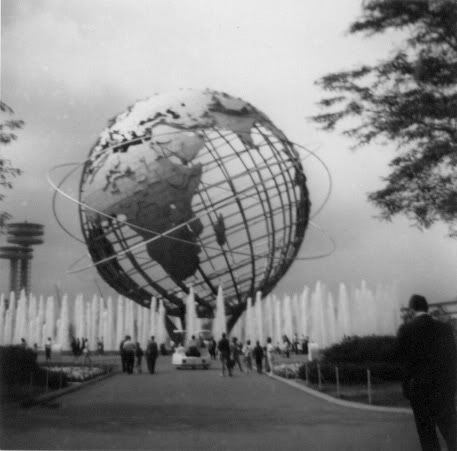
On my first trip to Flushing Meadows, Queens, in 1964, I took this picture with the plastic camera I bought at the dime store in Milford in preparation for visiting the World's Fair. I don't recall the brand of camera, but it was a simple fixed-focus box camera.

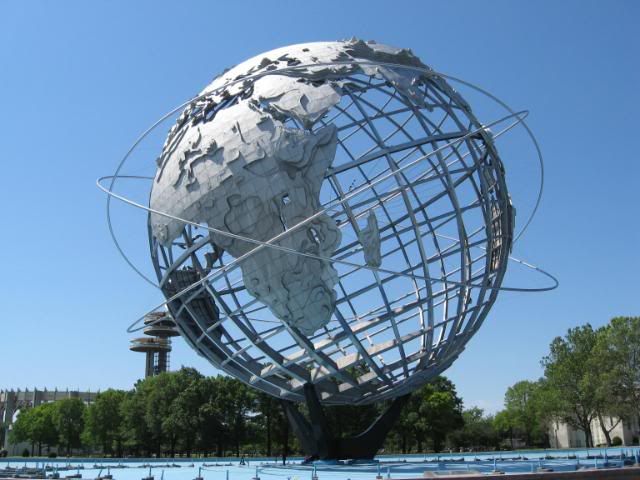
On our current vacation, Mary and I took the long ride on the 7 train from Manhattan to Flushing Meadows Corona Park. The former ash dump which was spruced up for the 1939 World's Fair and again for the 1964 World's Fair is a nice park today, and home to the U.S. Tennis Center. The Unisphere, erected for the '64 Fair, is still there, but the fountains are dry.

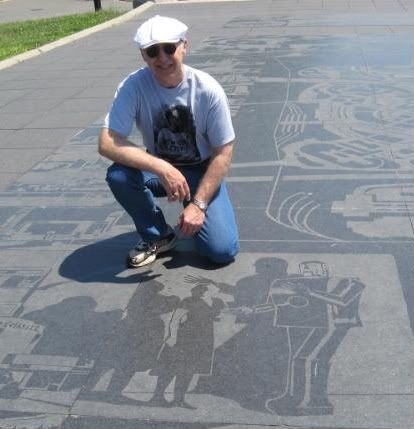
The plaza next to the Unisphere is decorated with maps of the 1939 and 1964 fair grounds, and various icons of each fair. Here I am posing with an etching of Elektro and a female admirer, along with the original photograph.


(Originally published May 26, 2008; edited February 5, 2011)

Friday, May 16, 2008

Semicolon revisited

In an earlier post, I dissed the use of semicolons, based on the opinion of the late, great Kurt Vonnegut. Even Vonnegut, however, flagrantly used a semicolon in the same book where he decried the use of the said punctuation. So I feel I too must be fair and balanced. One of my heroines in the field of language is Erin McKean, who has established the Semicolon Appreciation Society, which I have to support if for no other reason than its similarity to The International Association of Turtles.