The following is the essay I read at the reunion of the Wawasee High School Class of 1971 on August 6, 2011.
At graduation, some of us could have accurately said to each other, “See you in the next century.” Hard to believe, but here we are, 40 years later, dripping with nostalgia, and at our age, we’re lucky if that’s all that’s dripping. But here we are, still standing…or sitting down…or possibly lying down as the evening progresses.
We’ve seen a lot of changes in the world during our lifetimes. We came into a world shaped by a World War—the second and last World War, though there have been plenty of wars since then—Korea, the Cold War, Viet Nam, the War on Poverty, the War on Drugs, the First Gulf War, Iraq, Afghanistan, and so forth.
But WWII was the big one, and it changed our parents forever, though they might not have talked about it much. It gave them the satisfaction of fighting the good fight, of pulling together as a nation. Having lived through the worst of times, they saw the best of times ahead for them, and for us, their children. They liked Ike. They loved Lucy.
We were children of the 50s. You didn’t carry a phone with you then. You rented a phone—a single sturdy black phone—a phone with a dial—from Ma Bell, and it sat on its own piece of furniture in the living room. Even though dial phones have been extinct for decades, you still push the redial button to call someone back.
We grew up with television, with Miss Francis and Ding Dong School, with Captain Kangaroo, and Howdy Doody. With Disney in black and white and later the Wonderful World of Color, with Davy Crocket and coonskin caps, with Ed Sullivan and Elvis, but only from the waist up.
And we listened to the radio—AM stations, because that’s where the good music was. WOWO in Ft. Wayne, WLS and WCFL in Chicago. The only time we listened to FM was to hear Milo Clase broadcast the county basketball tourney on WRSW out of Warsaw.
We lived through the turbulent 60s, bombarded by ads for everything. Coke—the pause that refreshes, the real thing. I’d like to teach the world to sing. The Flintstones told us that Winston tastes good like a cigarette should. You don’t believe me? You can see the commercials with Fred and Barney puffing away on YouTube. By the way, it wasn’t until our graduation year of 1971 that cigarette ads were banned from TV.
And still we listened to music—on transistor radios, on 45s and LPs, and eventually on those awesome 8 track tapes, and the even more amazing cassettes.
24/7 news was unknown when we were kids. We got our TV news once a day from Walter Cronkite or Huntley and Brinkley. Local news came from real reporters like Harry Kevokian on channel 22, who was more concerned about current events than how his hair looked.
In our youth, computers filled rooms and cost millions of dollars. To have computers in your home, your car, or on your lap was unthinkable. We suffered through chemistry class with slide rules. Then in 1971 the microprocessor was invented and pocket calculators could be had for a few hundred dollars. There were no ebooks or iphones or email when we were in school. Only birds tweeted and Amazon was a river or a really big woman. Back then, text was a noun, something you produced with a typewriter, and the only thing you used your thumbs for was the space bar. You didn't delete your mistakes, you erased them, or covered them up with white fluid. Now text is also a verb, something we do with our thumbs, on devices that fit in our purses and pockets.
We remember where we were when JFK was shot, and how our little world seemed less secure after it happened. The summer of love came and went in 1967. We might have read about hippies in LIFE magazine and dreamed of wearing flowers in our hair, but we had to bale hay or work at other summer jobs. A guy needed money to buy V-neck sweaters he could tuck into his pants when fall came. Like many of our fashion statements, tucking one’s sweater into his pants seems laughable now. The girls, of course, could not wear pants to school. But we all have fond memories of mini skirts.
Change accelerated during our high school years. The assassinations continued in 1968 with Bobby Kennedy and Martin Luther King. In 1969, we watched men walk on the moon. In 1970, students died at Kent State. Protests and riots became commonplace. We felt the rumblings of change from afar on our farms, in our small towns, on our lake shores and creek banks, but there were crops to be harvested, football two-a-days to suffer through, and homecoming floats to be made, and life went on.
And here we are, four decades later—children of the fifties, geezers of the twenty-first century. It's been quite a ride. Thank you and enjoy the evening.

Sunday, August 07, 2011


Thursday, May 26, 2011

Saturday, May 14, 2011

Sunday, May 08, 2011

Saturday, March 26, 2011
The Weekend in Black and White: TV
 Breakfast where the news is read.
Television, children fed.
Unborn living, living dead.
Bullet strikes the helmet's head.
From The Unknown Soldier by Jim Morrison

Saturday, March 12, 2011

Friday, March 11, 2011
Adventures With Acme, Part 5
In previous posts (see links below), I have chronicled the trials and tribulations of owning a vintage plastic camera. It's been over a year since my last post on this topic, so an update is long overdue.
In order to minimize light leaks, I have added some gaffer's tape to cover the red window on the back. This can be peeled back when winding the film. One lesson I learned is that the adhesive on the tape can pull the red window out of the camera, so I added a small piece of tape to the back of my makeshift cover. The two pieces of tape are placed with adhesive surfaces together, so the red window will no longer get pulled out.

Another problem I encountered was the locking lever on the bottom of the camera being inadvertently moved to the "Open" position, allowing the back of the camera to fall off. I solved this with another strip of gaffer's tape applied to the bottom of the camera. It can be peeled back for intentional opening of the camera.

My most recent misadventure with the Acme involved faulty winding of the film. I could get the film to advance, but it didn't feel right. When I opened the camera, the film was wound loosely, and the piece that holds the take-up spool in place fell out. I had some stuff called Sugru in the shop. It's a putty-like substance that cures into a silicone material that is marketed for fixing things you might otherwise throw away. I used this to hold the broken piece in place and to reinforce the corresponding piece on the other side of the mechanism.

So now the Acme is ready to go again--till the next malfunction.
Links:
Adentures With Acme, Part 1
Adentures With Acme, Part 2
Adventures With Acme, Part 3
Adventures With Acme, Part 4
In order to minimize light leaks, I have added some gaffer's tape to cover the red window on the back. This can be peeled back when winding the film. One lesson I learned is that the adhesive on the tape can pull the red window out of the camera, so I added a small piece of tape to the back of my makeshift cover. The two pieces of tape are placed with adhesive surfaces together, so the red window will no longer get pulled out.

Another problem I encountered was the locking lever on the bottom of the camera being inadvertently moved to the "Open" position, allowing the back of the camera to fall off. I solved this with another strip of gaffer's tape applied to the bottom of the camera. It can be peeled back for intentional opening of the camera.

My most recent misadventure with the Acme involved faulty winding of the film. I could get the film to advance, but it didn't feel right. When I opened the camera, the film was wound loosely, and the piece that holds the take-up spool in place fell out. I had some stuff called Sugru in the shop. It's a putty-like substance that cures into a silicone material that is marketed for fixing things you might otherwise throw away. I used this to hold the broken piece in place and to reinforce the corresponding piece on the other side of the mechanism.
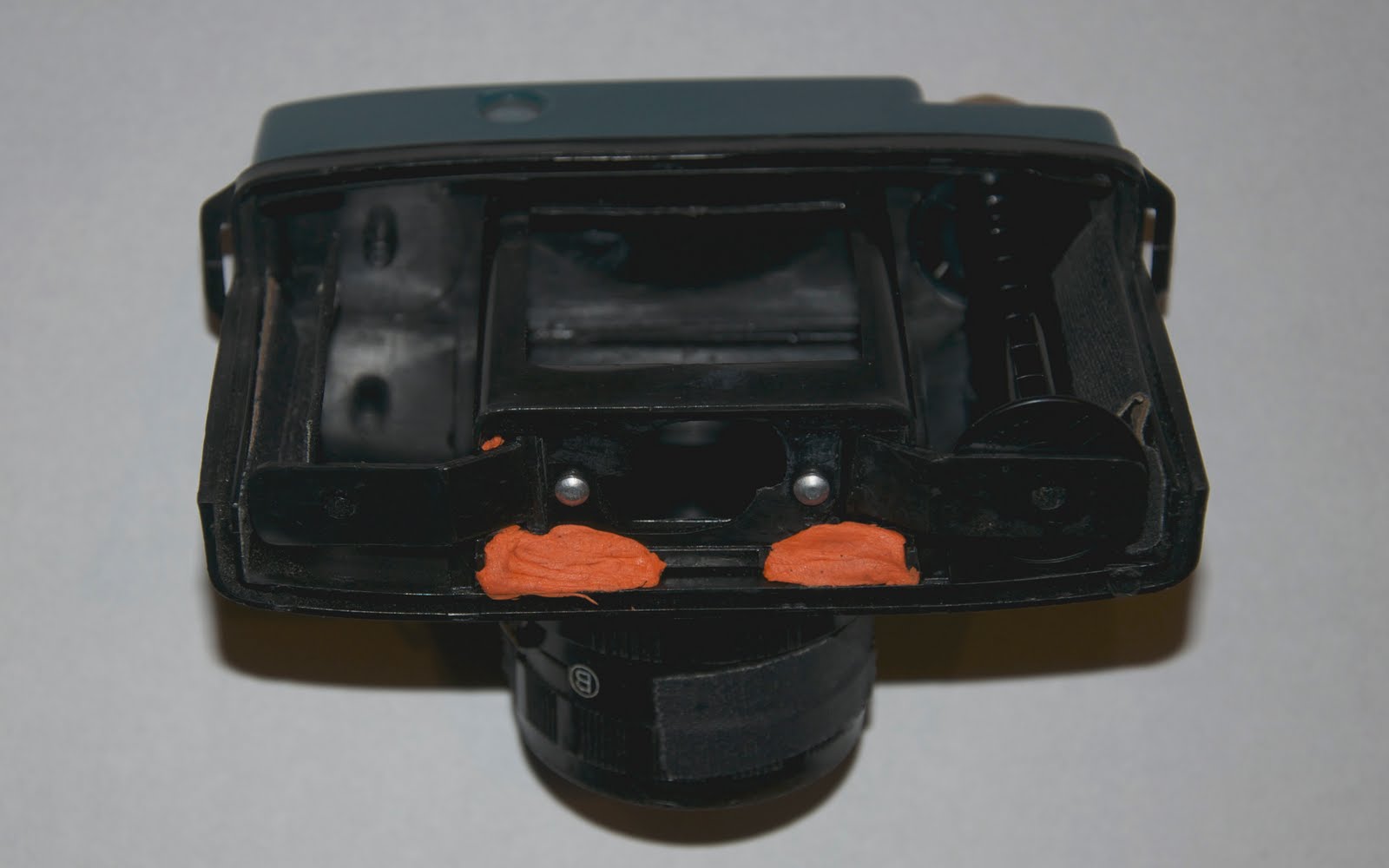
So now the Acme is ready to go again--till the next malfunction.
Links:
Adentures With Acme, Part 1
Adentures With Acme, Part 2
Adventures With Acme, Part 3
Adventures With Acme, Part 4
Sunday, February 06, 2011
Monochrome Weekend: Sky

Thursday, February 03, 2011
Skywatch Friday: After the Blizzard

I took this picture of blue sky while walking the dogs today. It's rare we see such clear, blue skies in northern Indiana in winter.

Tuesday, February 01, 2011
Abstraction
Through the photo-sharing site Flickr, I got in touch with Bill Dunbar, who is married to a distant cousin of mine in Elkhart, Iowa. We have collobarated on a few photographic projects. I expose a roll of film, rewind it, mail it to him, and he does a second set of exposures on the roll.
Three pictures from one of our projects appear on the "Group Exhibit: Abstraction" page in Issue 45 of the online fine art photography magazine, F-Stop. Bill made his exposures in Iowa using a 1946 Argoflex E, and I shot in Indiana, using an Agfa Speedex B2 of unknown vintage. The film was Kodak TX400, developed in Diafine.

Lantern and Leaves

Lute

Trees
Three pictures from one of our projects appear on the "Group Exhibit: Abstraction" page in Issue 45 of the online fine art photography magazine, F-Stop. Bill made his exposures in Iowa using a 1946 Argoflex E, and I shot in Indiana, using an Agfa Speedex B2 of unknown vintage. The film was Kodak TX400, developed in Diafine.


Subscribe to:
Posts (Atom)