Saturday, September 26, 2009

Shadow Shot Sunday #71

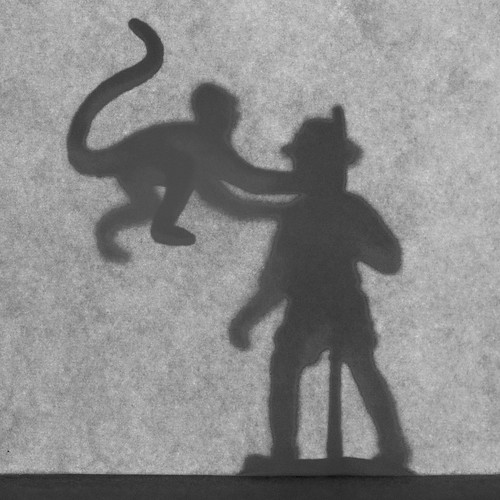
This week's entry for Shadow Shot Sunday, Monochrome Maniacs, and Bad Haiku memes.

In the jungle, the mighty jungle,
intrepid explorer
attacked by cheeky monkey.

Terror in the Jungle


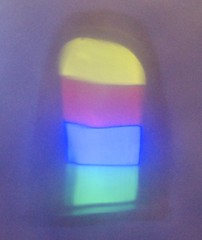
Stained Glass

After concentrating on film photography for a while, I'm easing back into the digital world. I'm so used to all the strange effects produced by shooting film with plastic cameras, that I couldn't go back to tack-sharp, perfectly metered, auto-focused digital photography.

This was taken at Calvary Cemetery, Niles, Michigan. There is a small 8-sided building (chapel?) on the grounds. This shot was taken by putting the camera against one window from the outside and shooting across the inside at ISO 2500, f/16 for 1 sec. The distortion is produced by the window the camera lens was held against.

Friday, September 25, 2009

Downtown Chesterton

My previous posting of a picture from the 2009 Wizard of Oz Festival elicited a comment about the retro look of the town of Chesterton. Here's another picture I took along Main Street where I was trying to capture that feel.

Click on the picture for a larger version.

I was looking at the "Main Street" and "Peggy Sue's Diner" signs in the viewfinder of the Holga camera. One of the many quirks of the camera is that you get more image on the medium format film than you see in the viewfinder. Thus I wound up with the old-fashioned barber pole on the right and the Wizard of Oz character (the scarecrow, I think) attached to the building at the top of the photo.

Thursday, September 24, 2009

Skywatch Friday Season 4, Episode 11

Wizard of Oz Festival, Chesterton, Indiana

Wednesday, September 23, 2009

Adventures With Acme, Part 3

As threatened in previous posts "Adventures With Acme," Part 1 and Part 2, I am offering up some more of the pictures from the first roll of 120 film out of my Acme plastic camera.


Adventures with Acme, Part 2

Last week, I discussed my recent purchase of a cheesy toy camera on eBay.

Toy cameras have been popular with artists for several decades. The cheap plastic lenses, light leaks, and other imperfections of these cameras can result in interesting photographic effects, and the simple mechanics of the cameras prevent one from becoming caught up in technology. With a toy camera, you can concentrate on seeing your subject, and not endless fiddling with camera settings. One of the more popular brands has been the Holga, originally manufactured in Hong Kong beginning in 1982. They are now being manufactured in China and have been refined somewhat, but still have their quirks. Diana is another brand of toy camera that has been popular among artistic types. It was made in Hong Kong in the 1960s and 70s. The brand has been revived in the form of the the Diana F+, which is now being is being sold by a company called Lomography, which also markets Holga.

I noticed the Acme camera which I purchased on eBay for $14.66 bears a striking resemblance to the Diana, as you can see below.


At the wonderful web site Toycamera.com, I have learned that the Acme was made by the same Great Wall Plastic Company in Hong Kong where the original Dianas were produced. Great Wall turned out clones of the Diana under many brand names. For unknown reasons, several clones, including the Acme, had fake rangefinder light meters built into the camera bodies.

When the Acme arrived in its original cardboard box, a couple of problems became immediately apparent. The lens was just press fit onto the camera and could be easily pulled off. This was easy enough to fix with a little gaffer's tape. The shutter lever on the side of the lens barrel was intact, and the shutter worked. The switch on the other side of the lens for instant vs. button exposure also worked. Unfortunately, a third switch for selecting aperture was missing. The description on the box indicates "3 Apertures for Various Weather." Que sera sera--whatever the aperture will be will be.

More problematic was the fact that the knob to wind the film was cracked where it fit over its associated shaft. I made a couple attempts to fix it with super glue, which failed. I tried screwing the knob to the shaft, which resulted in the shaft cracking. The more I worked on it, the more the brittle plastic of the mechanism crumbled. Finally, I made a replacement shaft out of an oak dowel, with a little oak paddle on the end that would slip into the film spool. The oak paddle broke off after winding the film through a couple exposures, so the next repair used an ebony paddle on an oak shaft, which so far has worked.

I was careful to take the camera into a totally dark room to remove the film when I made these repairs, and store it in aluminum foil until I could put it back in the camera. Unfortunately, on one occasion, I neglected to move the locking lever on the back of the camera to the closed position after reinstalling the film, and the back of the camera fell off. I probably also suffered some light leaks when I removed the broken winding knob from its shaft with the film in the camera.

A few exposures survived all these events, and this is one of my favorites. It's a low spot in our neighborhood where mist was rising from the ground one morning. I can't explain the peculiar glow and all the other crazy artifacts on the image.

In postprocessing, I put a negative filter on the image, which I also like:

In future posts, I'll present some more conventional images, if you can apply that term to pictures taken with this type of camera.
Sunday, September 20, 2009

Saturday, September 19, 2009

RIP Les Paul

No two ways about it--Les Paul was a genius. When he passed away at age 94 on August 13, 2009, America lost a national treasure. He was the father of the solid body electric guitar, an inventor, and a great guitarist. His obituary in the New York Times details all of that.

Up till near the end of his life, Les played two shows every Monday night at the Iridium Club in New York City. Mary and I saw him play there three times. Normally, Les came out into the audience after the second show to meet and greet fans and sign autographs. The first and second times we went to the early show, but when we went to the Iridium last year with our English friends Nigel and Judith, we went to the second show so I could get an autograph from Les. I took a copy of the sheet music to Mockin' Bird Hill, which was a hit for Les and Mary Ford in 1951. Unfortunately, the club's air conditioning wasn't working on that Monday night, and Les was exhausted after the second show. It was announced that he would not come into the club after the show. I tried to unsuccessfully to convince one of the band members to take my sheet music backstage and get it signed. Being a persistent English woman--stiff upper lip and all that--our friend Judith took my sheet music and Sharpie and managed to get backstage and get the autograph, pleading that she had come all the way from England to get it.

And here it is (my scanner isn't big enough to get the whole cover of the sheet music):

Friday, September 18, 2009

Skywatch Friday Season 4, Episode 10


A Kodak moment in the old Studebaker industrial corridor, South Bend, Indiana

Thursday, September 17, 2009

Adventures With Acme, Part 1

Readers with nothing better to do than to frequent this blog will be aware that recently I have eschewed digital photography in favor of film. Well, I really haven't given up on digital photography all together.I just wanted to use the word "eschewed." One thing is sure--I have become a regular customer at Gene's Camera Store, the only local place I know of that sells and processes 120 film.

My current arsenal of film cameras includes a Kodak Duaflex III twin lens reflex camera, and two toy cameras: a Holga 120CFN and an Acme W20. That's right--there really was a camera with the brand name Acme, made in Hong Kong. I picked it up on eBay. I read with amusement the description offered by the seller:
You are bidding on a Vintage Acme Camera with original box, model No. W20. Takes 16 color or black and white photos with Kodak 120 roll film. The camera looks like it's in great condition, never used, but I don't know if it works. The box is in good condition and shows some wear.
It was pretty obvious from the pictures accompanying the listing that the camera's condition was hardly "great...never used." Note, among other signs of wear and tear in the picture below, how the label around the lens is askew. There! I've done it! I used "eschew" and "askew" in the same post!


Despite the appearance of the camera, with an opening bid of $4.99, I couldn't resist. My winning bid, the solitary bid after some other adventuresome soul opened with the minimum $4.99, was $6.83, a dollar less than the shipping charges. So for a grand total of $14.66, I was the proud owner of a vintage plastic camera.

The brand name Acme conjures up images of Road Runner cartoons, and the outlandish devices that Wile E. Coyote ordered to capture the Road Runner.

The Acme Catalog by Charles Carney, published by Chronicle Books.

From the Wikipedia article, Wile E. Coyote and Road Runner, with italics added by me:
Wile E. Coyote often obtains complex and ludicrous devices from a mail-order company, the fictitious Acme Corporation, which he hopes will help him catch the Road Runner. The devices invariably fail in improbable and spectacular ways. Whether this is result of operator error or faulty merchandise is debatable. The coyote usually ends up burnt to a crisp, squashed flat, or at the bottom of a canyon (some shorts show him suffering a combination of these fates).
Thus, gentle readers, ends Part One of our cautionary tale. In Part Two, I will publish some photographs obtained before, during and after the Acme W20 failed in improbable and spectacular ways, along with descriptions of my improbable and far from spectacular repairs.