Wednesday, November 04, 2009

Neptune in the Heartland

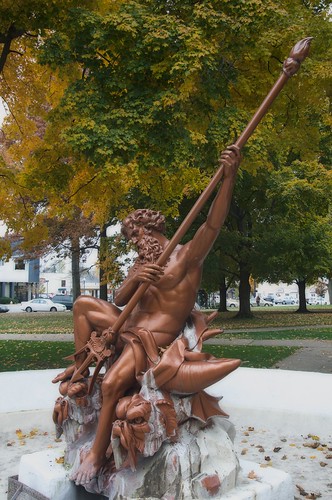
Earlier this week, I posted a monochrome photo of the Neptune Fountain on the courthouse square in Goshen, Indiana. Here is a color photo of the same fountain from a different angle.

Neptune Fountain, Goshen, Indiana

This landmark has been present for my entire life, though I believe the trident went missing or was broken for a while. I rode by this piece of art many times as a child, either on visits to relatives in Goshen, or on shopping trips, back in the days when department stores were located downtown. Later, as a teenager, I drove or rode past this fountain on innumerable nights, along with carloads of other hormonally oversaturated adolescents who were cruising the streets. This activity became so popular that eventually the town enacted an ordinance which specified the middle lanes of the major thoroughfares as emergency lanes at night, thus cutting down on the snarl of traffic and eventually eliminating the allure of cruising Goshen.

I had never thought about how such an impressive sculpture came to land in a small town in the Midwest until I dove into my usual intensive research (i.e., Googling) so I could include some information about the fountain with my first post. As luck would have it, a book was published earlier this year on the topic of zinc statuary, and in another stroke of luck, the book, sans pictures, is available online via Google books. I even went so far as to go to the Hesburgh Library at Notre Dame so I could actually pull the substantial 706 page book off the shelf and see the pictures. The book is Zinc Sculpture is America: 1850-1950, by Carol A. Grissom.

From the book, I learned that the Goshen Neptune Fountain is not unique. It is based on a work by French sculptor Gabriel Vital-Dubray (1813-1892). Many copies were produced and placed in public spaces in Europe, South America, and the U.S. In Germany, Kahle and Son cast the statue in zinc. One of these was erected at the city Neustadt an der Weinstrasse in 1882. In France, Neptune was cast in iron by the Val d'Osne company. On October 28, 2008, Christie's auction sold the cast iron example below for $110,500.

Neptune Statue, from a private collection. The edge of the conch-shell is signed and dated V. DUBRAY/1856, and the base is stamped VAL D'OSNE.

In America, two companies in New York City sold similar Neptune statues, cast in zinc. The Goshen Neptune was sold by the J.L. Mott Iron Works. It seems to be cast from the same model as the Val d'Osne statues. Four Neptunes from J.L. Mott were also installed as part of an elaborate fountain at Bedford and Division Avenues in Brooklyn. Unfortunately, that fountain was dismantled in 1950.

At least one other zinc Neptune survives in the U.S., sold by the J.W. Fiske company. Originally installed at the old sailors' home at Sailors' Snug Harbor, Staten Island, the statue deteriorated and was replaced with a cast iron replica. The original is now on display in the basement of the Visual Arts/Neuhouse Gallery on the grounds of what is now the Snug Harbor Cultural Center. The Fiske version differs from the Mott version in a few details, such as the appearance of the dolphins at the base, and must have come from a different model. Below are pictures of the origin Snug Harbor Neptune, and its replacement.

Original Neptune Fountain, Snug Harbor, Staten Island
Photo used under Creative Commons License. See original by wallyg at:
http://www.flickr.com/photos/wallyg/
For terms of CC License, click here: CC BY-NC-ND 2.0

Neptune Fountain Replica, Snug Harbor, Staten Island
Photo used under Creative Commons License. See original by apollonia666 at:
http://www.flickr.com/photos/apollonia666/.
For terms of CC License, click here: CC BY-NC-SA 2.0

Well, so how did old Neptune wind up in Goshen? In 1901, an enterprising individual named James Polezoes immigrated to the U.S. from Greece. He wound up in Goshen in 1910, where he opened a confectionery across the street from the county courthouse, selling candy and ice cream. He must have done quite well in that business, and in 1912, he purchased the Neptune Fountain as a gift to his adopted city for helping him achieve the American dream. Another Greek immigrant, Nicholas Paflas arrived in Goshen in 1912, and worked for Polezoes, making hand-dipped chocolates and running the soda fountain. In 1920, Paflas bought the confectionary and named it the Olympia Candy Kitchen. It's still in operation in the original location, run by Paflas family members, but that's another story.

Sunday, November 01, 2009

Monochrome Fountain

Elkhart County Courthouse, Goshen, Indiana. Poseidon Fountain or Neptune Fountain (1912), J.L. Mott Iron Works. Cast zinc with bright copper paint. The water is turned off for the winter. When the fountain is running, water spouts from the mouths and nostrils of the sea creatures at Neptune's feet.

Shadow Shot Sunday #76

Magnolia throwing leaves in her chicken costume. Captured with a Holga 120 CFN plastic camera, Kodak Tri-X film, developed in Diafine.

Thursday, October 29, 2009

Manini'owali Beach Sunset

Big Island of Hawaii, January 2009

Tuesday, October 27, 2009

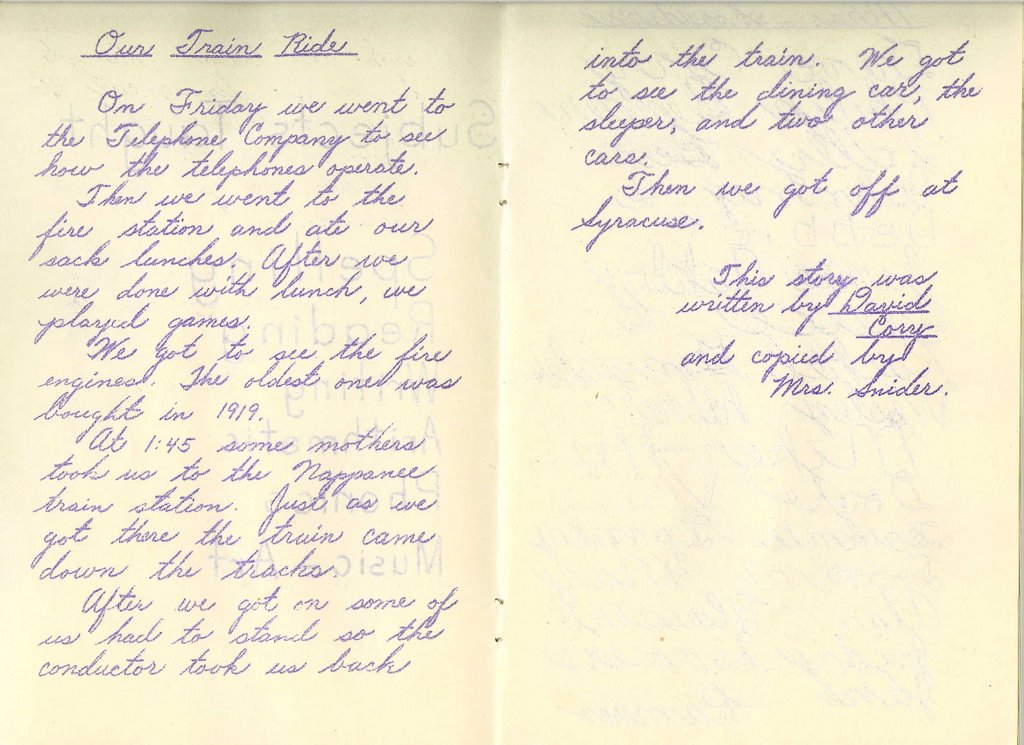
The Great Train Ride of 1961

As I explained back in 2006, in a post titled "Another San Francisco Dead Author," one of my earliest writing efforts still extant is the following account of a second-grade field trip. It could have occurred as early as the fall of 1960, but I think it more likely happened in the spring when teachers wanted to get out of the classroom at least as much as their young charges. If you want to know the tenuous connection between this trip and a dead author in San Francisco, you'll have to follow the link to the 2006 post. It's not worth repeating here.

Click to enlarge.

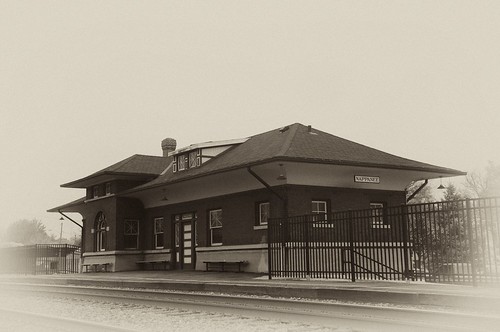
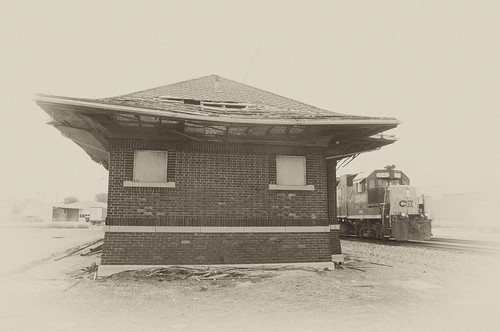
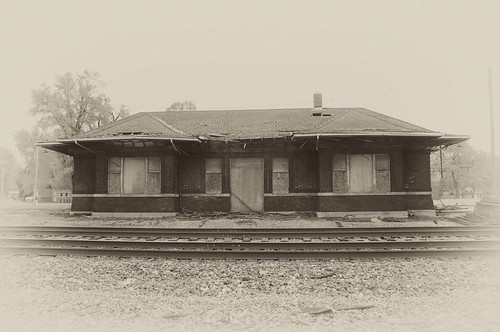
Today, I had a day off, and spent a few hours driving around the area looking for photo ops. I didn't really think about it till I was driving home, but I had taken pictures of the two train stations I visited almost a half century ago. The Nappanee station has been maintained over the years, but the Syracuse station, now owned by CSX, has fallen into disrepair. There is a movement afoot to save the station, move it, and renovate it. I hope it happens.

Nappanee Station
Nappanee Station, 2009

Syracuse Station
Syracuse Station and Passing CSX Freight Train, 2009

Syracuse Station
Syracuse Station, 2009

Sunday, October 25, 2009

Shadow Shot Sunday #75

A brass horse converted to monochrome with Silver Efex Pro.


Friday, October 23, 2009

The Origin of "South Pacific"


Rogers: Knock knock.

Hammerstein: Who's there?

Rogers: Sam and Janet.

Hammerstein: Sam and Janet who?

Rogers: Sam and Janet Evening...

Thursday, October 22, 2009

Skywatch Friday, Season 4, Episode 15

Grass

Ornamental Grass and Clouds, 2009. Shot with an Acme W20 camera and Tmax 400 film. Developed in Diafine.

Wednesday, October 21, 2009

Kinetic Sculpture

Annular Eclipse V
Annular Eclipse V, 2000, by George Rickey

George Rickey was born in South Bend, Indiana in 1907. Several of his works are on temporary display around town now. The photo was taken with an Acme toy camera (a Diana clone) on Kodak Tri-X film, developed in Diafine.

Sunday, October 18, 2009

Binky-gram

Scout view for a head CT. The newborn has a pacifier in his mouth.


Addendum, Monday, 10/19/2009: I've noticed a number of people have arrived here from the Shadow Shot Sunday site and not left any comments. This indicates to me that they

a. think this is a lame entry
b. don't understand it
c. are shocked by it
or
d. all the above

Perhaps a little explanation is in order. A scout view is an X-ray obtained in a CT scanner. It is the digital equivalent of the films one frequently sees hanging upside down on a viewbox on televised medical dramas. The scout view allows the technologist to know precisely where to perform the CT scan. Since people sometimes refer to the shades of gray on a radiograph as shadows, I thought I would present this as a "shadow shot." This image was a routine part of a medically necessary exam. The child wasn't exposed to radiation just so I could have a picture to put online. And by the way, the scan of the head was normal, and everyone lived happily ever after.

If any of the conditions in the list above still apply after reading this brief explanation, please feel free to leave a comment to register your disappointment, befuddlement, anger, or dyspepsia.